
 Dan WolkenSenior writerWed, December 3, 2025 at 8:31 PM UTC·8 min read
If you’re around downtown Atlanta this weekend, it will be difficult to tell that the SEC championship game — like all conference championship games — is a dinosaur.
Fans wearing Georgia red and Alabama crimson will flood hotel lobbies and bars, ringing cash registers across the city. The atmosphere in Mercedes-Benz Stadium will be among the best all season. And the winning team will celebrate like it’s the Super Bowl.
AdvertisementAdvertisementAdvertisement“It’s a chance to win an SEC championship,” Georgia coach Kirby Smart said. “That’s a very rare thing.”
Smart is a true believer in the value of the conference championship game. He was 16 for the first one in 1992, when the SEC changed college football history by matching up Alabama and Florida at Legion Field in Birmingham. As Smart became a player at Georgia and then an assistant coach at LSU and Alabama, the SEC championship only grew in its lore, becoming a de facto national title game for a long stretch of years.
“It’s one of the most viewed games of the year every year,” Smart said. “A couple years it's been more viewed than even the national championship game. I have a lot of respect for it.”
And yet, with the expansion of the College Football Playoff to 12 teams and likely beyond in the future, voices like Smart are becoming few and far between. Though the SEC championship game is still good business for the SEC and the city of Atlanta, the problem resides within the following question:
AdvertisementAdvertisementAdvertisementBesides money, what’s the point?
Alabama vs. Georgia is game we’ve already seen this season, when the Crimson Tide won 24-21 in Athens. Unless something calamitous happens to No. 9-ranked Alabama on Saturday, both teams will be in the College Football Playoff – where they could perhaps even meet for a third time. Whereas the SEC championship game was often a must-win in the BCS and four-team CFP era, it’s now barely a step above an exhibition game in terms of national championship impact.
You could even look at this game as a lose-lose for both teams. Last year, quarterback Carson Beck suffered a season-ending injury in Georgia’s win over Texas. The Bulldogs may not have won the national title anyway, but that injury undeniably cost them their best chance. And this year, if Alabama were to lose by three or four touchdowns, the committee might have a hard time putting a three-loss team that just got blown out into the playoff field.
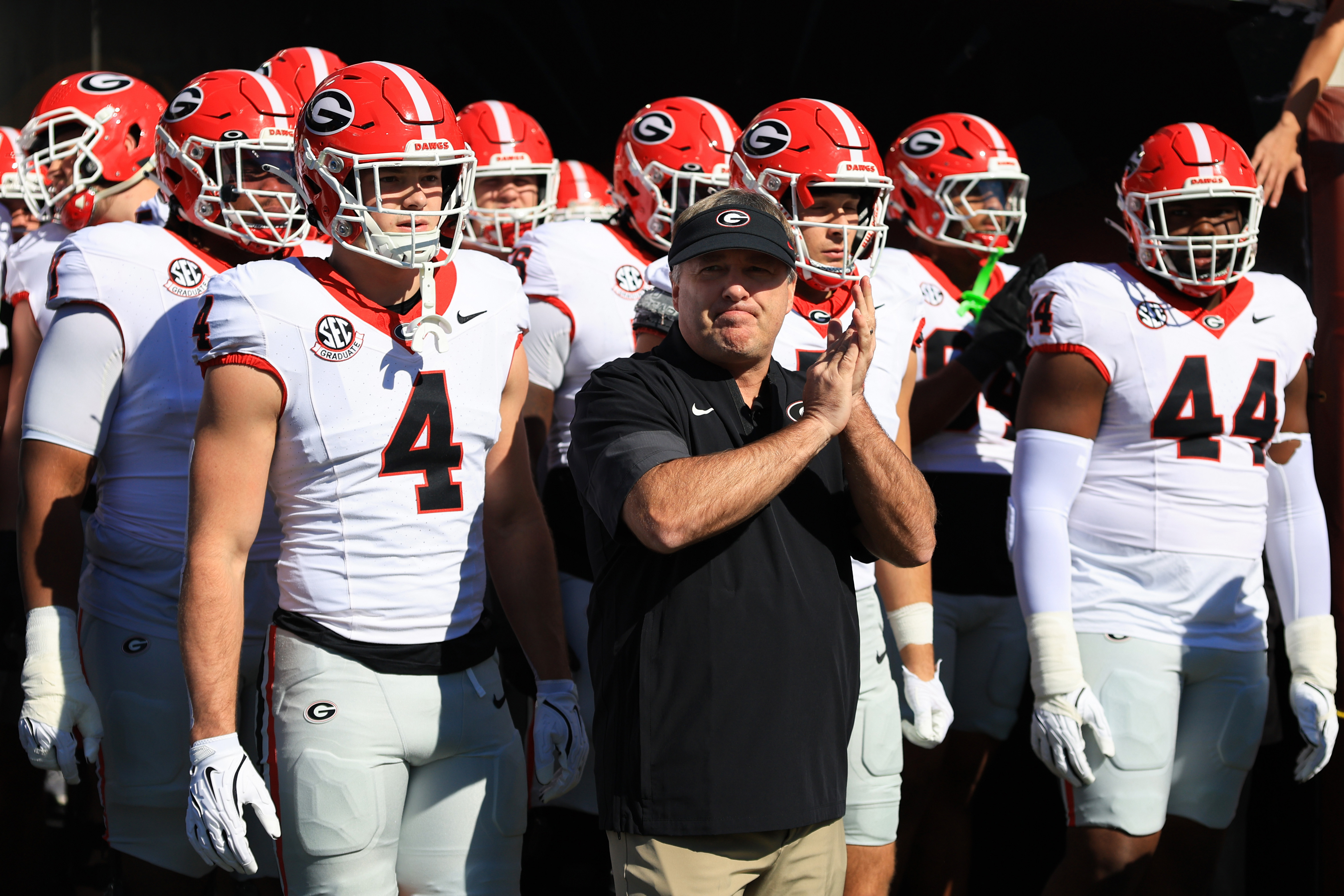
 Kirby Smart and the Georgia Bulldogs will meet Alabama for the second time this season in the SEC title game on Saturday. (Megan Briggs/Getty Images) (Megan Briggs via Getty Images)
It's almost all risk, very little reward.
AdvertisementAdvertisementAdvertisementIt requires someone like Smart, who sees winning the SEC as a worthy and perhaps equally important goal to the CFP title, to imbue this game with the prestige it once had.
“The SEC we're talking about now was not the SEC we were talking about for the last, I don't know, almost a hundred years,” Smart said. “It's a challenge to win that trophy. It's a mark of toughness, of battle scars. The team that wins it has been through a gauntlet, and it has been tough. I think it's a great chance to win a championship.”
He’s right. Winning a conference championship, especially in the SEC, should matter a lot.
But within the broader culture of college football, Smart is losing the argument.
AdvertisementAdvertisementAdvertisementIn Indianapolis this weekend, a rare No. 1 vs. No. 2 matchup is being met largely with a shrug of the shoulders because everyone knows it’s merely an appetizer for Ohio State and Indiana en route to their more significant goals. It’s an important test for both teams after beating up on the rest of the Big Ten, and it should be an entertaining game to watch, but it’s no different than a college basketball conference tournament final that gets forgotten 24 hours later when the March Madness bracket comes out.
For better or worse, the college football season is a three-month qualifier for the CFP. That is the lens through which fans, players and coaches increasingly see the sport.
The upside to that plays out every week, where more than a dozen games — many of which were formerly irrelevant in the old system — have a direct impact on the field.
The downside is that conference championship games, for the most part, exist as filler programming that adds very little to the fabric of the season. If anything, they mostly just get in the way college football’s ability to offer a more sensible schedule.
AdvertisementAdvertisementAdvertisementAssuming the playoff expands to 16 in the near future — no guarantee, but certainly the way sentiment seems to be trending among administrators — imagine a world where the regular season ended the Saturday after Thanksgiving and there were no championship games to play.
You could immediately start the playoff this weekend with the round of 16, then take the Dec. 13 weekend off for the Heisman Trophy ceremony. The quarterfinals would be played the weekend before Christmas, the semifinals on New Year’s Day and you could wrap up the season a little more than a week later, avoiding competition with the NFL deep into January where the CFP championship game has struggled for attention.
There are other advantages, too. Having the CFP start immediately after the regular season could help mitigate the impact of coaching changes on playoff teams, especially if college football eliminated the early recruiting period. In that calendar configuration, the only important consideration for new coaching hires would be the opening of the transfer portal on Jan. 2. With only two teams still alive in the playoff by that point, the odds of a major disruption to a playoff contender — like we’re seeing now with Ole Miss and the departure of Lane Kiffin — would be considerably lower.
It would also eliminate some of the controversy and chicanery that could be in play this weekend from the CFP selection committee. If Alabama loses and falls out of the playoff, the entire offseason will be consumed by SEC grievance. If the committee vaults Miami above Notre Dame for the final spot — a real possibility even though neither team is playing this weekend — it will look like unnecessary theatrics designed to generate controversy, even if it’s the right decision.
AdvertisementAdvertisementAdvertisementIt's also a burden for the committee. If they ignore the championship games as a data point, there’s no point in playing them. But if a team is knocked out of the playoff because they had to play an extra game against a difficult opponent that other contenders didn’t have to play, it seems unfair.
So again, what are we doing here?
In a sport where it’s already hard enough to evaluate teams given the scheduling disparities between and even within conferences, trying to judge one set of teams that played 13 games against a set of teams that played 12 games is practically impossible.
With playoff expansion, college football has evolved beyond conference championship games. Even last year in Atlanta, there were swaths of empty seats for Texas vs. Georgia, which has almost never happened in the history of the SEC championship. But with the fan bases of both teams counting on multiple road trips in the CFP, it was sensible that a lot of would-be ticket buyers were saving their money for more consequential games.
AdvertisementAdvertisementAdvertisementAn SEC traditionalist like Smart won’t like it, but the trend is likely to continue. The reality is, as conferences have gotten numerically and geographically bigger, winning a conference title does not represent what it used to. Heck, with the imbalanced schedules and ridiculous tiebreakers, the conference standings aren’t really even of that much use trying to figure out who the best team is among that grouping.
For evidence of that, see the ACC where the league’s best team — Miami — is sitting on the sidelines while Virginia will play 7-5 Duke, which won a five-way tiebreaker on a technicality for the right to play in the title game. And since the committee only guarantees automatic bids to the five highest-ranked conference champions, Duke probably wouldn’t get into the playoff anyway since they’d likely be ranked behind presumptive Sun Belt champion James Madison.
The conference championship games were a creation of the old era, where smaller conferences and a smaller playoff made them useful in narrowing the field of contenders.
Now, they’re just unnecessary games with a dwindling number of acolytes aside from Smart and those who will profit financially. The SEC will do a better job than anyone of making its championship feel important, but nothing outlasts inertia over the long haul.
And interest in these title games will only to continue trending in one direction.
AdvertisementAdvertisement