
- News
- Health
The technology boosts the chances of a procedure suceeding which removes deadly clots
Storm NewtonWednesday 03 December 2025 12:56 GMT
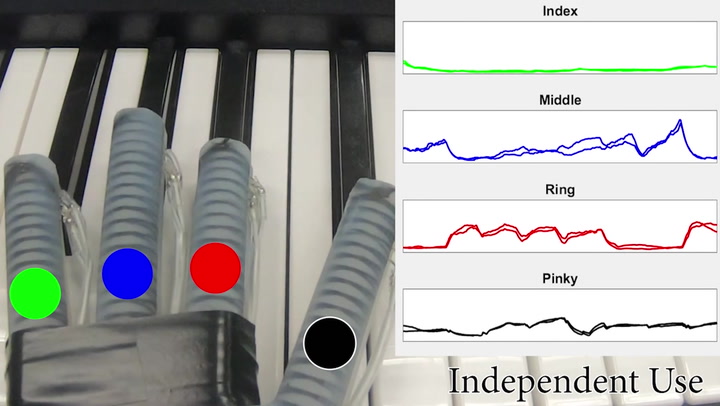 CloseNew AI robotic glove helps stroke patients relearn how to play the piano
Sign up for our free Health Check email to receive exclusive analysis on the week in health
Get our free Health Check email
Get our free Health Check email
Email*SIGN UPI would like to be emailed about offers, events and updates from The Independent. Read our Privacy notice
Artificial intelligence (AI) is helping stroke patients in England access vital treatment more quickly, a study has found.
The technology aids doctors in identifying major stroke cases within minutes, boosting chances of a procedure removing deadly clots.
Called the Brainomix 360 Stroke imaging platform, the AI tool analyses CT scans in real time.
This makes it more likely that patients will have access to a thrombectomy, where doctors use a catheter to remove a blood clot from an artery.
Most effective within hours of symptoms, it can sometimes be performed up to 24 hours after a stroke.
Swift treatment via this procedure significantly improves recovery by reducing brain damage, states the Stroke Association.
For the study, published in Lancet Digital Health, some 15,377 patients had their scans analysed by AI.
At some centres, the technology helped speed up treatment by a little over an hour.
Patients reviewed by AI were also more likely to have a thrombectomy or intravenous thrombolysis, which uses drugs administered through an IV drip to break up blood clots.
Elsewhere, researchers found thrombectomy rates at hospitals taking part in the study doubled from 2.3 per cent to 4.6 per cent.
This is compared to an increase from 1.6 per cent to 2.6 per cent at hospitals not using the platform.
It comes after figures published last month revealed the thrombectomy rate in England remains below the European average.
The latest national stroke audit, commissioned by the Healthcare Quality Improvement Partnership, showed rates of mechanical thrombectomy increased to 4.4 per cent in 2024/25, up from 3.9 per cent in the previous 12 months.
The report suggests that, as evidence advances, it is likely that up to 15 per cent of patients will be eligible for the procedure.
 The technology makes it more likely that patients will have access to a thrombectomy, where doctors use a catheter to remove a blood clot from an artery
Dr David Hargroves, NHS national clinical director for stroke and co-author of the study, said: “This landmark study confirms what we have already been seeing in daily practice: that stroke AI imaging is helping us deliver faster decision-making and better care for our patients.
“This technology supports clinicians to make rapid treatment decisions, which means more patients can receive life and disability-saving treatments in time – giving them a better chance of returning to independent living.
“This publication provides robust, real-world evidence of the impact of AI in stroke care and shows why the NHS moved quickly to roll this technology out nationwide.”
Jean Hines was scanned immediately after arriving at the Royal Berkshire Hospital in August.
Within 25 minutes she was on her way to John Radcliffe Hospital in Oxford where she underwent a successful thrombectomy.
The 83 year-old said: “I feel incredibly lucky. Everything happened so quickly and I know that made all the difference.
“When I was on the ward I saw people who had lost their speech or movement, and it really hit me how life-changing a stroke can be. I’m so grateful for the speed of the treatment — I know that’s why I wasn’t left with serious disabilities.”
The Brainomix 360 Stroke platform has already been rolled out at more than 70 NHS hospitals.
Juliet Bouverie, chief executive of the Stroke Association, said: “Every day in the UK, 240 people wake up to the reality of life after stroke.
“This medical emergency requires timely treatment to reduce the risk of a stroke survivor being left unable to move, speak, see, or even swallow.
“Stroke has been at the forefront of innovative healthcare for some time now, and AI imaging is helping to support stroke diagnosis and treatment. As thrombectomy is most effective within the first few hours of the onset of stroke – we welcome technology which speeds this process up.
“However, it’s been almost six years since this technology was first introduced, and many patients are still struggling to access thrombectomy.
“Last year, only 4.4 per cent of stroke patients received this life-changing and life-saving treatment. This is for a myriad of reasons, including the need to provide ongoing support for clinical teams so they can make the most of the technology.
“We have long been campaigning for increased access to thrombectomy across the country, and this application of AI is part of this solution. But we still need all services to provide 24/7 thrombectomy access so every stroke patient can get the timely treatment they need to survive and thrive.”