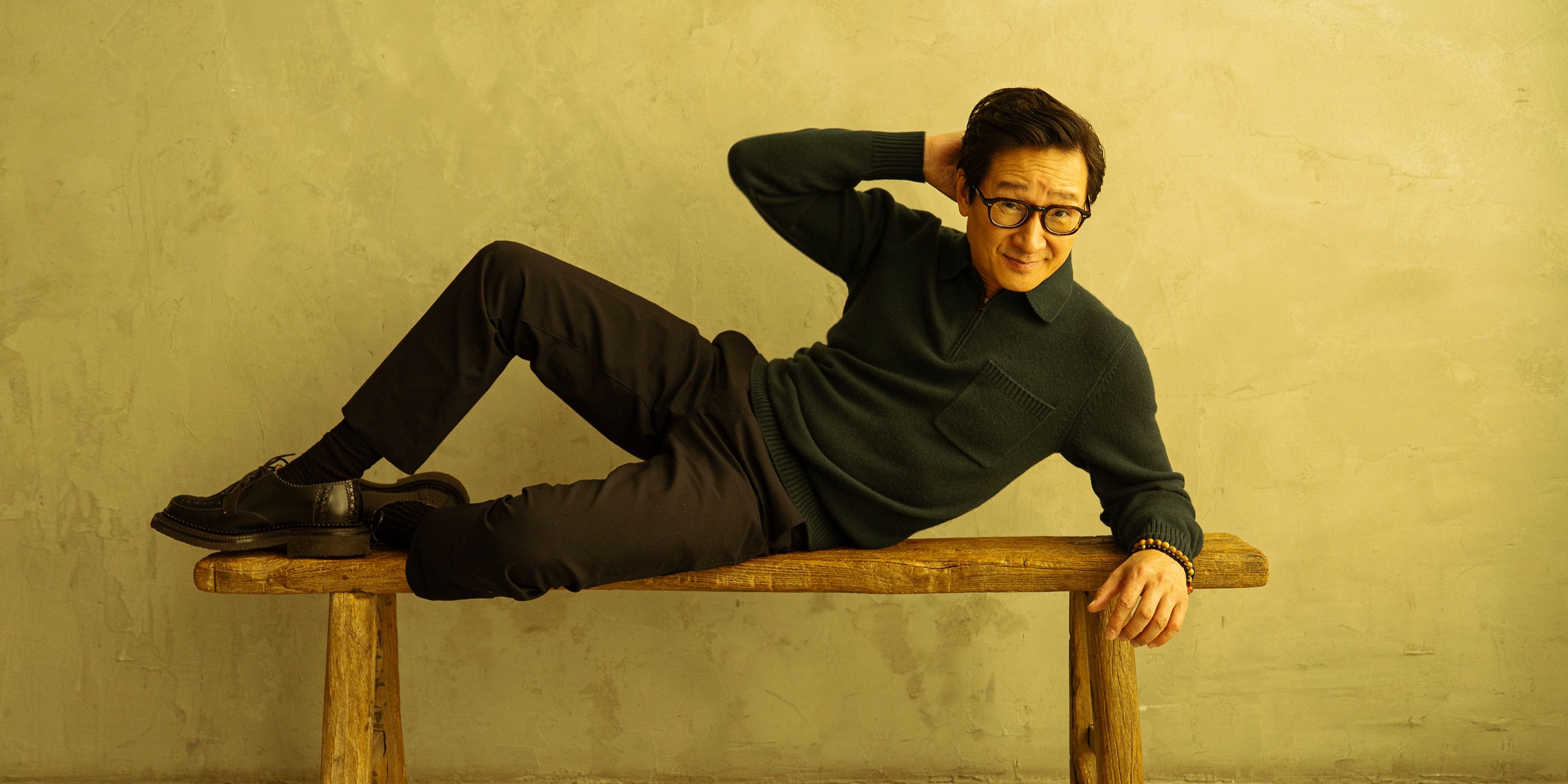
 Photography by Andrew Lipovsky for Collider
Ke Huy Quan teaches us that when destiny comes calling, you answer the first time and the second, and you grab on without letting go.
 By
Therese Lacson
Published 30 minutes ago
Therese Lacson is a Senior TV Editor who has been with Collider since 2021. She got started in this business over ten years ago working primarily as an interviewer and critic. At Collider, she works closely with the features team to support the writers and also ideates and develops content daily. She has covered major industry events including Cannes Film Festival, Sundance Film Festival, SXSW, Toronto International Film Festival, and San Diego Comic-Con. Although she reviews and covers both film and television, her focus is in television and her expertise is in fantasy and sci-fi genre shows. Her favorite shows to cover include House of the Dragon, Bridgerton, Fallout, 9-1-1, and Rivals.
Summary
Generate a summary of this story
follow
Follow
followed
Followed
Like
Like
Thread
Log in
Here is a fact-based summary of the story contents:
Try something different:
Show me the facts
Explain it like I’m 5
Give me a lighthearted recap
By
Therese Lacson
Published 30 minutes ago
Therese Lacson is a Senior TV Editor who has been with Collider since 2021. She got started in this business over ten years ago working primarily as an interviewer and critic. At Collider, she works closely with the features team to support the writers and also ideates and develops content daily. She has covered major industry events including Cannes Film Festival, Sundance Film Festival, SXSW, Toronto International Film Festival, and San Diego Comic-Con. Although she reviews and covers both film and television, her focus is in television and her expertise is in fantasy and sci-fi genre shows. Her favorite shows to cover include House of the Dragon, Bridgerton, Fallout, 9-1-1, and Rivals.
Summary
Generate a summary of this story
follow
Follow
followed
Followed
Like
Like
Thread
Log in
Here is a fact-based summary of the story contents:
Try something different:
Show me the facts
Explain it like I’m 5
Give me a lighthearted recap
Imagine this: You're 12, and it’s your first time watching a movie in a theater, but it's not a little flick that's being shown at the cinema by your house. It's the TCL Chinese Theater on Hollywood Boulevard. Oh, and by the way, you're on the red carpet next to Harrison Ford and Steven Spielberg, and you're in the movie. That 12-year-old was Ke Huy Quan, and that first time in a movie theater happened to be the premiere of Indiana Jones and the Temple of Doom. Little did he know at the time that his journey as an actor would lead him down several twists and turns, ultimately culminating in a dazzling return to Hollywood 38 years later with Everything Everywhere All at Once.
Speaking with Quan for his newest film, Zootopia 2, in which he voices a pit viper aptly named Gary De'Snake, it's obvious that the 54-year-old actor doesn't take a single thing for granted when it comes to his storied career. After a full three-hour press junket, Quan admits that he's a bit tired, but it in no way affects his clear energy or passion for his work.
"I grew up on Disney animated cartoons and films. Never thought one day that I would get to be a Disney animated character, so this is absolutely incredible," he effuses. Though his latest role might be less surprising for audiences who have been following his career lately, especially after his historic Academy Award win for Best Supporting Actor in 2023, many also know just how complicated his journey through an ever-evolving Hollywood was. From starting at the very top, with movies like Indiana Jones and the Temple of Doom and The Goonies, to being out of work in Hollywood as an actor for almost 20 years, Ke Huy Quan has more than proven he belongs in this industry.
Quan's Journey Began Long Before 'Indiana Jones'
 Photography by Andrew Lipovsky for Collider
Quan's story doesn't start when he first got cast in Indiana Jones, but all the way back in Vietnam. After the Vietnam War, Quan's parents made the difficult decision to flee the country. Upending your life is difficult enough, but they had to do it with nine children in tow. "It was not an easy decision. But at that time, they felt like they had no choice," Quan explains. "It was a really rough time because, post-war, especially in Saigon, which is called Ho Chi Minh City now, the majority of the people living in Saigon were ethnically Chinese, and we were being targeted. A lot of us had businesses, we were educated, and they were targeted."
Being ethnically Chinese after the war presented issues for many Hoa people (or Chinese-Vietnamese), and many of the refugees escaping the country to find refuge abroad came from this ethnic group. "My parents were seeing some of their friends in the neighborhood being taken away. I think they were really worried about us, and they were worried about the future," Quan says, describing the sacrifice and decision that his parents made to get out of Vietnam. Having a large family, especially, meant that it wouldn't be easy. "There were a total of 11 of us. And it was not something that you would do in broad daylight. We were trying to escape. So to be as discreet as possible, we were trying to do it in the middle of the night. And, of course, when you have that big of a family, it draws a lot of attention." Quan remembers his parents splitting up the family to give them a better chance of escape.
"Little did I know that it would only be four years later, my destiny would come calling."
"If one gets caught, the other hopefully will be successful. And that's exactly what happened," he reveals. "My mom took three of my siblings and went to Malaysia. And then my dad, the first attempt failed, the second attempt failed. And then luckily, on the third attempt, we went to Hong Kong, and we ended up staying a year in a refugee camp, before we immigrated to the United States." Quan, who was only 7 years old at the time, was not as aware of how hard or difficult the journey was for his parents, though he describes the whole experience as traumatic. "I don't think my parents, my family, would ever talk about it. It was something that we all experienced together. As an adult now and having the benefit of looking back, I’m more grateful and appreciative of my parents and the sacrifices that they made. Otherwise, I wouldn't even be here."
When the offer came to go to the United States, the family jumped on it, with Quan taking his first plane ride to Los Angeles. "Back then, Chinatown, Los Angeles, was just a very little Asian community," Quan recounts. "That's where we stayed. We didn't have a car. Everything we needed was within a one-mile radius. And that was our new life. We went to elementary school and started assimilating into this new life, learning the language. But the best part was reuniting with the family. We were very lucky because all of us made it. Some of my parents' friends were not so lucky. Not everybody made it out alive, so that was something that we were really grateful for." As Quan remembers his past, he offers a smile. "Little did I know that it would only be four years later, my destiny would come calling."
When Destiny (a.k.a. Steven Spielberg) Calls, You Answer
 Image via Paramount Pictures
The story of how Ke Huy Quan got the part of Short Round in Indiana Jones and the Temple of Doom is almost legendary by this point. Casting director Mike Fenton was looking for an East Asian boy to take on the role and auditioned in several major cities, including Los Angeles. As Quan tells it in his interview on Jimmy Kimmel Live, he tagged along with his little brother and was coaching him behind the camera before he was given an opportunity to audition as well.
When he got the call from Spielberg's office, he arrived in a three-piece suit, dressed to impress by his mom, but clearly uncomfortable. As Quan tells it, Spielberg gave him a big hug and told him to come back the next day wearing something a bit closer to his own style. "I went back the next day. I walked in the room, and there was Steven Spielberg, George Lucas, and Harrison Ford. We spent an entire afternoon together, and three weeks later, I was on a flight to Sri Lanka, and it was the best adventure of my life."
For Quan, working on Temple of Doom was life-changing. "It blew me away," he excitedly recalls. "Even when we were in Sri Lanka, I didn't even know that they built that village. I thought it was an actual village that we got to shoot in, and all the people were just local people, you know? But I was mesmerized by everything I was watching. I was just fascinated. I was having an incredible time, but yet, I didn't know what we were making. I hadn't seen Raiders [of the Lost Ark], at that time, or any of the Star Wars films. So, I had no clue that they were incredibly famous, successful filmmakers. I knew that they were really good at the job, and they were just like big kids."
Working with the likes of Spielberg and Lucas, however, wasn’t the only thing that excited the young, first-time actor. "Not only was I on set with all of these incredibly talented people, but I got to be out of school. I had my own tutor, so as a kid, you can imagine how fun that is. And every day it was just like going to the playground. Once when we were finished with Sri Lanka, we moved to London, where we shot all the interior stuff at Elstree Studios, and those were all practical sets."
"We spent an entire afternoon together, and three weeks later, I was on a flight to Sri Lanka, and it was the best adventure of my life."
Quan still remembers walking up to the walls of Temple of Doom’s stunning London sets and touching them to see if they were real. "It wasn't hard for me, as a kid, to react to, to look scared, or to look excited, because everything felt real to me." With his mom travelling alongside him the entire time, Quan got both a translator and a studio tutor. "By law, I was required to get three hours in, and I was in the trailer with her, but the whole time I was with her, my mind was on the set because I wanted to go back. It was that much fun."
After lunch, Quan would go straight to Spielberg's office, where the director had arcade games set up. "I would play games until we'd get called to the set," Quan confesses. But did he ever beat the seasoned director at said games? "No. No, he's a big kid. He loves those games, plays with them every day. There was one game in particular that I remember vividly. It's called Pole Position. In that video game, you race cars on this racetrack, and he was so good with that game."
But as fun as the production process was for Quan, it wasn’t until Temple of Doom premiered in 1984 that he saw what the magic of filmmaking could achieve. "That was my first time ever watching the movie put together, complete with sound effects, with music. It was also my first time watching a movie on the screen. Prior to that, as you can imagine, when we immigrated to America, we didn't have any money, we didn't have a car. Going to the movie theater to watch a movie, it was the last thing on our mind. My parents, my older siblings — they were all really busy, working and learning English at the same time. And what we watched at home was those rented TVB, Hong Kong TV video cassettes. That was it. I had no exposure to Hollywood movies." And then, Quan fondly adds: "The first time I watched a movie in a movie theater, I was in it."
From One Smash Hit With 'Temple of Doom' to Another Named 'The Goonies'
 Photography by Andrew Lipovsky for Collider
As anyone with Chinese immigrant parents (or, to be honest, any immigrant parent at all) will tell you, the idea of their children finding a career in the arts is somewhat of a nightmare. Pursuing medicine, law, and business comes with a guaranteed chance of success and financial stability. Artists, historically, experience the exact opposite. However, Temple of Doom was a smash hit. It broke records in its first week at the box office, from earning 1984’s highest opening weekend to ultimately becoming the highest-grossing movie of the year, raking in $333.1 million.
For Quan, whose parents were very business-oriented (his dad had a plastic bag factory back in Vietnam, and his mother owned a clothing store), the expectation of immigrating to America was the creation of a successful business. "When I told them that I wanted to be an actor, the reason they were very accepting is because, when you're in a movie called Indiana Jones and the Temple of Doom, where it was the most successful movie in 1984, it wasn't hard to convince them," Quan explains. "They have nine children. If eight of them went into business and one went into the arts, that's okay." And as the seventh in a family of nine, his parents already had their hands full.
While Quan was the only kid on the set of Temple of Doom, his follow-up project would lead him in an entirely different direction. The next year, he starred as Data in Richard Donner’s action-adventure film The Goonies, alongside Sean Astin, Jeff Cohen, Corey Feldman, and Josh Brolin.
Quan jokes now that on Indiana Jones, "I didn't have to fight for attention" — but The Goonies felt like a return to a more familiar dynamic. "That's what it was like in my household. It was hard to get my parents' attention because you can imagine having so many siblings, and that's what it felt like. We were constantly pulling Dick Donner, our director, pulling his hand. 'Hey, Dick, Dick, listen to me. You know, I got to say something.' Imagine all seven of us doing that at the same time." But Quan once again pauses to praise The Goonies’ practical sets. "It was like going to the playground. Except this time, it looked like I was with my friends — with my family."
Quan later starred alongside Astin in two more films, Encino Man and Love Hurts, and joined the MCU as O.B. in Loki Season 2, on the heels of Brolin's villainous turn as Thanos, but it was Cohen, who now doubles as his lawyer, with whom he formed the strongest friendship. "Jeff Cohen is my best friend. I see him, and I talk to him all the time." Quan recalls being one of the Cohen Garner firm's earliest clients. "When he reached out, he said, 'Hey, I'm a lawyer now. I'm starting my own firm. Do you want to sign with me?' And, at that time, I’d just graduated from college, so my future was bright. He thought I was going to go on to have this incredible career. But, you know..."
When I take a moment to remind Quan that he does, in fact, have an incredible career, he emphasizes that his friendship with Cohen has persisted even through the years when he wasn't appearing on screen. "It took 20 years. But in this 20-year span of time, he was incredible. He was first and foremost a dear friend who was very supportive and was always there when I needed him. And also, professionally, when I needed him for legal advice or anything I needed, if I called him, he would pick up the phone." Quan admits that during his sabbatical, he wasn't exactly the best client. "And you got to understand, I didn't make him any money. Literally nothing for the first 20 years. Now, when I get a paycheck, and I'm writing that commission check to him, I do it with a big smile on my face. And I always send him a note. That is a friendship that I cherish dearly, and it goes back 40 years."
A Change of Pace Came for Quan After Hollywood Success
 Image via Warner Bros.
After The Goonies, Quan pursued work in Asia, thanks to the worldwide success of his first two films. He appeared in the Taiwanese film It Takes a Thief and Japan’s Passengers, and even now recalls the stark contrast between working on big-budget Hollywood movies and his experience overseas. "Your first movie is Indiana Jones, and your second is The Goonies. When you're a kid, that's what you expect every single movie is going to be like. Naturally, you think that this is the norm. Not all movies are made like that. I literally started at the very, very top with these incredible filmmakers, but also, they were considered big budget." Quan admits that most young actors don’t get their start in the type of films that defined the beginning of his career. "Very quickly, I realized how special those two movies were as I got older and realized that not all movies are made like that. In fact, the movie that I made in Taiwan was the norm. Indy was not the norm. The Goonies was not the norm.”
Back in Hollywood, he landed a role in the one-season sitcom Together We Stand, and his role in Encino Man allowed him to cross paths with Brendan Fraser. As opportunities dwindled, Quan earned the lead in the Taiwanese TV show Eunuch & Carpenter. "It was at a time when I called Los Angeles my home, and I got my start in Hollywood. All I wanted was to make movies in Hollywood, but at that time, nobody was calling, and I was just, 'Okay, what's next?' Just waiting. Waiting. And when an opportunity from overseas [came], from Asia — because Indy and Goonies were huge in Asia — what other choices are there? I jumped at the chance."
The move to Taiwan resulted in a bit of a culture shift for Quan. The actor points out something many Chinese immigrants and Chinese-Americans, like yours truly, understand, but may be an aspect of the culture not fully understood by Western audiences. "I was young at that time, and I don't read or write Chinese, but I can speak it fluently. That's something that I have my parents to thank for, because they always insist that we speak Cantonese at home, but when I went to Taiwan, they spoke Mandarin. It was not a language that I understood fully. I wouldn't call it cultural shock because I understand that culture, but it was a different language.
"When you think about all Chinese, or even when you think of Asians, there are so many nuances, there are so many different dialects in Chinese culture. But I enjoyed it. It was a learning experience for me. And again, looking back, that's part of my life experience." After 40 episodes of Eunuch & Carpenter and continuing to struggle to find work in Hollywood, Quan's career took a major hit.
Quan Remembers the Moment It Was Time To Take a Step Back From Acting
 Photography by Andrew Lipovsky for Collider
It is well-known by this point that the reason Ke Huy Quan left Hollywood was due to the lack of roles for him as an Asian American man. The actor still remembers the day when he started to consider taking a step back from his dream. "I hadn't had an audition for a long, long time. And, so my agent said, 'Hey, I know this is not much, but there is this really small role. You know what? Let me send it to you, and let me know what you think.' And when I got a hold of the side, it didn't have a character name. I think it was only one sheet. The side only consisted of one sheet, and I was looking at my lines, and there were only two lines on that page, and they were very short lines, and I said, 'Yeah, sure. Why not?' I hadn't worked in a long time, and there were no other audition opportunities.
"So I drove there, walked into the room, and there were literally 30 other Asian actors. I went to the desk to sign in, and I looked at the sheet, and they were all going for the same role. I was still being optimistic. I was still happy to be there because I just wanted to work. I just wanted to do something. Walking into the room, I remember there was a casting director and a casting associate, reading the lines with me. And when I walked in, of course, just because of the movies that I've been in, they said, 'Oh, Ke, we're so happy to have you here. We really love your work. We're big fans of Indiana and The Goonies.' A lot of times when I go in and audition, that's the beginning. That's what I'm used to. And it kind of gives me hope that I'm going to land the role because, hey, they're fans! That's great! I have a leg up."
But then a week went by, and by the time Quan followed up with his agent, it seemed like the role had gone to someone else. Quan, who was still living in the aftermath of the success of Indiana Jones and The Goonies, was shocked that he couldn't even land that small role. "It was that moment of realization," he recalls, thinking of the part with a character who didn't even have a name and only had a few lines. "I can't even get that. I just felt this idea [that] maybe my time had passed. That's when the idea of stepping away started percolating."
"I convinced myself that I no longer wanted to act, and I was happy with my new career, with my new life. It was great — or, at least, that's what I told myself."
As parts continued to dwindle, Quan went off to USC film school for his degree, where he edited a comedy horror short titled Voodoo that would go on to win the Audience Award at the 2000 Slamdance Film Festival. As Quan transitioned to behind-the-camera work, though he was no longer on screen, he still managed to land a major gig coming out of school. "My first job right out of college was X-Men. Initially, because of the unique job that I was doing at the time, I was one of the action choreographers. We spent weeks in a makeshift stage where we came up with that fight between Mystique and Wolverine. Once we had those choreographed moves down, the first thing we did was to show it to the entire production."
When he performed the choreographed fight for director Bryan Singer, producer Lauren Shuler Donner (who was married to Richard Donner), a young Kevin Feige, and several people from all different departments, Quan remembers feeling like he was on screen again. "I was in the spotlight. I felt like I was on camera, and then felt great. But then very quickly, once I was done and when we got time to shoot it, it was weird watching it behind the camera. I didn't realize that I really enjoyed showing people what I can do. But at the same time, once when I showed that, then I had to step away."
Still, Quan remains humble, noting that it was still an incredible first job to have right out of film school. The only downside was that it wasn't what he really wanted. "When I was having those really unique and weird and complicated feelings, I kept telling myself, 'Hey, Ke, your time in front of the camera is over. This is what you do now.' I convinced myself that I no longer wanted to act, and I was happy with my new career, with my new life. It was great — or, at least, that's what I told myself."
A New Career Behind the Scenes Leads to a Secret Romance Between Co-Workers
 Photography by Andrew Lipovsky for Collider
However complicated those feelings were, Quan's time working behind the camera led him to not only work with directors like Singer and later Wong Kar-wai on 2046, but also to meet his wife, Echo Quan. " [Wong Kar-wai] had an office there in Shanghai and an office in Hong Kong, but nobody was running the Shanghai office, and he wanted me to go over there. At the time, China was just on the verge of becoming what it is today. People were opening up offices in China to be a part of this; everybody saw it coming. I walked into the office, and there were a few people there — but my wife, Echo, immediately caught my eye."
Quan already has a fond smile on his face as he recalls their first meeting. "I remember she had big, beautiful eyes and a big smile, and we just immediately clicked. It was one of those really special relationships where we could talk nonstop. She loves to talk, and I love to listen to her talk. We would just be chatting for hours and hours and hours, and the next day, again, we would just pick up right where we left off, and it would just be like that. It was just an incredible time. That's my favorite memory from Shanghai," Quan laughs. "Since we were working for the same company, we were trying to kind of keep it really on the down-low. We didn't tell anybody.
There was one person, above everyone else, that Quan felt guilty about keeping his relationship a secret from: the reason he had traveled to Shanghai in the first place. "Interestingly, even after we got married, I was so embarrassed because I kept it away from Wong Kar-wai all this time,” he admits, before revealing the moment when he finally spilled the beans to the director over dinner in L.A. many years later. “I sat down, and I said, 'Kar-wai, this dinner is on me, and I'll tell you why: I want to tell you who my wife is.'"
Funnily enough, it doesn't seem like Quan and Echo’s marriage was that much of a surprise for the auteur. "I think he had an inkling," Quan says with a grin, referencing a time before he’d started dating his wife when the three were having dinner together. "It was Kar-wai, me, Echo, and his team. I was sitting next to Kar-wai at that time, and he leaned over, and he said, 'What do you think of Echo?' This is before we started dating. I said, 'I think she's great. She's lovely. She's got a great personality.' And he said, 'I think she will make a great wife.'" The rest, as they say, is history.
'Crazy Rich Asians' Might Have Opened the Door, but 'Everything Everywhere All at Once' Blew the Roof Off
 Ke Huy Quan as Waymond eats chapstick and prepares to fight in Everything Everywhere All at OnceImage via A24
While attending film school, Quan had bigger aspirations of filmmaking, but given his experience with directors like Spielberg, Donner, and Wong, it was inevitable that he would end up drawing comparisons. "Yes, I had that aspiration. But then I keep thinking: I'm never going to be as good as them. I think one day I'll probably want to direct, but I think this whole time it was just... When those opportunities dried up, I didn't want to leave the industry. I just wanted to stay in it."
"I felt like this incredible gravitational force pulling me out of it when I wasn't working most of the time. And it feels like I was desperately hanging on. 'No, no, no, please let me stay in here.' That was a big reason why I wanted to go to film school and started working behind the camera."
Little did Quan know that the acting world wasn't done with him. It wasn't until a little movie called Crazy Rich Asians debuted in 2018 that he began to think of returning to Hollywood. Quan remembers his first experience watching the influential film that starred a primarily Asian and Asian American cast. "I think the best way to explain it is when Indy 3 came out. I love the franchise so much. But when it came out, it was me being in that theater like, 'Oh my God, this is an incredible movie.' But yet it's that bittersweet moment, [because] I'm not in it, you know?
"It was really a culmination of... it wasn’t just that moment, but ever since 2000, seeing the rise of more prevalent Asian actors working in Hollywood, and really working. Not like back in the early days, when I was working for two months out of a year, or one month out of two years. That's why every time I fill out those forms, they say, 'What's your profession?' And me putting down 'actor' just feels like I'm a phony. But seeing my fellow Asian actors working consistently, that gave me this idea of coming back home."
When the opportunity for the unconventional Everything Everywhere All at Once came around, bringing with it actors like Michelle Yeoh and Jamie Lee Curtis, Quan took it. In a previous conversation with Quan in 2022 for the film, he explained his reaction to winning the part of Waymond, the patriarch of the Wang family: "I wanted this more than anything else, you know? Had you asked me, ‘Do I want to win the lottery? Or do I want to win this role?’ Without a doubt, I wanted this." In his return to the screen, the film also took more than one page from the productions of his first-ever movie roles. Shooting on practical sets offered Quan a sense a familiarity, and the story of a Chinese-American family thrown into the chaos of the multiverse offered the perfect re-launching pad for his career.
In a full circle moment, it was actually due to those years with his wife, Echo, who’s fluent in both Mandarin and Cantonese, that came in handy for playing Waymond. "I think my Mandarin got better because of her. And interestingly, that's why I think everything happens for a reason. When we did Everything Everywhere All at Once, all that dialogue was Mandarin. So it came really handy having spent 20 years with her, and she ended up doing the dialogue translation from English."
When Everything Everywhere All at Once was finally released, the film resonated with far more than just Asian American audiences. It not only became A24's highest-grossing film, a title it still retains today, but it also earned 11 Academy Award nominations and won seven, including Quan's win for Best Supporting Actor and Best Picture. While Crazy Rich Asians was the first movie in decades to feature an all-Asian cast, Everything Everywhere All at Once blew that milestone out of the water, and Quan himself was at the center.
Creating a Legacy That Will Last Not Just One Generation, but Generations
 Photography by Andrew Lipovsky for Collider
Quan's splashy return to Hollywood made him a star again. He quickly followed Everything Everywhere with the Disney+ series American Born Chinese (coincidentally, the cast also included his EEAOO co-stars, Michelle Yeoh and Stephanie Hsu), where he played Jamie Yao, an actor whose life parallels Quan's own history onscreen. In the series, Jamie plays the bumbling Freddie Wong in a fictional sitcom called Beyond Repair, where the show leans into racial stereotypes and often renders Freddie the butt of the joke. While Quan's career is not completely identical to Jamie's, his character offers a gut-wrenching monologue in a Beyond Repair reunion that speaks to Quan's own journey.
As Jamie explains, he wants to play the hero — not someone with superpowers, but someone who goes on a journey and fights for something that matters. It's hard not to see Quan pouring his heart into this monologue as his character explains that, to him, his parents are heroes, but people like that just weren't on TV at the time. And while Quan's early roles as Short Round and Data are undeniably enjoyable and memorable, it's clear to see how different his career is now from what it used to be. No longer is he the sidekick or the comedic relief. Waymond Wang catapulted him to leading man status, but this was a talent that Quan had not only had from the beginning but also cultivated despite years of struggling through an industry that had left him behind.
On the heels of American Born Chinese, he appeared in Loki Season 2 as Ouroboros, aka O.B., and stole viewers’ hearts as the quirky TVA employee. The action comedy Love Hurts, which gave him the opportunity to play a a romantic lead opposite Ariana DeBose, showed off his stuntwork as a hitman-turned-realtor. Most recently, Zootopia 2 is sure to endear him to an entirely new audience of young viewers. "The animators are just amazing, the way they were able to take these animals, some where people are really afraid of them, but yet turn around and make them so cute, and adorable, and loving, and funny," Quan explains. It’s a pertinent point considering his character, Gary, is a pariah even in the world of Zootopia because of his identity as a snake.
Ironically, Quan considers himself the "new kid" when it comes to voice acting. "When I got offered Gary De'Snake, instinctively, having done a lot of live action, you go, 'Oh, great. I'm going to get to work with Jason Bateman. I'm going to go to work with Ginnifer Goodwin,' and all these incredible actors who provided the voices for the first one. I didn't even get to meet them! I'm just in the recording booth." Acting live in front of the camera means that he is responsible for his own performance, but in voice acting, Quan’s only coming to the table with half of that performance.
"It's really the animator. It’s their contribution to provide the facial expression and body movement. It's really a combination of myself and my animator to create this one performance, but I loved it," he effuses, before detailing the setup for his work in the booth that most surprised him. "I didn't know that it was going to be this physically demanding. You don’t just stand there, even though there is a mic, and I stand with the script. There's actually a physical handlebar that is bolted down in concrete for you to grab onto and shake and move in a way that your character would move on screen. Each recording session is three hours. At the end of every session, I am drenched in sweat."
Quan also has nothing but praise for the minds behind the Zootopia sequel. "I love our creative team, our directors Byron Howard and Jared Bush, and [producer] Yvett Merino. I think they’re geniuses, just the ideas that they come up with, it's so clever. The jokes are so funny." As you'll hear from anyone who grew up watching Disney movies like Quan, the experience of joining one is deeply affecting. "They're fun, they’re entertaining, but yet you walk away with a beautiful message. So now, getting to be on the other side, where I get to be a Disney animated character and to be part of a family where this movie is going to have a wonderful influence on the next generation, as an actor, that's a dream come true."
Though there have been some bumps in the road, Quan is living his dream and embracing it wholeheartedly without shirking the legacy of the movies that got him to where he is today. He has an innate understanding of the way in which movies can bond people together, but still marvels at the continuing legacy of something like The Goonies. "I didn't know it would last 40 years, that it would have this incredible impact on not one generation but generations. [People] share stories about how their parents showed the movie to them, and it was a movie that they would watch over and over again together. That's how they bonded." It's something he hopes that Zootopia 2 will become a part of someday. Time will tell, but Quan's big return to Hollywood has more than cemented that his movies will linger in the minds of more than just one generation.
Quan admits to me now that he's a rather private person, having grown up in a culture that favors keeping your emotions to yourself. His latest return has shed light on the changes in the industry and just how important it is for stories like Quan's to be heard. "I rarely share anything," Quan confesses, "and I don't know how and why and where I got the courage, but I think it was just this fact that I could not believe that I was given this incredible second opportunity." messIf anyone can take a second opportunity and turn it into a total revitalization, it's the actor who’s already laid out a clear road map for that success — full of determination, humility, and chasing your dream even after you've convinced yourself that your chance is over.
Photography: Andrew Lipovsky | Stylist: Chloe Takayanagi | Groomer: Kristan Serafino | Producer: Carol Lee | Assistants: Jordyn Katz & Janice Yi | Location: Cafe Studio NYC
 8
10
8
10
Zootopia 2
Like Follow Followed PG Family Comedy Crime Adventure Animation Release Date November 26, 2025 Director Byron Howard, Jared Bush Writers Jared Bush Producers Jennifer LeeCast
See All-
 Ginnifer Goodwin
Judy Hopps (voice)
Ginnifer Goodwin
Judy Hopps (voice)
-
 Jason Bateman
Nick Wilde (voice)
Jason Bateman
Nick Wilde (voice)
 Expand
Collapse
Expand
Collapse
-
 Movie
Movie
We want to hear from you! Share your opinions in the thread below and remember to keep it respectful.
Be the first to post Images Attachment(s) Please respect our community guidelines. No links, inappropriate language, or spam.Your comment has not been saved
Send confirmation emailThis thread is open for discussion.
Be the first to post your thoughts.
- Terms
- Privacy
- Feedback
 16 hours ago
From 'Gunsmoke' to 'Lonesome Dove,' the 10 Best Western Shows That Are Free To Stream Right Now
 16 hours ago
This Forgotten TV Series Was Spider-Man's First True Live-Action Appearance
 19 hours ago
‘The Conjuring: Last Rites’ Took a Pivotal Scene Straight Out of 'Avengers: Endgame's Epic Ending
 19 hours ago
'What Would You Do?' Holiday Special Trailer Checks Who's Naughty or Nice When Put to the Test [Exclusive]
More from our brands

34 Best Korean Dramas and Movies on Netflix to Watch Right Now
50 Best New Movies on Streaming to Watch Right Now

30 Must-Read Boys' Love Manhua For BL Fans
The 55 Best Movies of All Time, Ranked


26 Best Gender Bender Manhwa You Should Read

The 27 Best Kung Fu Movies of All Time, Ranked