- Home
- Investing
Caterpillar stock has been a remarkably resilient market beater for a very long time.
 By
Dan Burrows
published
28 February 2026
in Features
By
Dan Burrows
published
28 February 2026
in Features
When you purchase through links on our site, we may earn an affiliate commission. Here’s how it works.
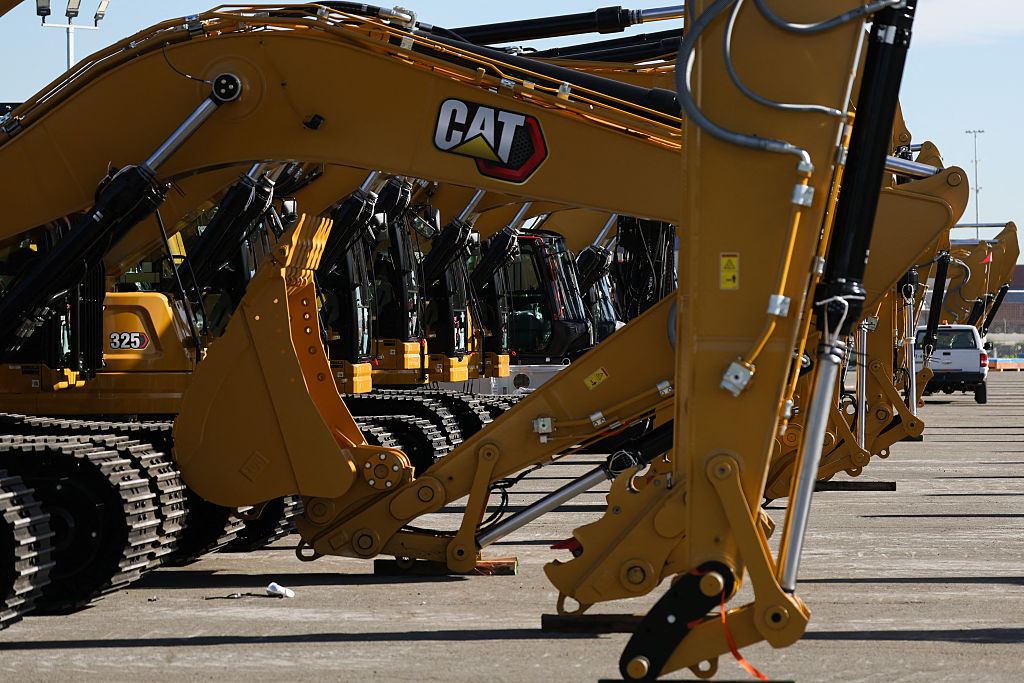
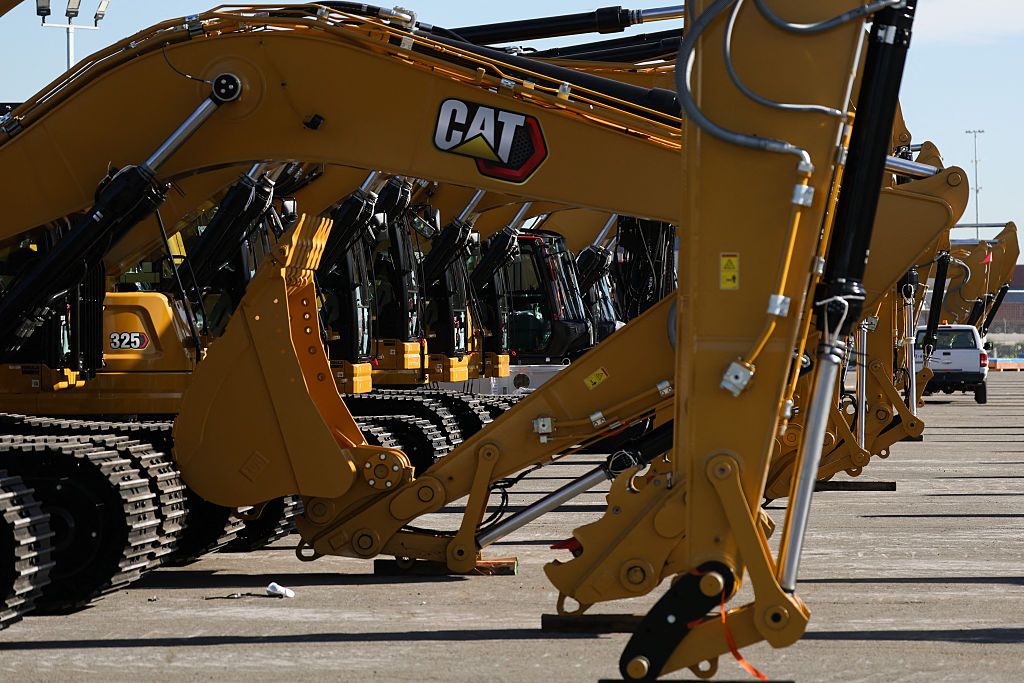
 (Image credit: Patrick T. Fallon / AFP via Getty Images)
- Copy link
- X
Profit and prosper with the best of Kiplinger's advice on investing, taxes, retirement, personal finance and much more. Delivered daily. Enter your email in the box and click Sign Me Up.
Contact me with news and offers from other Future brands Receive email from us on behalf of our trusted partners or sponsors By submitting your information you agree to the Terms & Conditions and Privacy Policy and are aged 16 or over.You are now subscribed
Your newsletter sign-up was successful
Want to add more newsletters?

Delivered daily
Kiplinger Today
Profit and prosper with the best of Kiplinger's advice on investing, taxes, retirement, personal finance and much more delivered daily. Smart money moves start here.
Signup +
Sent five days a week
Kiplinger A Step Ahead
Get practical help to make better financial decisions in your everyday life, from spending to savings on top deals.
Signup +
Delivered daily
Kiplinger Closing Bell
Get today's biggest financial and investing headlines delivered to your inbox every day the U.S. stock market is open.
Signup +
Sent twice a week
Kiplinger Adviser Intel
Financial pros across the country share best practices and fresh tactics to preserve and grow your wealth.
Signup +
Delivered weekly
Kiplinger Tax Tips
Trim your federal and state tax bills with practical tax-planning and tax-cutting strategies.
Signup +
Sent twice a week
Kiplinger Retirement Tips
Your twice-a-week guide to planning and enjoying a financially secure and richly rewarding retirement
Signup +
Sent bimonthly.
Kiplinger Adviser Angle
Insights for advisers, wealth managers and other financial professionals.
Signup +
Sent twice a week
Kiplinger Investing Weekly
Your twice-a-week roundup of promising stocks, funds, companies and industries you should consider, ones you should avoid, and why.
Signup +
Sent weekly for six weeks
Kiplinger Invest for Retirement
Your step-by-step six-part series on how to invest for retirement, from devising a successful strategy to exactly which investments to choose.
Signup + An account already exists for this email address, please log in. Subscribe to our newsletterAs the world's largest manufacturer of heavy construction and mining equipment, Caterpillar (CAT) has long been seen as a bellwether for the global economy. Happily for long-term shareholders, CAT's returns have greatly outpaced the global economy – and U.S. stock market – for decades.
Caterpillar's outperformance in the 21st century was never a foregone conclusion. If anything, a company founded a century ago to supply tractors for delta farmers and New Deal works projects should be about as old-economy as they come.
It's not. Caterpillar has spent the past two decades navigating massive cyclical changes to the global economy very much to shareholders' benefit. For example, few firms gained more from the China-led commodities supercycle of the early 2000s.
From just $107.88 $24.99 for Kiplinger Personal Finance
Become a smarter, better informed investor. Subscribe from just $107.88 $24.99, plus get up to 4 Special Issues
CLICK FOR FREE ISSUE
Sign up for Kiplinger’s Free Newsletters
Profit and prosper with the best of expert advice on investing, taxes, retirement, personal finance and more - straight to your e-mail.
Profit and prosper with the best of expert advice - straight to your e-mail.
Sign upOn the other hand, CAT could have had better timing when it acquired mining equipment giant Bucyrus International near the top of the cycle in 2011. The hangover from the end of the boom was a headwind for shares for a good 10 years.
However, it also forced CAT to double down on finding operational efficiencies, like expanding its parts and maintenance business. Services carry higher profit margins than sales of earthmoving equipment and diesel-electric locomotives.
Track all markets on TradingViewThe biggest driver of recent returns – and expanding multiples – is Caterpillar's emergence as a huge bet on the build-out of artificial intelligence. Indeed, CAT isn't a tractor company anymore; it's a very 21st-century critical infrastructure and energy play.
The AI era has created massive demand for the construction of data centers and the energy needed to power them. Rising prices for commodities, especially copper and lithium, have led mining companies to upgrade their equipment with Caterpillar's latest offerings.
And in another techy twist, Caterpillar even has a recurring revenue stream. Thanks to the Internet of Things (IoT), Caterpillar can make sure its legions of customers buy parts and services only from its own dealer network.
That said, stocks never go up in a straight line, and that's certainly been true of this Buy-rated Dow Jones stock.
The bottom line on Caterpillar stock
Long-time CAT shareholders are used to the cyclical nature of this bluest of blue-chip industrial stocks. Besides, periods of underwhelming performance always came with a reliable and rising dividend. As a member of the S&P 500 Dividend Aristocrats, Caterpillar is one of the best dividend stocks for dependable dividend growth.
At any rate, buy-and-hold patience has really paid off. The AI era has been a boon for CAT.
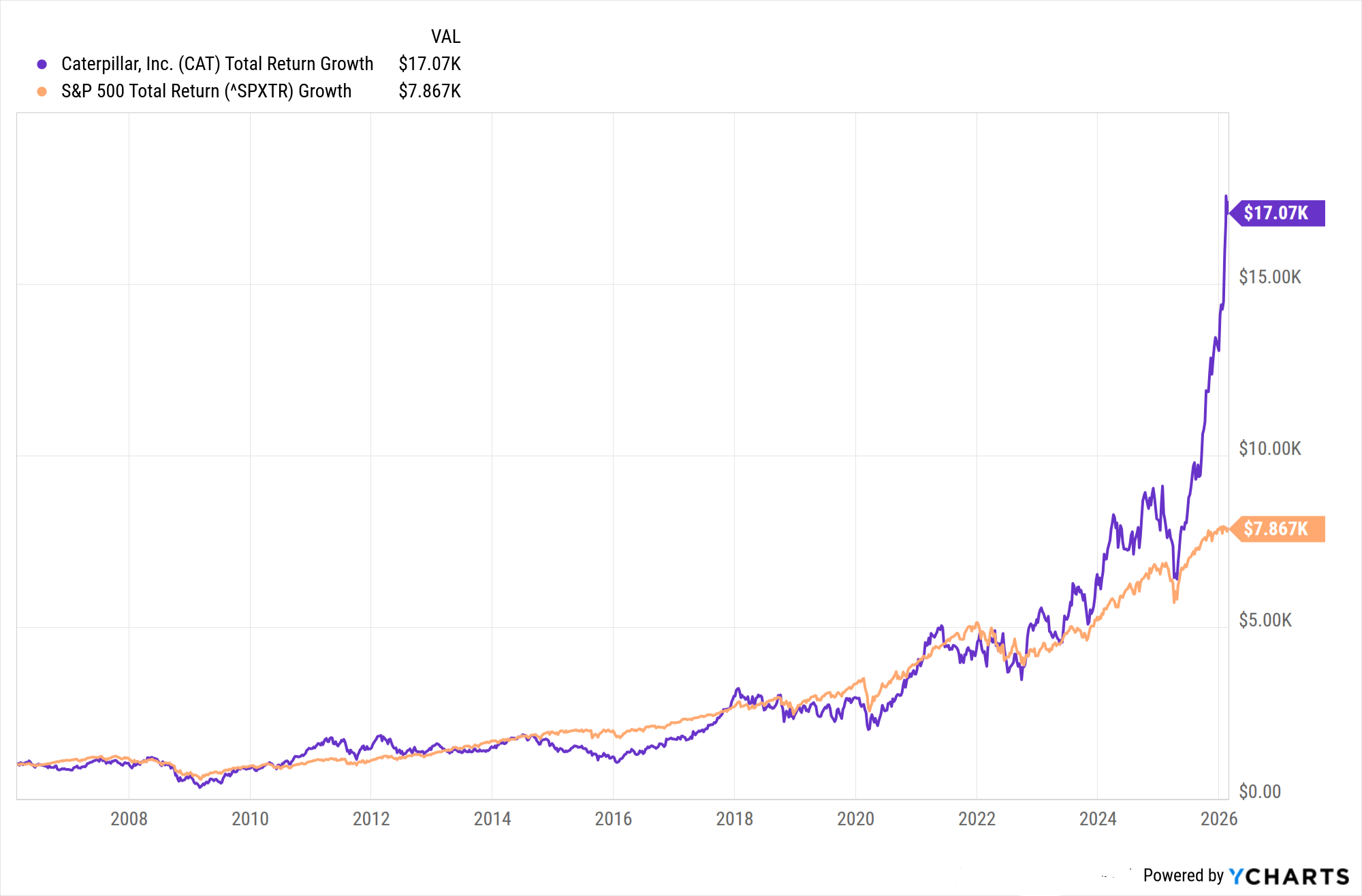
Over its entire life as a publicly traded company, CAT generated an annualized total return (price change plus dividends) of 16.3%. That beats the broader market by about 6 percentage points.
CAT also beats the S&P 500 by wide margins over the past one-, three-, five-, 10- and 15-year periods.
Which brings us to what $1,000 invested in Caterpillar stock would be worth today. Have a look at the above chart and you'll see that if you put $1,000 into CAT stock 20 years ago, it would be worth $17,000 today. The same amount invested in an S&P 500 index fund would be worth about $7,800.
Even better, Wall Street sees more outperformance ahead. Of the 29 analysts covering CAT stock surveyed by S&P Global Market Intelligence, 14 call it a Strong Buy, one says Buy, 12 have it at Hold and two call it a Strong Sell. That works out to a rare consensus recommendation of Buy with solid conviction.
Speaking for the bulls, Oppenheimer analyst Kristen Owen likes the company's exposure to both the world of electrons and the world of atoms.
"CAT is underappreciated as a play on AI for the physical world," writes Owen, who rates shares at Outperform (the equivalent of Buy). "We believe its strength and diversity of backlog growth, the durability afforded by 40% of sales stemming from services, and a continued willingness to consistently buy back shares as structural underpinning for CAT's next phase of growth."
More Stocks of the Past 20 Years
- If You'd Put $1,000 Into Sherwin-Williams Stock 20 Years Ago, Here's What You'd Have Today
- If You'd Put $1,000 Into Lowe's Stock 20 Years Ago, Here's What You'd Have Today
- If You'd Put $1,000 Into Apple Stock 20 Years Ago, Here's What You'd Have Today
 Dan BurrowsSocial Links NavigationSenior Investing Writer, Kiplinger.com
Dan Burrows is Kiplinger's senior investing writer, having joined the publication full time in 2016.
A long-time financial journalist, Dan is a veteran of MarketWatch, CBS MoneyWatch, SmartMoney, InvestorPlace, DailyFinance and other tier 1 national publications. He has written for The Wall Street Journal, Bloomberg and Consumer Reports and his stories have appeared in the New York Daily News, the San Jose Mercury News and Investor's Business Daily, among many other outlets. As a senior writer at AOL's DailyFinance, Dan reported market news from the floor of the New York Stock Exchange.
Once upon a time – before his days as a financial reporter and assistant financial editor at legendary fashion trade paper Women's Wear Daily – Dan worked for Spy magazine, scribbled away at Time Inc. and contributed to Maxim magazine back when lad mags were a thing. He's also written for Esquire magazine's Dubious Achievements Awards.
In his current role at Kiplinger, Dan writes about markets and macroeconomics.
Dan holds a bachelor's degree from Oberlin College and a master's degree from Columbia University.
Disclosure: Dan does not trade individual stocks or securities. He is eternally long the U.S equity market, primarily through tax-advantaged accounts.
Latest-
 Good Stock Picking Gives This Primecap Odyssey Fund a Lift
Outsize exposure to an outperforming tech stock and a pair of drugmakers have boosted recent returns for the Primecap Odyssey Growth Fund.
-
 5 Laundry Habits That Are Costing You Money
You might be flushing money down the drain if you have any of these laundry habits.
-
 More Tools to Build a Bond Ladder
Vanguard aims to launch a line of target-maturity corporate bond ETFs.
-
Good Stock Picking Gives This Primecap Odyssey Fund a Lift
Outsize exposure to an outperforming tech stock and a pair of drugmakers have boosted recent returns for the Primecap Odyssey Growth Fund.
-
More Tools to Build a Bond Ladder
Vanguard aims to launch a line of target-maturity corporate bond ETFs.
-
 A Newly Retired Couple With a Portfolio Full of Winners Faced a $50,000 Tax Bill: This Is the Strategy That Helped Save Them
Large unrealized capital gains can create a serious tax headache for retirees with a successful portfolio. A tax-aware long-short strategy can help.
-
 5 Retirement Myths to Leave Behind (and How to Start Planning for the Reality)
Separating facts from fiction is an important first step toward building a retirement plan that's grounded in reality and not based on incorrect assumptions.
-
 I'm a Financial Adviser: Silence Is Golden, But It Hurts Your Heirs More Than You Think
Talking to heirs about transferring wealth can be overwhelming, but avoiding it now can lead to conflict later. Here's how to start sharing your plans.
-
 Dow Dives 521 Points as Goldman, AmEx Slide: Stock Market Today
News of Block's massive layoffs exacerbated AI worries across the financial sector.
-
 The Merger Market is Heating Up. Here's How to Cash In
Investing in takeover deals can be a low-volatility way to diversify your portfolio.
-
 Vanguard Cuts Fund Fees Again. Here's Why That's Important for You
Vanguard recently cut fees on dozens of ETFs and mutual funds, which is great news for investors. Here's why.

