 By Tom O'ConnorShareNewsweek is a Trust Project member
Off the coast of Shanghai, analysts caught another glimpse this week of the new warship that could forever change the history of naval warfare.
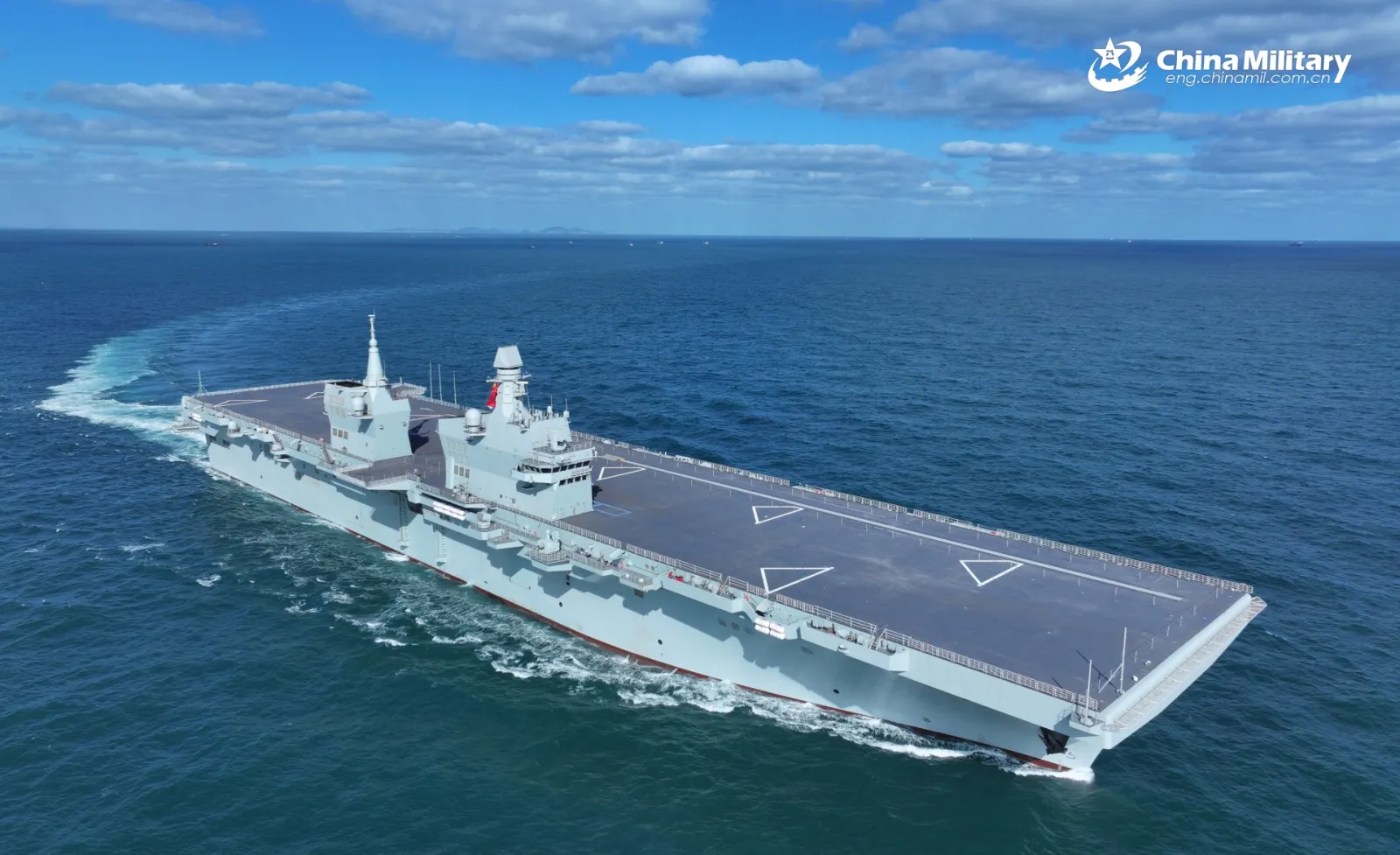
The People's Liberation Army Navy Type 076, variously described as an amphibious assault ship and helicopter landing dock, is far more than just another vessel being floated by China's historic shipbuilding effort that has already long outpaced the U.S. Navy in scale. Larger than its Type 075 predecessor, the ship boasts a combination of state-of-the-art launch capabilities and the capacity to carry a fleet of drones that observers believe could redefine how battles are fought at sea.
"The Type 076 is significant because it brings together a large amphibious assault ship, an electromagnetic catapult, and a deck optimized for a variety of uncrewed aircraft," James Patton Rogers, executive director of the Brooks Tech Policy Institute at Cornell University and NATO country director for the Full Spectrum Drone Warfare project, told Newsweek.
"Once fully operational, that means China could launch surveillance and strike drones at scale from well inside the first island chain, helping it find, track, and target adversaries across a wide area of the western Pacific," Rogers said. "It will play a major role in providing overwatch for ground deployments, but also its own offensive operations."
And with new footage indicating the first Type 076 vessel has embarked on its second set of sea trials in less than a month, Rogers, who also advises the U.N. Security Council on high-tech weapons systems proliferation, said a successful deployment "would mark an important shift in naval warfare, where drones move from being an add-on to being central to carrier and amphibious operations."
"Put simply," he added, "it's my view that we are at the start of a maritime drone revolution that will equal what we have seen over the battlefields of Europe."
 ...
...The Revolution Begins
Whispers of the Type 076 first began circulating around the internet in the summer of 2020. As the world wrangled with the COVID-19 pandemic, military enthusiasts began to report on a proposal by the China State Shipbuilding Corporation to build a more advanced successor to the Type 075, a line that today includes four ships named after the Chinese provinces of Hainan, Guanxi, Anhui and Hubei.
The reports came around the same time that Chinese President Xi Jinping declared in a July 2020 address to his armed forces that “drones are profoundly changing the face of warfare," instructing them "to strengthen drone warfare research, education and training, and accelerate the training of drone pilots and commanders," according to state-issued readouts.
The Type 076 was officially unveiled last December upon its launch at the Hudong-Zhonghua Shipyard in Shanghai, where it was revealed to bear the name of another Chinese province, Sichuan, and the hull number 51. The Chinese military described the ship as a "key asset" for projecting power in the far seas, boasting a full load displacement of over 40,000 tons, a twinship island superstructure, full flight deck and the electromagnetic catapult system.
Only two ships in service today possess this groundbreaking system and those are the U.S. and China's latest aircraft carriers, the USS Gerald R Ford and Type 003 Fujian, respectively.
In the words last week of People's Liberation Army Colonel Jiang Bin, spokesperson for the Chinese National Defense Ministry, "as a new generation of amphibious assault ship of the navy, the Sichuan plays an important role in promoting the transformation and development of the navy and improving its far-sea combat capabilities."
"China's independent development and construction of amphibious assault ships and other weapons and equipment is an arrangement made with an eye on national security needs and the overall situation of naval construction and development, with the aim of defending national sovereignty, security and development interests, and better maintaining world and regional peace and stability," Jiang said in reply to a reporter's question about the Type 076.
The Type 076 also caught the attention of the Pentagon, which referenced the ship several times in its annual report last year on developments regarding Chinese military power. The report identified the Type 076 as part of the "Yulan" class that "is expected to join the fleet in the second half of the decade and provide additional sea control via catapult-launched UAVs."
The U.S. Department of Defense—renamed the Department of War by the Trump administration in September—made some other observations regarding the rise of the People's Liberation Army Navy from a regional force to global maritime power.
"Toward the PRC’s goal of building a 'strong and modernized navy force,' the PLAN has replaced or updated its previous generations of platforms that had limited capabilities in favor of larger, modern multi-mission combatants," the report said. "Today, the PLAN is largely composed of modern multi-role platforms featuring advanced anti-ship, anti-air, and anti-submarine weapons and sensors."
"The PLAN is emphasizing maritime joint operations and joint integration with the other branches of the PLA," the report added. "This modernization aligns with the PRC’s growing emphasis on the maritime domain and increasing demands for the PLAN to operate at greater distances from mainland China."
The Type 076 appears well-suited to aid in this initiative, one that may complicate U.S. efforts to establish naval dominance in critical maritime flashpoints such as the disputed waters of the South China Sea and Taiwan Strait.
Hu Bo, director of the Beijing-based South China Sea Probing Initiative think tank as well as research professor and director of Peking University's Center for Maritime Strategy Studies, outlined to Newsweek what he saw as "two layers of meaning" behind the emergence of the Type 076.
While on the one hand Hu described the vessel's development as a "normal" step in China's ongoing military modernization that "has little to do with the regional situation," nor would it "have a significant impact on the regional situation," he also argued the ship would enhance China's ability to respond regionwide if and when necessary.
"From a tactical perspective," Hu said, "this clear deployment will give China more flexible means to respond to regional situations, including those in the South China Sea and the Taiwan Strait."
A Trial for the Ages
While the Type 076 has yet to enter service, the ship has been seen conducting at least two sets of sea trials since mid-November, with the most recent pictures and videos emerging earlier this week. Beyond simply trying out the ship itself, however, the exercise could prove a test for the future of the U.S. Navy's dominance at sea.
"China is not alone in this revolution and the U.S. and its allies are not asleep to the problem," Rogers said. "Washington is fielding new interceptors, electronic warfare measures, and high-power carrier-based laser systems to protect ships and bases, including in INDOPACOM."
"But most of this effort has been shaped by experience in the Middle East and Ukraine, not yet by sustained, large-scale maritime drone operations from platforms like Type 076," he added. "This will be the most important and challenging test of all."
The advent of modern drone operations has proved a serious challenge for traditional military doctrines and even the high-tech assets of the U.S. and allied nations.
While both parties to the Russia-Ukraine war now extensively operate UAVs of various types and sizes to conduct and support offensive operations, defenses remain difficult to mount. Outside the battlefield, NATO nations have struggled to counter reports of drone sightings that have led to airspace disruptions and airport closures across several major nations.
The U.S. has also had a difficult experience combating drones mounted by far smaller and less-equipped forces in the Middle East, particularly Yemen's Ansar Allah, also known as the Houthi movement. A costly U.S. campaign waged against the group's drone and missile capabilities amid the war in Gaza ended in ceasefire in May.
Bryan Clark, senior fellow at the Hudson Institute and former special assistant to the U.S. chief of naval operations, pointed to this example as a potential indicator for why the Type 076 could prove a major risk in the event of conflict.
"It could create a challenge for the U.S., because you could fly large numbers of drones off of these amphibious assault ships, you could create a pretty significant challenge for U.S. air defenses," Clark told Newsweek. "You saw how U.S. destroyers were being tested pretty hard by Shahed and other drones in the Middle East."
"You can see the Chinese doing a similar type of operation and launching a bunch of pretty capable drones off of an assault ship, creating a structured attack that U.S. destroyers might have difficulty encountering, especially if you combine it with cruise missiles and other weapons," Clark said. "And then also the implication is if they're going to fly UAVs off the flight deck, it might also drive undersea drones out of the well deck, and same with drone boats like you see in Ukraine."
 ...
...Dueling Doctrines
In fact, China, the world's largest drone producer, has already begun developing several lines of kamikaze-style drones that bear resemblance to Iran's domestically produced Shahed model seen throughout the Middle East and its Russia-licensed Geran variant used in Ukraine. The Chinese answer to these loitering munitions includes the DFX-50 and DFX-100 as well as the ASN-301, FL-300D and LOONG M9.
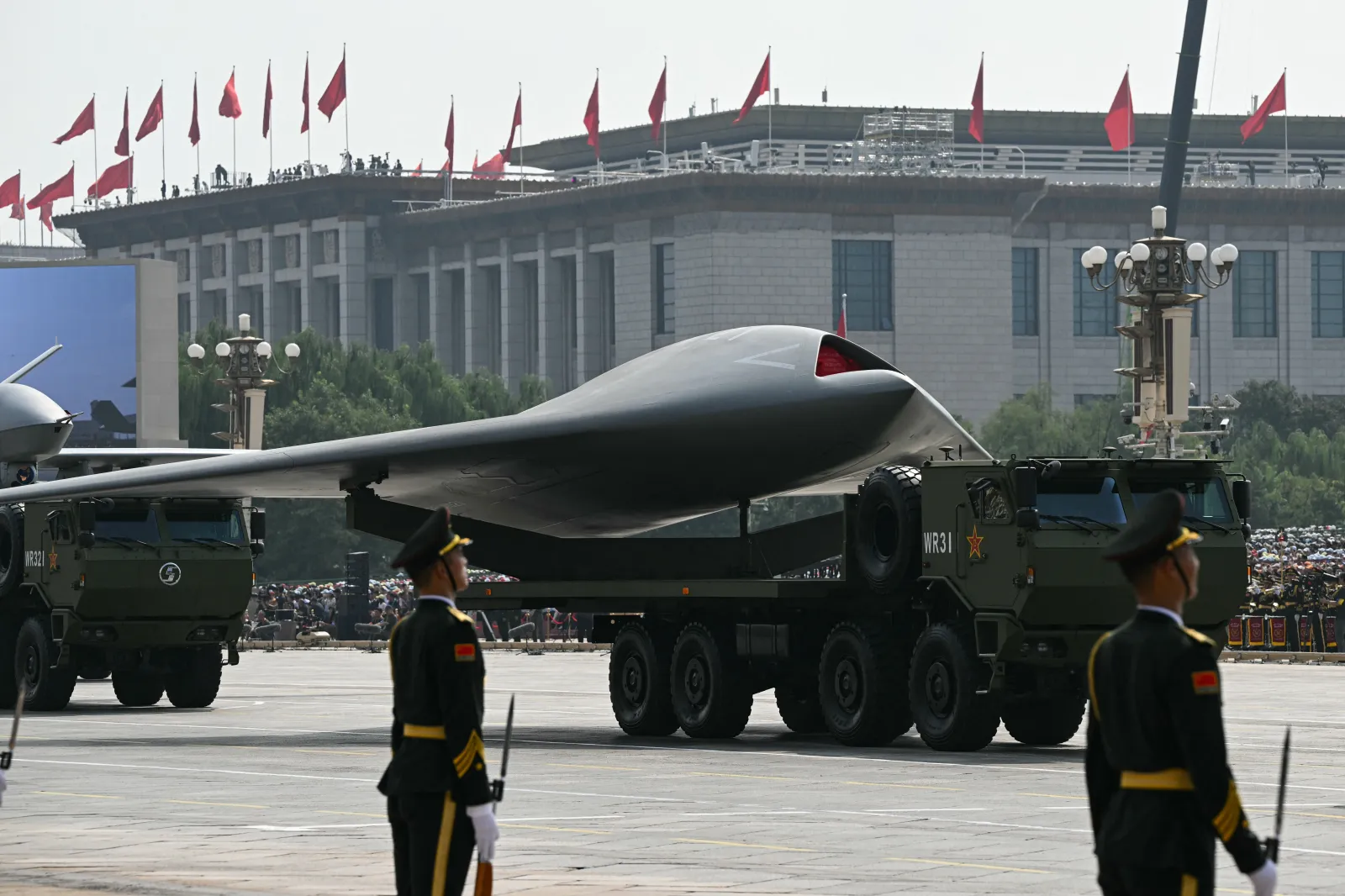
But even larger and more advanced drones, such as the WZ-7 Soaring Dragon, the GJ-11 Sharp Sword and its updated model being referred to as the GJ-21, appear to be suited for operating on carrier decks, such as that of the Type 076.
China has also begun developing unmanned platforms designed to carry drones. The Zhu Hai Yun, also developed by the China State Shipbuilding Corporation, is an oceanographic research vessel and though its purpose is scientific, its capacity to carry unmanned vessels has earned it the nickname as the world's first "drone mothership."
That same monicker has been applied to another unique unmanned craft being developed to wage drone warfare from above. The Ju Tian is a massive, long-range UAV carrier capable of deploying a swarm of up to hundred drones and a number of missiles dedicated to striking targets at land, air and sea.
Thus far, the U.S. has yet to invest substantially in dedicated drone carriers, much less unmanned ones, though the Pentagon has produced a range of unmanned platforms for use at sea such as the Global Autonomous Reconnaissance Craft (GARC) drone boat and at least one carrier-based UAV, the MQ-25 Stingray, which is dedicated for refueling purposes. The MQ-25, like other UAVs the U.S. deploys at sea, is designed to take off from traditional aircraft carriers, of which the U.S. boasts by far the world's largest fleet.
The Pentagon also commands a formidable line of amphibious assault ships, including the America class and Wasp class. With these ships, the U.S. Navy has opted for relatively smaller designs than the Type 076 that are focused first and foremost on sending helicopters, hovercraft, planes and personnel, specifically the Marines, into combat zones.
Here, Clark points to some key differences in the structures of the Chinese and U.S. militaries.
"Whereas in the Chinese military, the marine corps is part of the navy, in our military, it's part of the Department of Navy, but the Marine Corps has its own service chief. It's an independent member of the Joint Chiefs [of Staff]," Clark said. "It's got its own service, whereas in China, it is an integral part of the navy, so the marine corps head in the Chinese navy reports to the CNO [chief of naval operations]."
"So, here, I think one challenge is the Marine Corps doesn't want its ships to be used instead for drone operations, they want them to be used for Marines," Clark said. "The other challenge is the U.S. has not done a good job of scaling its drone development efforts to field enough drones that would be usable off of a ship like that."
Request Reprint & LicensingSubmit CorrectionView Editorial & AI Guidelines Add Newsweek as a preferred source on Google to see more of our trusted coverage when you search.
Recommended For You
 U.S.Half of Gen Z Wants Crypto For Christmas3 min read
 For MembersNewsUncommon Knowledge: Will Trump Accounts Pay Off?6 min read
 NewsIRS Issues Update on Trump Accounts3 min read
 NewsMalaysia Relaunches Hunt for Missing MH370 Flight: What To Know3 min read
 NewsTennessee Election Map Shows Huge Voter Shift From Trump to Democrats4 min read
 NewsExclusive: Democrat Targets Trump’s $175B Immigration Funds for Housing7 min read
Related Podcasts
Top Stories
 WorldRussia-Ukraine War Live: Putin Shares New Details on Trump Peace Plan2 min read
 WorldAmericans Are More Bullish Than Ever About US Military Power5 min read
 NewsPentagon Knew Survivors Remained Before Second Caribbean Boat Strike4 min read
 NewsDonald Trump Asserting Executive Privilege in January 6 Case: What We Know3 min read
 WorldMaduro Speaks Out After Rare Call With Trump3 min read
 NewsHuman Remains of Multiple People Found at California Home4 min read
Trending
 Winter weatherWinter Storm Warning As 17 Inches of Snow To Strike: ‘Extreme Caution’5 min read
 RepublicanRepublican Ousted by Democrat in Georgia3 min read
 Live BlogNATO Warns Putin: ‘We’re Not Going Anywhere’—Ukraine War2 min read
 WeatherWinter Weather Warning for Texas as Snow to Hit3 min read
 Donald TrumpDonald Trump’s Approval Rating Sees Major Shifts3 min read
Opinion
 OpinionPete Hegseth Is Not a ‘War Criminal’ | Opinion6 min read
 OpinionLebanon 2.0—Shepherding the Path to Peace | Opinion4 min read
 OpinionThe Cost of Detaining Immigrants Working Legally | Opinion5 min read
 OpinionProsecuting Congress for Stating the Law: An Impeachable Offense | Opinion4 min read
 For MembersOpinionConventional Wisdom: Trump Pardons Former Honduran President3 min read