 Image via New Line Cinema
 By
Marcel Ardivan
Published 25 minutes ago
Marcel is a writer who is passionate about most movies and series. He will watch anything that's good. He is a content manager by day and a videographer when needed. Marcel used to work at a major streaming service based in Asia Pacific as a Content Specialist and was the Distribution Manager for a local movie distribution company.
Sign in to your Collider account
follow
Follow
followed
Followed
Like
Like
Thread
Log in
Here is a fact-based summary of the story contents:
Try something different:
Show me the facts
Explain it like I’m 5
Give me a lighthearted recap
By
Marcel Ardivan
Published 25 minutes ago
Marcel is a writer who is passionate about most movies and series. He will watch anything that's good. He is a content manager by day and a videographer when needed. Marcel used to work at a major streaming service based in Asia Pacific as a Content Specialist and was the Distribution Manager for a local movie distribution company.
Sign in to your Collider account
follow
Follow
followed
Followed
Like
Like
Thread
Log in
Here is a fact-based summary of the story contents:
Try something different:
Show me the facts
Explain it like I’m 5
Give me a lighthearted recap
The most epic movies usually have grand battle scenes. They aren’t just about the spectacle, but they weave together storytelling, strategy, and characters into something unforgettable on screen. From war films to the fantasy genre, cinema has no shortage of jaw-dropping battles. These sequences often become the heart of their films, capturing the tension between survival and heroism. They’re the kind of moments that make us want to go to the theatres to experience them.
In this list, we’re highlighting the battle sequences that set the standard for movies. Each selection showcases a different facet of cinematic combat, from martial arts and urban firefights to historical wars. They’re meticulously crafted sequences that reflect the vision of their directors and leave an impact on cinema at large, showing how films can depict battles while also showcasing the human aspect of it all. In short, they are affecting, engaging, and outright irresistible for viewers.
10 ‘The Raid 2’ (2014)
 A young man wielding two sticks while covered in mudImage via Sony Pictures Classics
The prison riot sequence in The Raid 2 erupts when Rama (Iko Uwais), who's working undercover, finds himself caught between rival gangs as prisoners utilize makeshift weapons to defeat one another. The riot grows rapidly from fistfights to a full-blown battlefield as hundreds of inmates crash into guards and drag each other into the mud. The film follows Rama as he slips, dodges, and fights through bodies piling on top of each other.
The Raid: Redemption is often discussed as one of the best martial arts films ever made, and the sequel amps up the scale. This particular scene is a masterclass in action design. Director Gareth Evans shot the action with astonishing precision, making sure the viewer never feels lost despite chaos unfolding on screen. The muddy grounds are not just for aesthetics, as they also change how the fights are choreographed. The camera work, which often glides through the smallest of gaps, gives the sequence a visceral intimacy that puts the audience right in the middle of the action. It's a sequence that inspired other action set pieces like the one in Extraction 2.
9 ‘Red Cliff’ (2008)
 Image via Magnet Releasing
John Woo returned to his home country with an epic two-parter, Red Cliff, based on the story of the Battle of Three Kingdoms. There is a battle sequence in the first part in which the massive allied army led by Zhou Yu (Tony Leung) withstands an attack from Cao Cao's (Zhang Fengyi) army. Designed by master tactician Zhuge Liang (Takeshi Kaneshiro), the allied army successfully muffled the attack through the Bagua Formation, or the turtle shell formation, which lured their enemies into a vulnerable position.
This battle stands out because it merges the elegance of classic wuxia with large-scale military choreography. The turtle formation itself becomes a character as it shifts and expands with fluid precision. John Woo stages the entire scene as a calm, calculated trap springing into full motion, turning a chaotic battle into a controlled display of tactical mastery, highlighting the clarity and rhythm of the strategy to let the audience appreciate the strategy. With an epic setup and a whole lot of extras, Red Cliff is one of the most exciting epic films of all time. The American release condensed the film into 2.5 hours, so check out the complete version to witness this marvel.
8 ‘All Quiet on the Western Front’ (2022)
 Soldiers charging into battle during All Quiet on the Western Front (2022)Image via Netflix
In the latest adaptation of All Quiet on the Western Front, one of the film’s most gripping battle sequences shows Paul (Felix Kammerer) and his fellow German soldiers thrown into the center of trench warfare. The scene begins with an eerie calm before artillery suddenly rains down, obliterating trenches and throwing bodies into the air. Tanks roll over the battlefield, crushing barricades and forcing soldiers to retreat. Paul fights desperately in hand-to-hand combat, gas clouds drift across the torn landscape, and waves of enemy troops push forward.
This battle is powerful because it strips away any notion of glory and exposes the industrial, dehumanizing brutality of war, which is true to the book's message. It emphasizes exhaustion and chaos with soldiers slipping, scrambling, and clawing through mud while the camera stays tight, immersing the viewers in the horror. The production design, from cratered fields to blood-soaked trenches, reinforces the senseless destruction of modern mechanized warfare. The scene’s impact lies in its honesty to depict war on this scale as horror, not heroism, standing among the most devastating and authentically grim depictions ever filmed.
7 ‘Black Hawk Down’ (2001)
 Two Rangers face down a machine gun emplacementImage via Sony Pictures Releasing
Black Hawk Down recreates the 1993 Mogadishu raid that spirals out of control when two U.S. Black Hawk helicopters are shot down in hostile territory. The targeted operation, which was supposed to be a fast one, quickly becomes a desperate citywide rescue mission as American soldiers find themselves pinned down by overwhelming Somali militia forces. Streets turn into a maze of gunfire, rooftops become sniper nests, and convoys struggle through narrow corridors while RPGs and bullets tear through vehicles.
While the film is one long, big battle sequence, the scene where the helicopters are shot down and immediately swarmed is deeply intense. The battles are praised for their gritty realism, relentless pacing, and ground-level immersion, with Sir Ridley Scott shooting the action with a documentary-like perspective. The choreography feels authentically messy, emphasizing confusion and miscommunication rather than the usual clean Hollywood approach. The impact was immediate: Black Hawk Down redefined modern combat sequences and influenced a generation of war movies, games, and TV shows with its relentless portrayal of urban firefights.
6 ‘13 Assassins’ (2010)
.jpg?q=49&fit=crop&w=825&dpr=2) Image via Toho
Image via Toho
The climax of 13 Assassins erupts when a group of samurai led by Shimada (Koji Yakusho) springs their trap on Lord Naritsugu’s (Goro Inagaki) massive escort. They lure the enemy into a booby-trapped village filled with exploding barriers and hidden blades to level the balance. The orderly ambush devolves into a sprawling battle that rages through streets, alleyways, and burning houses. Amid the chaos, each warrior gets their moment, showcasing their heroism and their skills.
This 45-minute finale is one of the greatest modern battle sequences for its sheer ambition and practical execution. Director Takeshi Miike choreographs the action with raw ferocity, never losing spatial clarity despite dozens of simultaneous fights. The production design turns the village into a living battlefield full of traps and environmental hazards that give the choreography texture and unpredictability. The impact was massive: 13 Assassins revitalized interest in samurai epics, particularly in America, where it won several critics' awards. This long, satisfying sequence is a demonstration of craftsmanship and controlled chaos executed at the highest level.
5 'Gladiator’ (2000)
 Image via DreamWorks Distribution
Gladiator opens with the Battle of Germania, where the Roman army faces off against a fierce Germanic tribe in a snowy forest. Maximus (Russell Crowe) commands his troops with discipline as catapults hurl flaming projectiles and cavalry divisions sweep through the enemy lines. The Romans advance in tight formations, while their opponents rush forward with primal fury. Maximus cuts through the battlefield with calm precision, while bodies collide in the dense woods.
Again directed by Ridley Scott, this scene remains iconic because of its blend of gritty realism and epic spectacle. Scott choreographs the battle with a strong sense of geography, using the forest to create claustrophobic pockets of violence. He also highlights the tactical maneuvers while showing important character work that sets the tone for the rest of the film. This battle sequence set a new standard for large-scale ancient warfare on screen. Its balance of cinematic beauty and raw brutality made it instantly memorable and hugely influential.
4 ‘Lawrence of Arabia’ (1962)
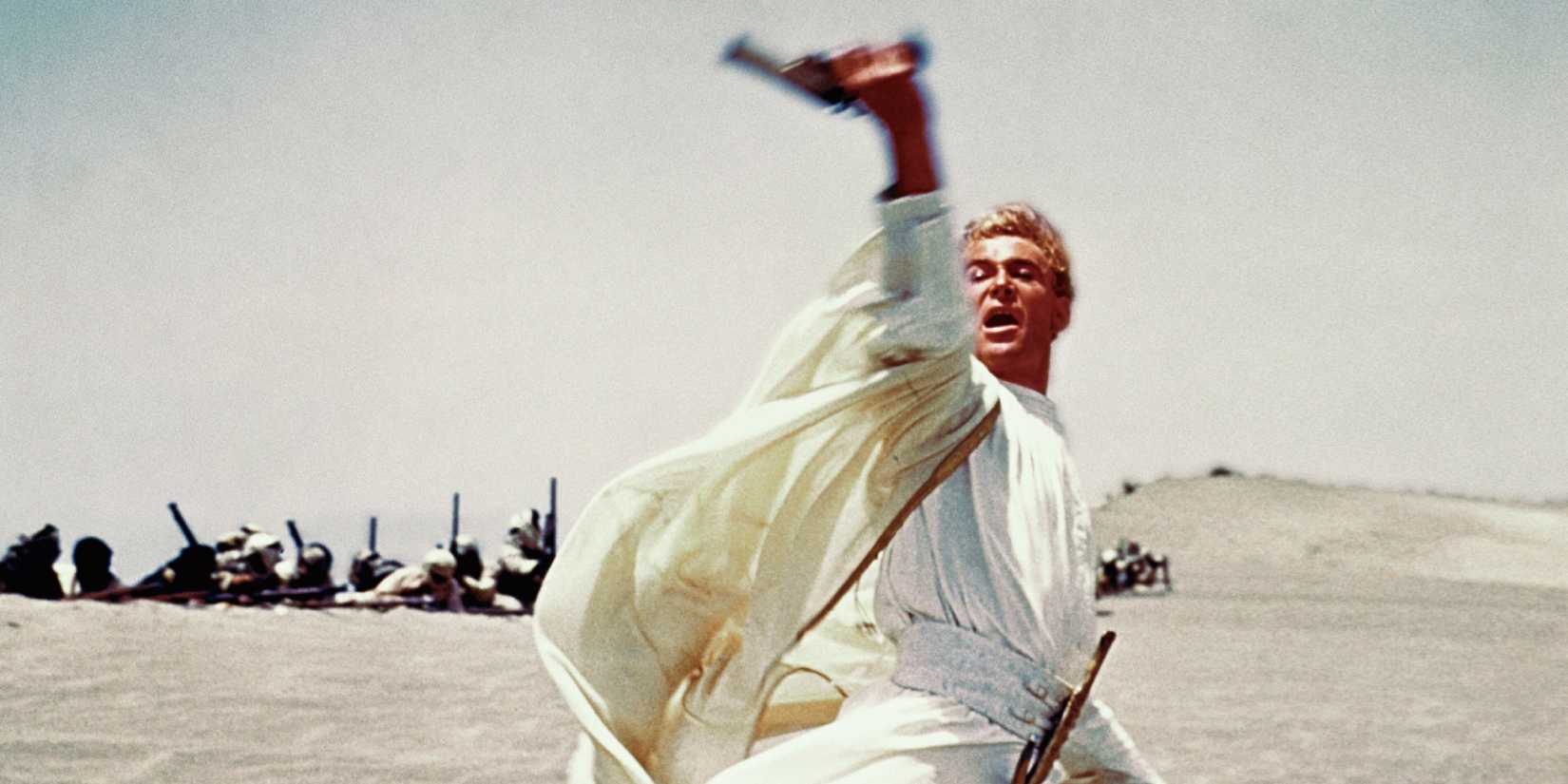 T.S. Lawrence (Peter O'Toole) waving a gun in the desert from Lawrence of ArabiaImage via Columbia Pictures
The Attack on Aqaba sequence in Lawrence of Arabia unfolds as a daring desert maneuver in which T.E. Lawrence (Peter O'Toole) leads Arab fighters across the impossible, scorching sands to attack Aqaba from behind, which is the only approach the Turks believed was impenetrable. After the brutal desert crossing, the assault begins with a chaotic charge as Lawrence’s forces descend on the city from the land side, rendering the big, sea-facing cannons useless.
What makes the Aqaba sequence so celebrated is David Lean’s mastery of scale and visual storytelling. The battle unfolds in long, confident shots, allowing the viewer to take in the landscape, the movement of the horses, and the shifting tactical momentum. The staging favors clarity and geography over chaos, showing the elegance of battle and also a narrative payoff to Lawrence’s near-mythic ambition. A must-see whenever it plays in the cinemas, Lawrence of Arabia has no shortage of epic sequences, but this one might be the most memorable and satisfying.
3 ‘Ran’ (1985)
 Ran - 1985Image via Toho
Based on King Lear, Akira Kurosawa's Ran features one of the best battle sequences ever to be put on screen. The castle attack in the film begins with uncomfortable silence as armies surround Hidetora’s (Tatsuya Nakadai) fortress. Suddenly, drums and horns erupt, and archers unleash volleys that rain down on the defenders. Flames roar through the castle as enemy troops breach the gates and slaughter everyone in sight, leaving the old lord wandering in shock. The scene is both grand and tragic, capturing the fall of a ruler.
Kurosawa stages the battle with minimal dialogue, letting the visuals speak with painted banners whipping in the wind, burning corridors collapsing, and soldiers cutting through opponents with ruthless efficiency. What makes this battle exceptional is Kurosawa’s painterly control over composition, color, and pacing. He treats violence like a tragic opera, using wide shots that frame soldiers as tiny figures swallowed by flames and chaos. Many have said Ran is Kurosawa's crowning achievement, with its ambitious scope and gorgeous visuals, and this scene alone solidifies it.
2 ‘Saving Private Ryan’ (1998)
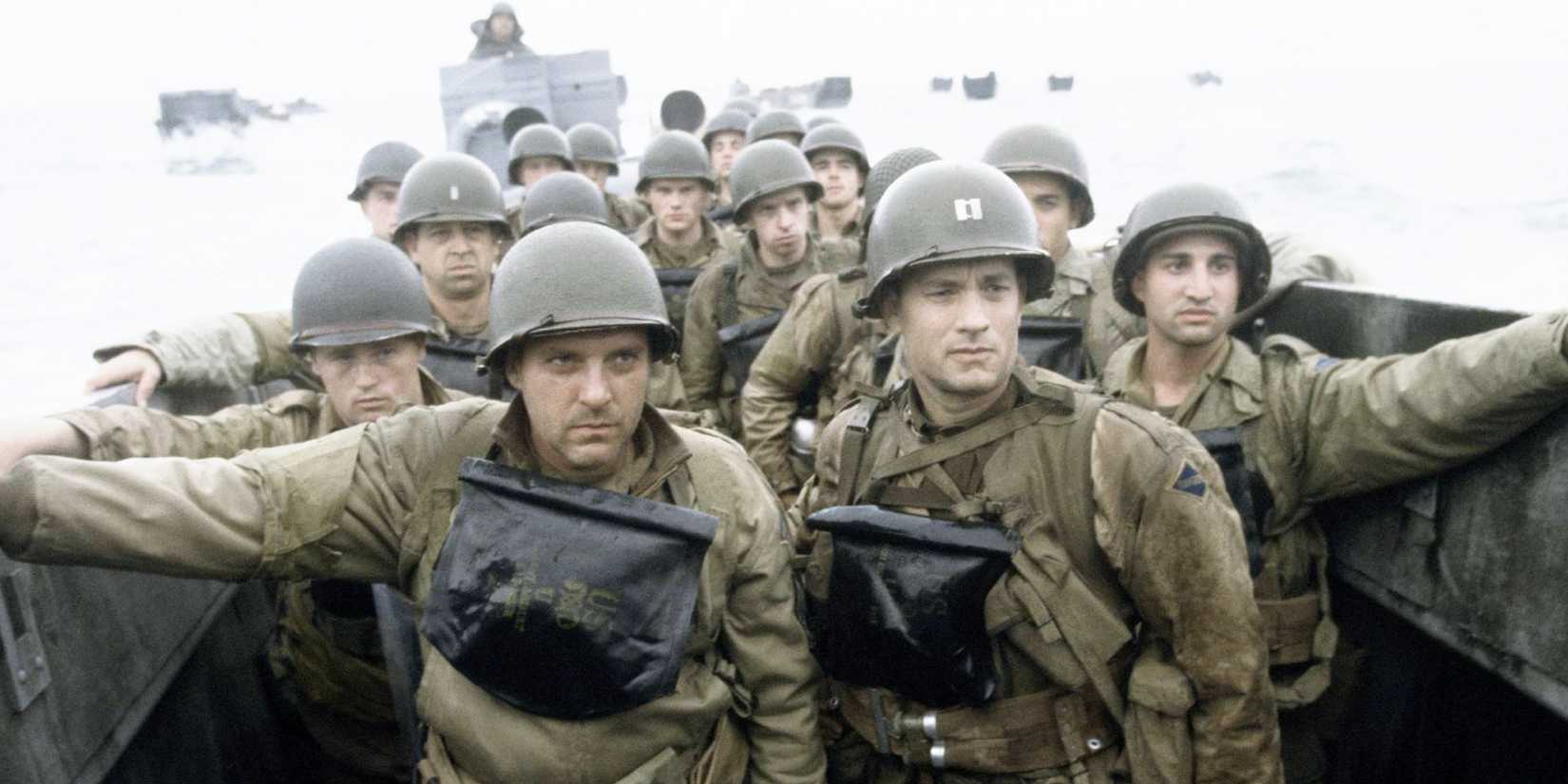 Soldiers in the lead-up to the Normandy invasion during World War II in Saving Private Ryan (1998)Image via DreamWorks Pictures
Saving Private Ryan famously opens with a visceral D-Day landing sequence. As the soldiers land on Omaha Beach, chaos erupts; bullets rip through men instantly, explosions churn the water, and bodies fall before even reaching the sand. A group of soldiers who survive, led by Captain John Miller (Tom Hanks), scramble onto the beach, using metal obstacles and dead comrades as cover while trying to break through the German fortifications.
This sequence is legendary because Steven Spielberg aimed for authenticity over spectacle. Many veterans and historians praised the sequence for its accuracy. The 10-minute scene captured the brutality of the D-Day landing, reshaping the entire war genre in the process. The handheld cameras, washed-out colors, stuttering shutter speed, and deafening sound design create an immersive sense of terror and confusion. Spielberg drags the audience through mud and blood as the troops fight inch by inch, a harrowing experience that feels raw, disorienting, and overwhelmingly human.
1 ‘The Lord of the Rings: The Two Towers’ (2002)
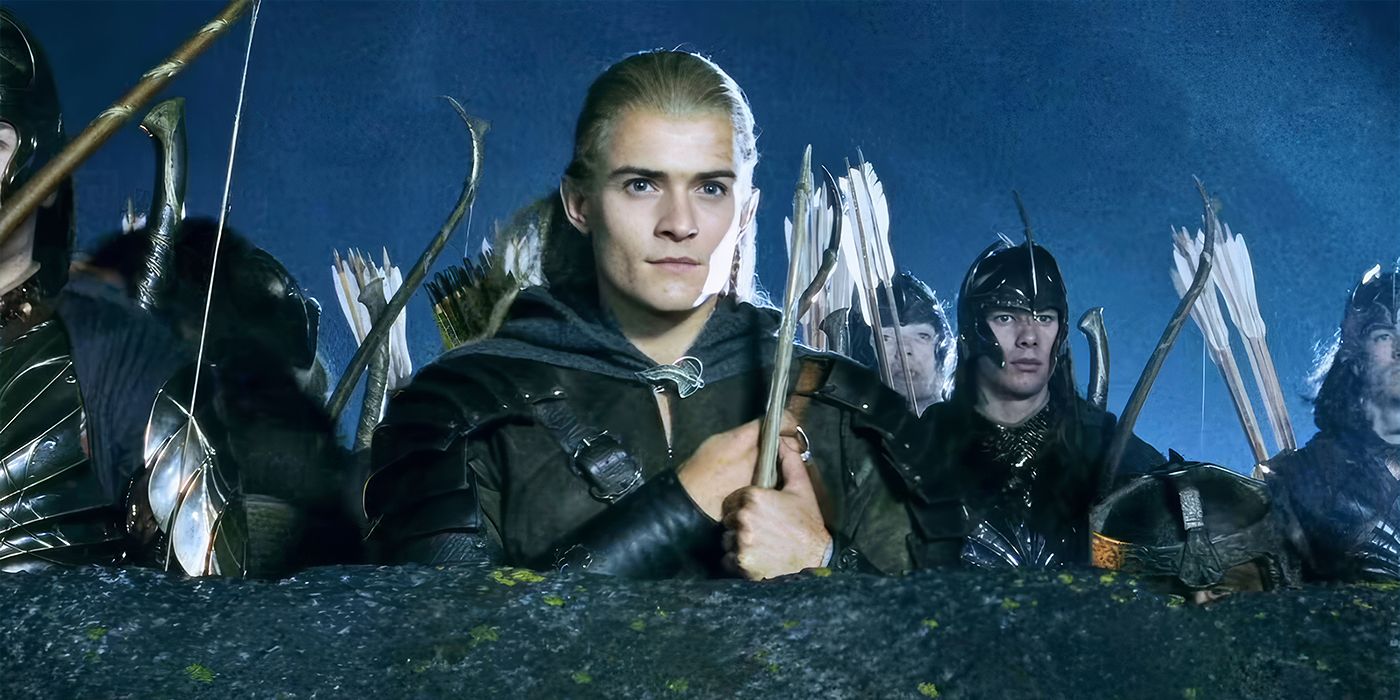
 Gandalf's reinforcements arrive and flank the orcs from behind in Lord of the Rings: The Two TowersImage via Warner Bros.
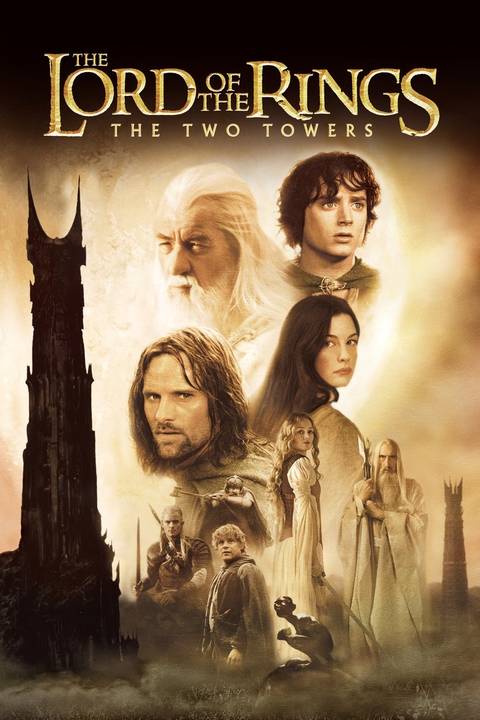
A large portion of The Lord of the Rings: The Two Towers is dedicated to The Battle of Helm’s Deep, where the people of Rohan defend their fortress against a vast Uruk-hai army. The standoff quickly erupts into all-out war as the rain pours and the enemy lines charge without fear. The defenders desperately hold the walls, only to watch the Uruk-hai breach their defenses. As the battle reaches its lowest point, Aragorn (Viggo Mortensen) and Theoden (Bernard Hill) lead a last stand before Gandalf (Ian McKellen) arrives at dawn with the Riders of Rohan.
Helm’s Deep stands as arguably cinema’s greatest battle because every decision builds real tension and stakes. Sir Peter Jackson blends practical sets, massive extras, and groundbreaking CGI to create a tactile sense of scale. The choreography is clean yet frantic, capturing the exhaustion of the heroes and the brute force of the Uruk-hai. Many of the pivotal characters, including Orlando Bloom's Legolas and John Rhys Davies' Gimli, are given moments to shine. Its night-rain aesthetic and tactical strategies make it not just visually spectacular but resonant with audiences.
 The Lord of the Rings: The Two Towers
PG-13
Adventure
Fantasy
Action
Release Date
December 18, 2002
Cast
Elijah Wood, Ian McKellen, Viggo Mortensen, Sean Astin, Andy Serkis, John Rhys-Davies, Orlando Bloom, Bernard Hill, Miranda Otto, Dominic Monaghan, Billy Boyd, Christopher Lee, Cate Blanchett, Liv Tyler, Hugo Weaving, David Wenham, Brad Dourif, Karl Urban, Craig Parker, Bruce Allpress, John Bach, Sala Baker, Jed Brophy, Sam Comery, Calum Gittins
Runtime
179 minutes
Director
Peter Jackson
Writers
Fran Walsh, Philippa Boyens, Peter Jackson, Stephen Sinclair, J.R.R. Tolkien
Genres
Adventure, Fantasy, Action
Powered by
The Lord of the Rings: The Two Towers
PG-13
Adventure
Fantasy
Action
Release Date
December 18, 2002
Cast
Elijah Wood, Ian McKellen, Viggo Mortensen, Sean Astin, Andy Serkis, John Rhys-Davies, Orlando Bloom, Bernard Hill, Miranda Otto, Dominic Monaghan, Billy Boyd, Christopher Lee, Cate Blanchett, Liv Tyler, Hugo Weaving, David Wenham, Brad Dourif, Karl Urban, Craig Parker, Bruce Allpress, John Bach, Sala Baker, Jed Brophy, Sam Comery, Calum Gittins
Runtime
179 minutes
Director
Peter Jackson
Writers
Fran Walsh, Philippa Boyens, Peter Jackson, Stephen Sinclair, J.R.R. Tolkien
Genres
Adventure, Fantasy, Action
Powered by
 Expand
Collapse
Expand
Collapse
-
 Movie
Movie
-
 The Lord of the Rings: The Two Towers
-
 Saving Private Ryan
We want to hear from you! Share your opinions in the thread below and remember to keep it respectful.
Be the first to post Images Attachment(s) Please respect our community guidelines. No links, inappropriate language, or spam.Your comment has not been saved
Send confirmation emailThis thread is open for discussion.
Be the first to post your thoughts.
- Terms
- Privacy
- Feedback
 Nov 8, 2025
The Best Action Scene of Every Year of the 21st Century So Far
 5 days ago
The 10 Greatest Movie Trilogies of the Last 100 Years, Ranked
 4 days ago
The 10 Greatest Dystopian Action Movies, Ranked
 2 days ago
7 Stephen King Books That Are 10/10, No Notes
More from our brands

Best New Movies To Watch On Streaming Right Now

The 15 Best War Movies Based on True Stories
The 40 Best Action Adventure Movies
27 Best War Movies on Max to Watch Right Now

The 55 Best Movies of All Time, Ranked

The 15 Best Action Movies of the Century So Far

15 Movies With Better Battles Than The Lord Of The Rings
What To Watch
 July 20, 2025
The 72 Best Movies on Netflix Right Now
Trending Now
July 20, 2025
The 72 Best Movies on Netflix Right Now
Trending Now
 'Good Boy's Ending Is Modeled After the Most Famous Stephen King Adaptation
 This ‘Game of Thrones’ Star’s Dark Medieval Series Doubles as the Perfect Gritty Historical Binge
 The Greatest Martial Arts Movie From Every Year of the 1990s