“I think sometimes of that black and white historic photograph of 100 people giving a Nazi salute, except one person,” the artist told Hyperallergic. “I think that’s me.”
 Yashica Dutt
December 3, 2025
— 8 min read
Yashica Dutt
December 3, 2025
— 8 min read
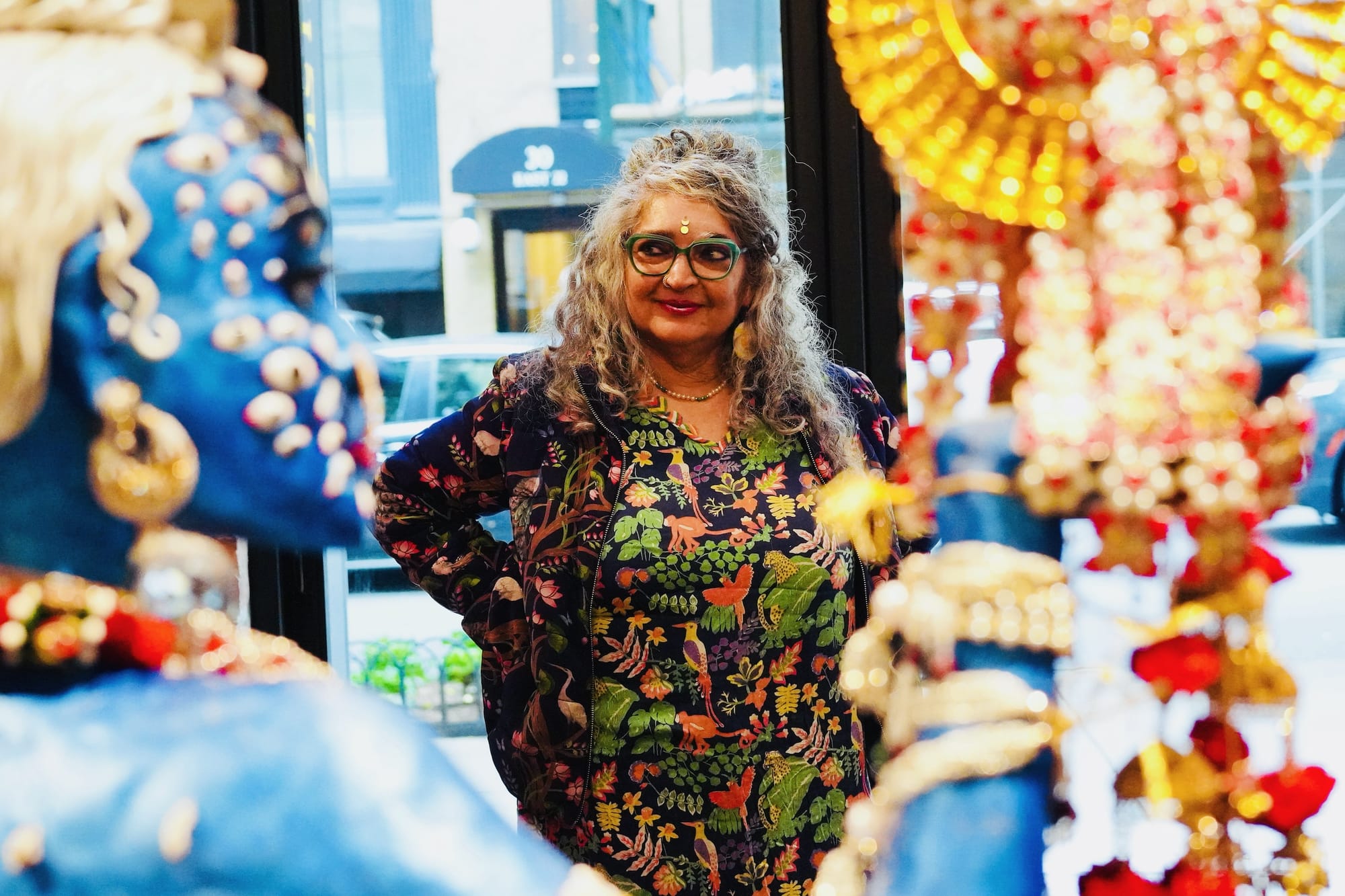
 Pyaari Azaadi giving a tour of her exhibition Talkin' Bout a Revolution at Pen and Brush in October (photo by Abeer Y. Hoque, courtesy the artist)
On walking through the doors of Talkin’ Bout a Revolution at Chelsea’s Pen and Brush, it is impossible not to marvel at the sheer volume of work that stretches across the gallery’s two floors. For her mid-career survey on view through February 14, 2026, South Asian artist Pyaari Azaadi (formerly known as Jaishri Abichandani) produced over 200 pieces, which include wall-sized multimedia paintings, sculptures that range between life-sized and miniature, photographs of Desi queer nightlife from 1990s New York City, and performance art video installations. But perhaps most striking is that Azaadi’s art is a testament to the relationships she has cultivated within the South Asian diaspora over her decades of practice as an artist, activist, and community organizer.
In the exhibition, Azaadi lays bare her tender yet tendentious relationship with her mother, whom she has previously described as someone “who could only see me as an extension of her own very shameful self.” At the gallery entrance, a five-foot-tall (~1.2-meter-tall) sculpture of her mother as a blue-skinned goddess shows her holding a severed head that is meant to be the artist’s own. Another painting that covers an entire wall renders three generations of women in Azaadi’s family sticking out blackened tongues, highlighting the intergenerational nature of trauma that is passed through words, particularly in South Asian family dynamics.
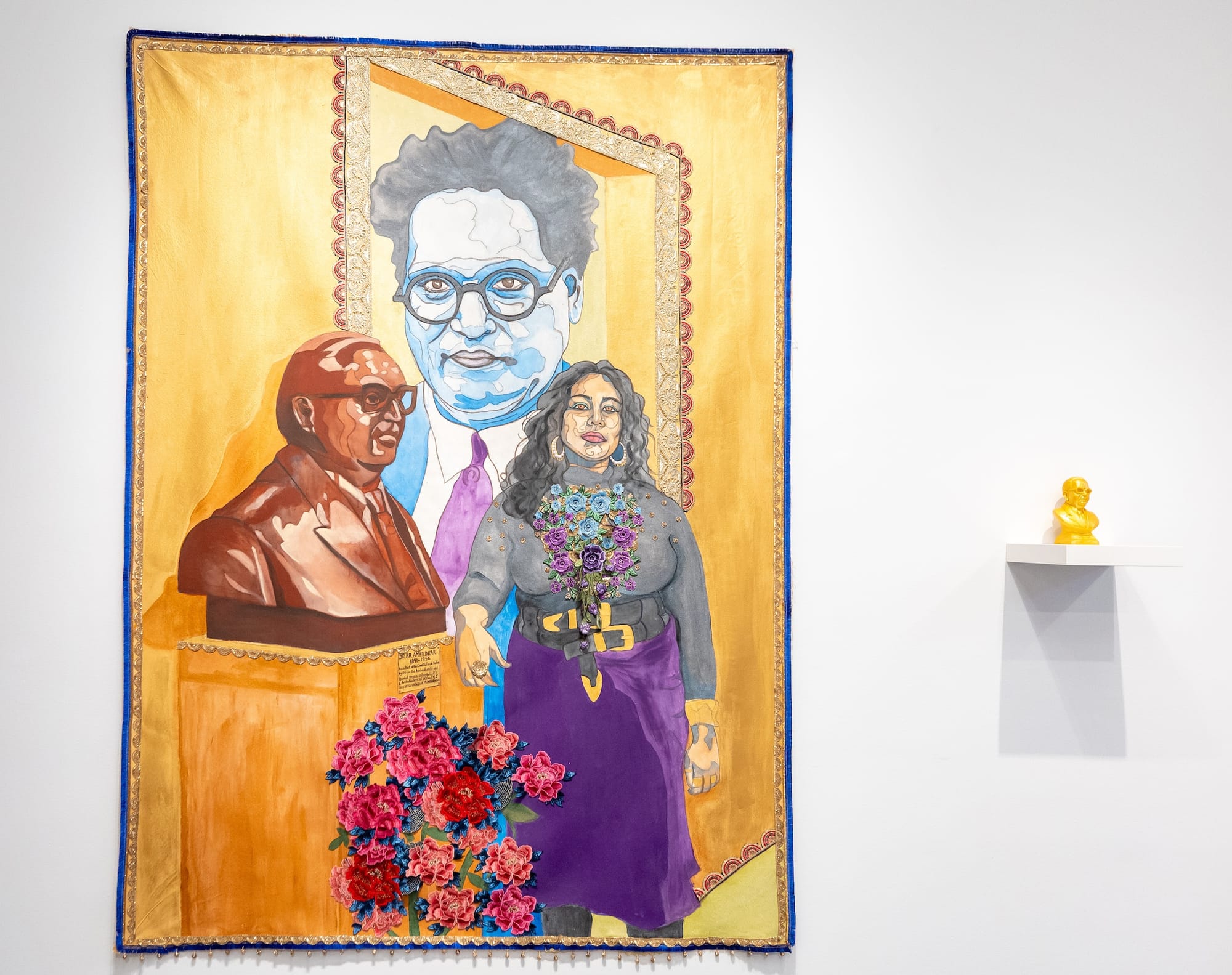 Pyaari Azaadi, "Yashica Dutt in the Age of Ambedkar" (2023), acrylic paint and fabric trims on canvas, beside a small bust of Ambedkar (image courtesy the artist and Pen and Brush)
But beyond personal relationships, Talkin’ Bout a Revolution also reads like a love note to the labor of artists, writers, activists, and organizers in Azaadi’s expansive orbit. Paintings and photographs tease out their work and offer commentary on the complicated nuances of a community that continues to struggle with visibility for those at the margins of caste, class, and belonging — subjects that Azaadi has never been afraid to tackle, even if it meant less mainstream and market-oriented opportunities. One is the wall-sized painting in which Azaadi shows me standing next to a bust of Dalit civil rights icon Dr. B.R. Ambedkar, as a younger version of him at around my age looks over us.
Hyperallergic has followed and covered Azaadi’s work for some time, including Editor-at-Large Hrag Vartanian’s recent essay about her quest for justice and acceptance in the aftermath of sexual assault by an established Indian artist early in her career. I recently sat down with Azaadi for a conversation about her inherently political practice, the repercussions of calling out the violence she experienced, and her relationship with Hinduism, which emerges as a major theme in her exhibition. The interview has been edited for length and clarity.
Hyperallergic: Everyone at the opening of your exhibition, which I attended, talked about how prolific you are. What has your career trajectory been like so far?
Pyaari Azaadi: I moved to America as a teenager, and we left behind everything, save for a few photographs. And photography was the initial way in which I could regain and create memories, document my family, the community, and archive everything. It was also a filter, literally between me and the world, because [I had] this feeling of always feeling like an outsider, even when you’re in the middle of your own community. My first exhibition was in Toronto at Desh Pradesh, which was a South Asian Festival for arts, culture, and politics.
H: This was the ’90s?
P: Yes. I started the South Asian Women’s Creative Collective (SAWCC) in 1997. And by then, I had already experienced the rapes by a prominent Indian-origin artist. So, it was really crucial to start a space that was safe, where other South Asian women artists weren’t being preyed upon. Later, as the Queens Museum’s first director of public events, I was really torn that I was creating a lot of space for my peers, and unable as an artist to access those spaces myself. So, I made the difficult decision of leaving the Queens Museum and have kind of struggled since to be seen as an artist.
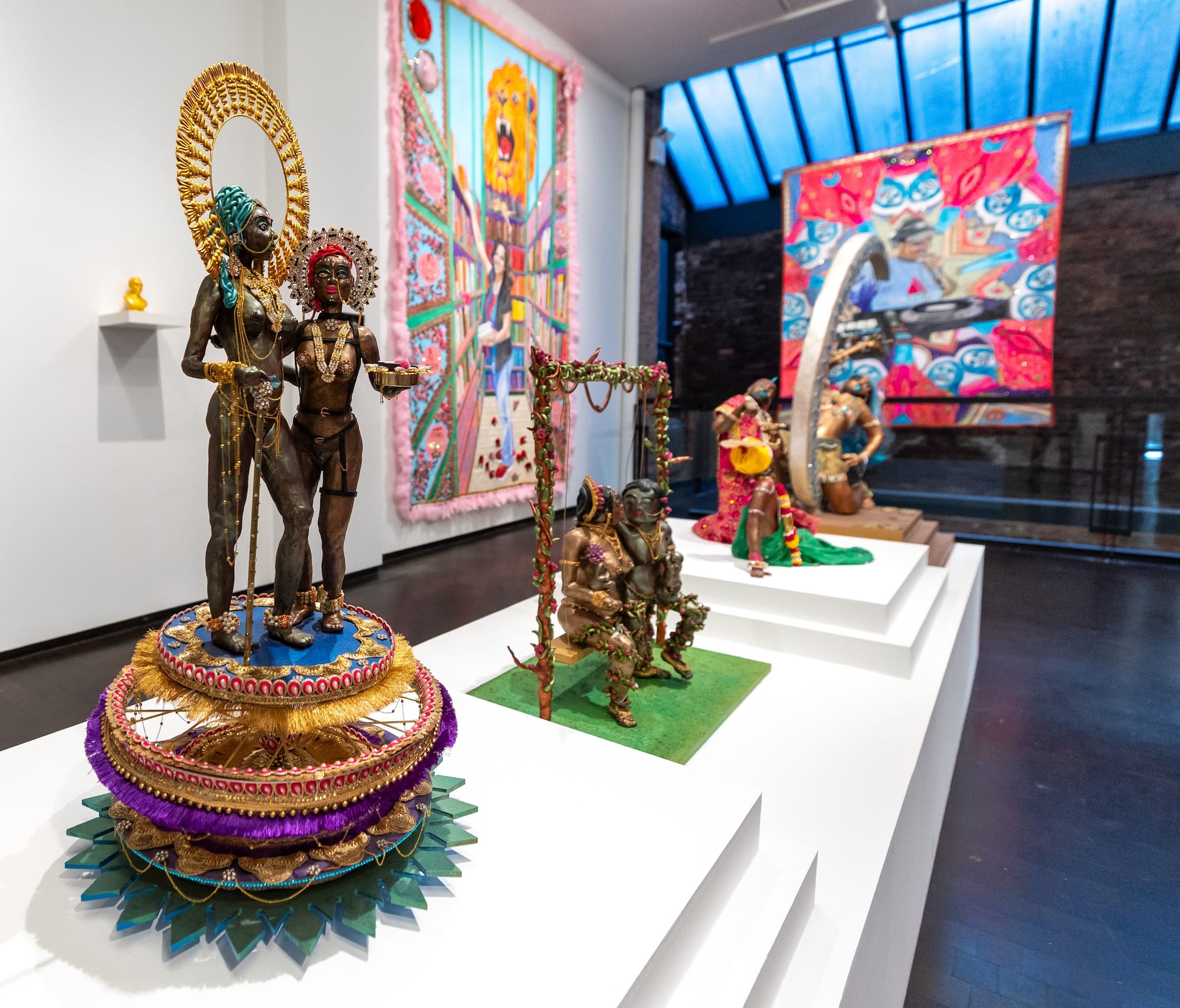 Installation view of Talkin' Bout a Revolution (image courtesy the artist and Pen and Brush)
H: You mentioned the assault you experienced as a young woman. Can you share what kind of impact that has had on your life?
PA: I had met him in the ’90s. He was 28 years older than me. I was traveling as his assistant, and those were basically three weeks in Kerala, where I was completely isolated. I was being sexually violated, so I tried to get through it without being killed.
And I remember writing in my diary that if genius meant being so unkind to people that I would really rather not be a genius. And it took from then to 2017 to understand what had happened to me as sexual assault. [It was] only then that I made the links between me and Weinstein’s survivors, because I had just held myself responsible the entire time.
H: I just want to really thank you for your vulnerability. And I want to speak a little bit about what it means to be a South Asian woman artist, somebody who has not been afraid to use her voice, who challenges people when they need to be challenged.
PA: I think sometimes of that black and white historic photograph of 100 people giving a Nazi salute, except one person. I think that’s me. Yes, I am extremely critical of not just American society, but also our diasporic community, and its penchant for White-adjacent capitalist success, and that has cost me a lot throughout my career.
There are a lot of very successful South Asian artists who are absolutely okay with the capitalist model, and the work they’re creating is for White people, because this is the context they’re in. And I dedicated my entire show to our community. I see how moved people are, and I can see the popular response to it. But at the same time, I’m also seeing the lack of coverage and sales, because it is very difficult to exist as a South Asian feminist killjoy in this hyper-capitalist society.
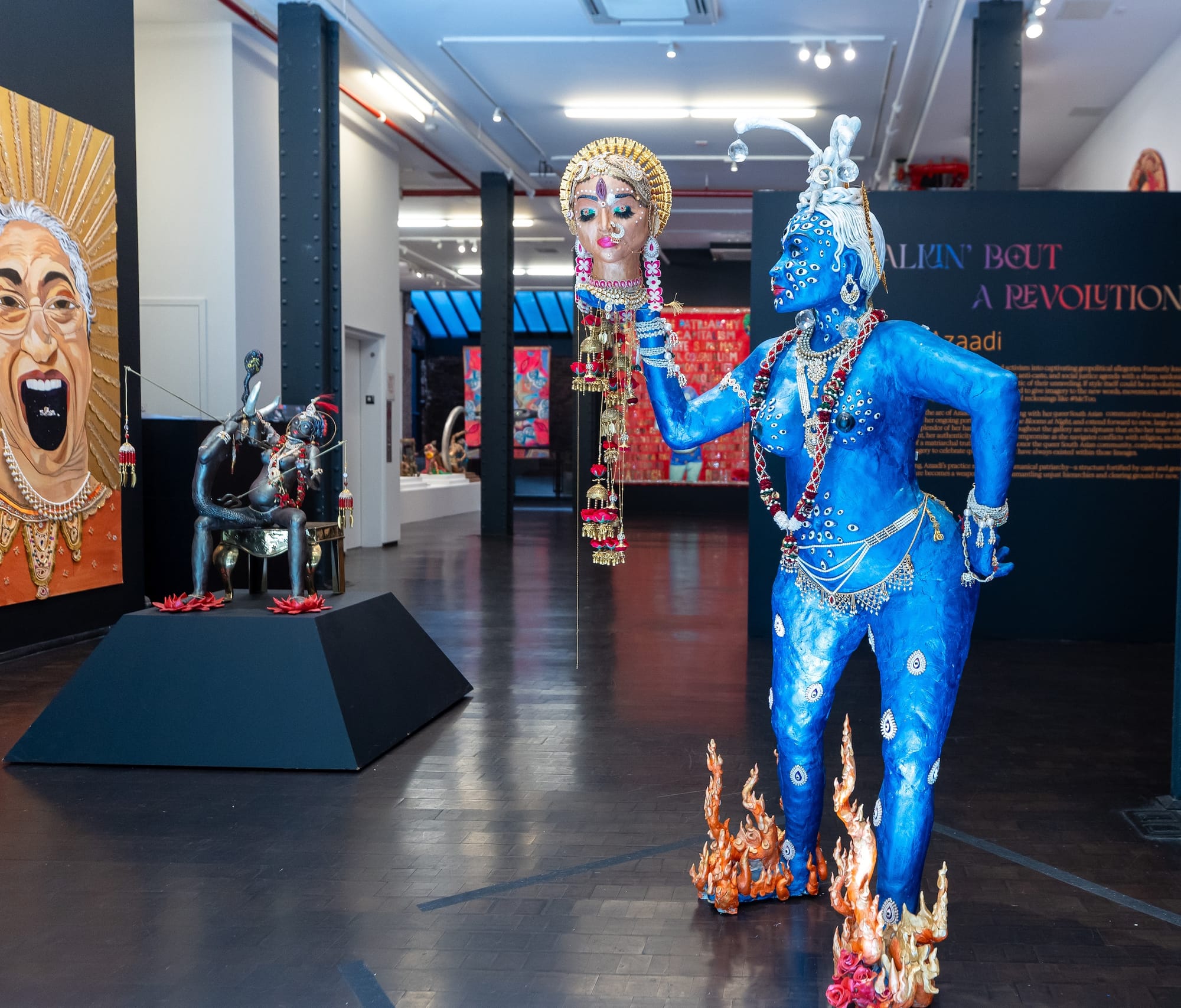 Pyaari Azaadi, "Myself, Daughter of Indira, Granddaughter of Ganga" (2021) (image courtesy the artist and Pen and Brush)
H: How much of your art is what you want to make, versus one that will be commercially viable? How do you strike that balance in your exhibition?
PA: It’s kind of humiliating to be 56 and selling things for a couple of hundred bucks. But then I realized that most artists have to rely on that model of having a small, affordable series of work that brings in the money in order for you to make the things that are really big and ambitious that you know need to create, whether someone's buying them or not.
H: One of the things that stuck out to me personally is that in your exhibition, you center Dalit voices. There are at least six or seven pieces based on Dalit women, including myself. Why is that important for you?
PA: How can I, as a woman of color, acknowledge my debt to Black feminists and the color privilege with which I exist, but then not acknowledge my caste privilege? Why would I want to participate in a system of oppression when I’m dedicated to equality?
H: Much of the work in your show depicts or references Hindu iconography. How do you synthesize that?
PA: It’s a language like any other. It’s an aesthetic language that is actually more my mother tongue. So why would I speak in any other tongue? Why not use that very tongue to critique it? I ran into a Brahmin woman two weeks ago who said, “Oh, I really love how you’re reclaiming it.” And I was like, “I’m not reclaiming it. I’m messing with it.” There's no part of me that needs to reclaim it.
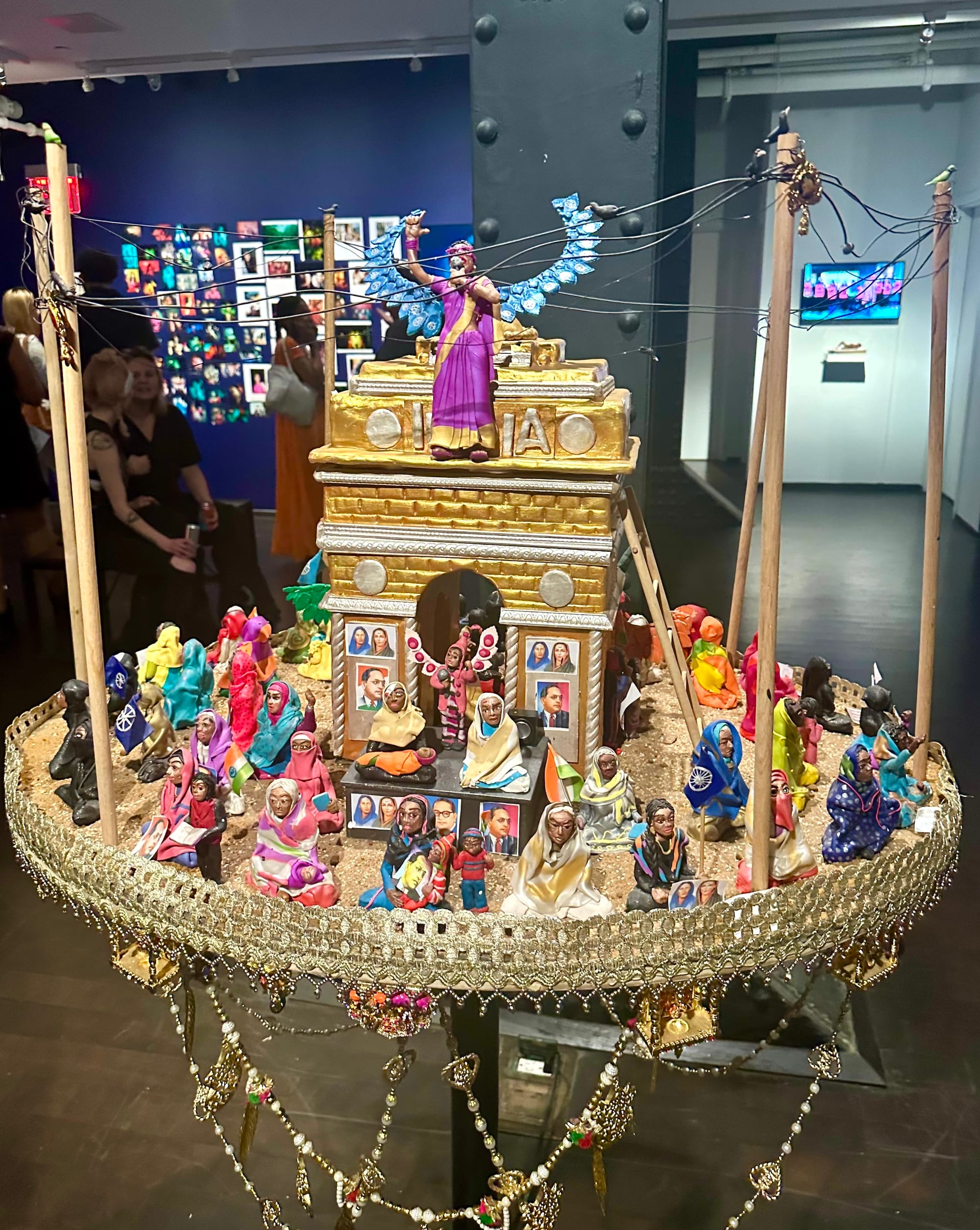 Pyaari Azaadi, "Azaadi" (2025), featuring polymer clay models of trans activist Grace Banu atop India Gate and of the women who participated in a 101-day-long sit-in at Shaheen Bagh in protest of the Citizenship Amendment Act from 2019 to 2020 (photo Lakshmi Rivera Amin/Hyperallergic)
H: Last year, you changed your name from Jaishri Abichandani. Now you go by Pyaari Azaadi. Tell me about that decision.
PA: There are these Hindu fundamentalist goons that go around India shouting “Jai Shri Ram, Jai Krishna” as they're killing and pillaging Muslim and Dalit people. And it was just really painful to hear my name every time this kind of violence was being enacted. There's this little sculpture in the show of Shaheen Bagh [protest site in New Delhi, India], and there's a little girl in the sculpture, and you can hear her voice, and she’s saying, “Bacche mange? Azaadi. Boodhey mange? Azadi. Pyaari pyaari azaadi” (“What do kids want? Freedom. What do elders want? Freedom. Sweet, sweet freedom”).
H: I want to end with the question about New York City’s mayor-elect, Zohran Mamdani. Do you think things will change for South Asian art spaces with a South Asian mayor in City Hall?
PA: It definitely will for those who play the market game. It definitely will for those who already have the access.
H: Does that mean anything to you personally?
PA: It means the world. But because he is the young man who fasted with taxi drivers for two weeks, not because he went to very elite private institutions and comes from a lot of cultural capital and access. Because he chose, even with all of that access, to stand with those South Asian New Yorkers who are the most marginalized.
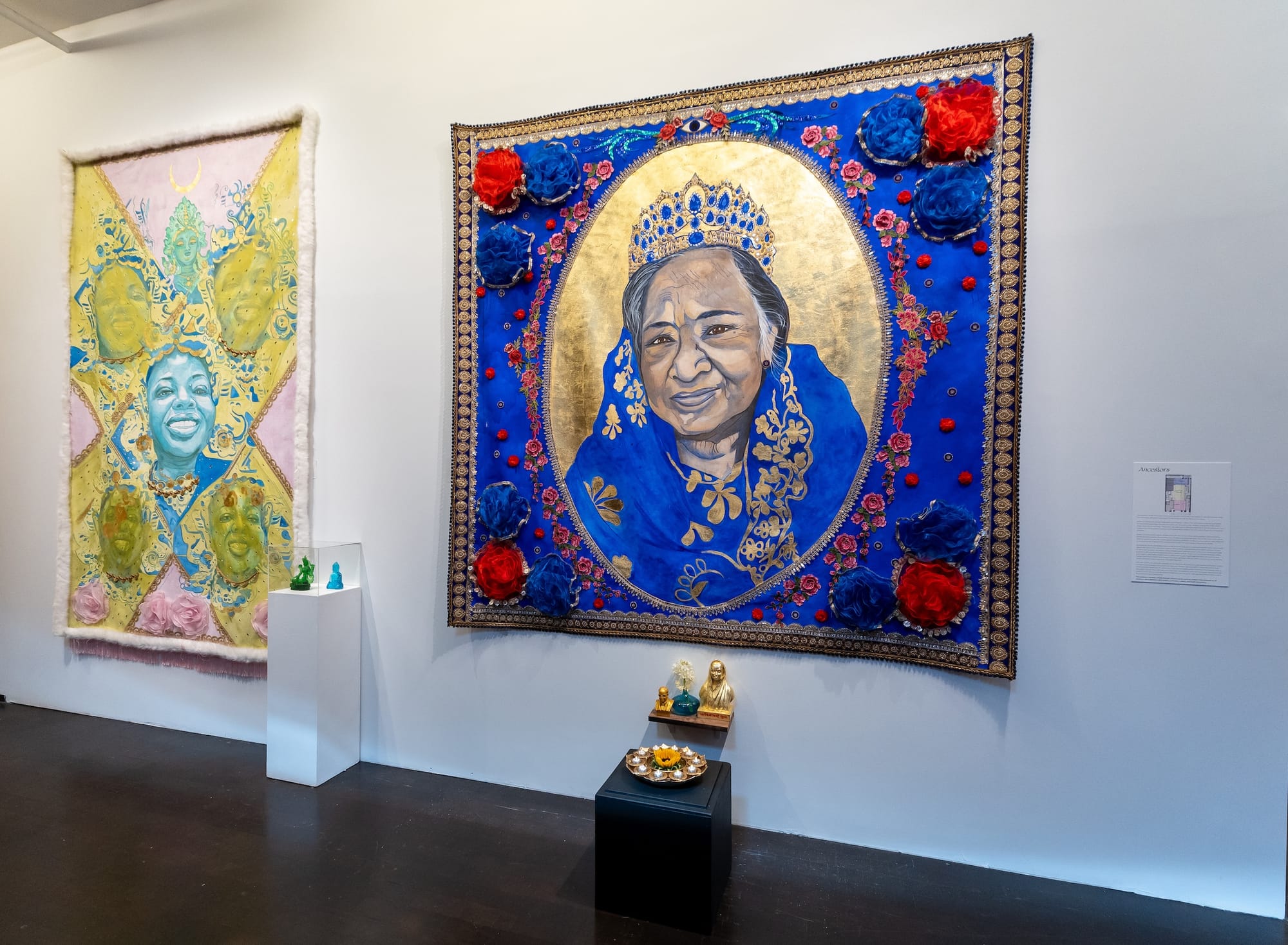 One section titled "Ancestors" features large-scale works honoring late artist Nona Faustine (left) and late doctor and Dalit activist Thilakavathy Soundararajan (right), mother of Equality Labs Founder Thenmozhi Soundararajan. (image courtesy the artist and Pen and Brush)
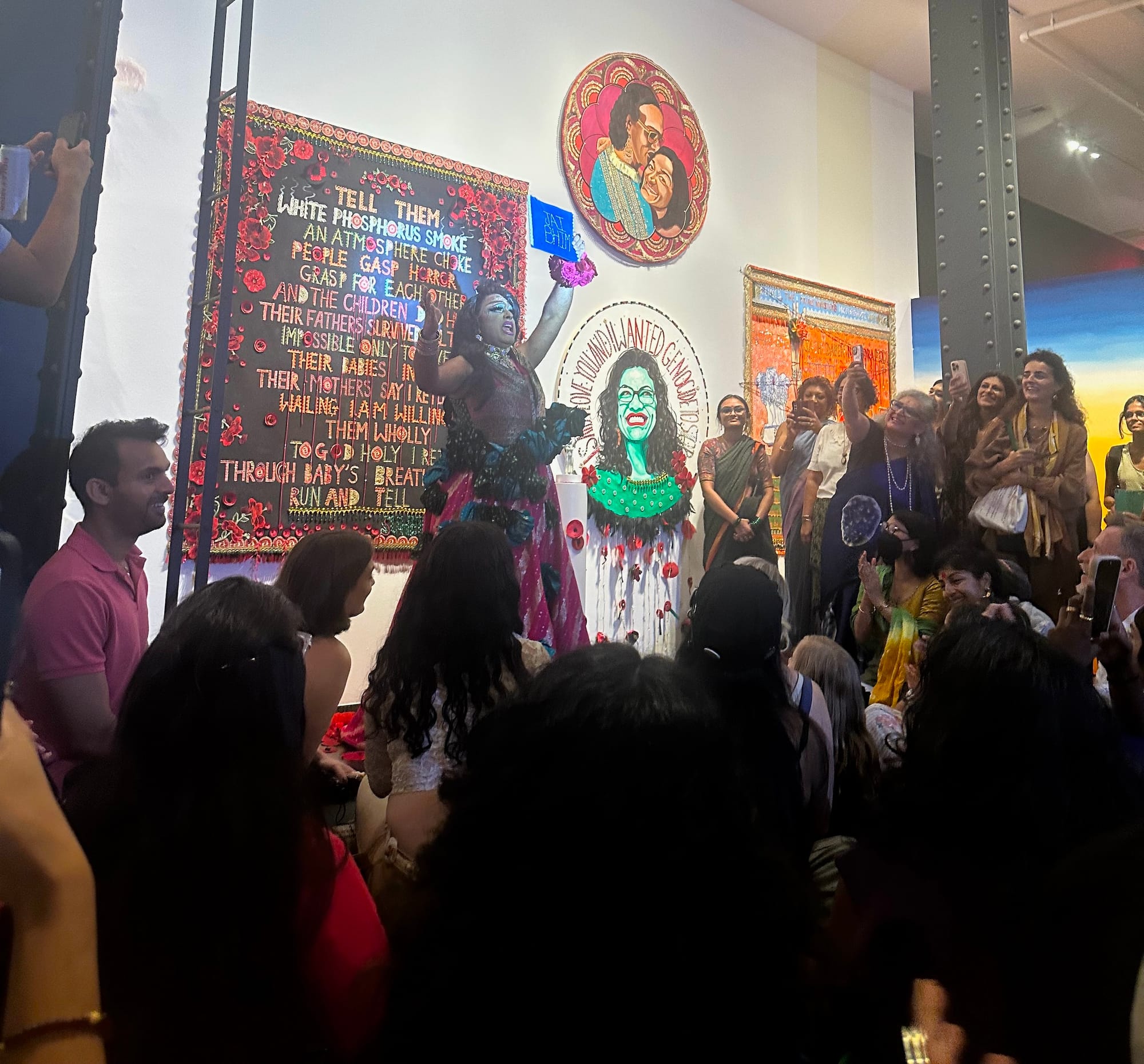 Drag performance by LaWhore Vagistan — holding an artwork reading "Jai Bhim," an anti-caste greeting and affirmation of solidarity invoking the legacy of Ambedkar — at the packed exhibition opening on September 25 (photo Lakshmi Rivera Amin/Hyperallergic)
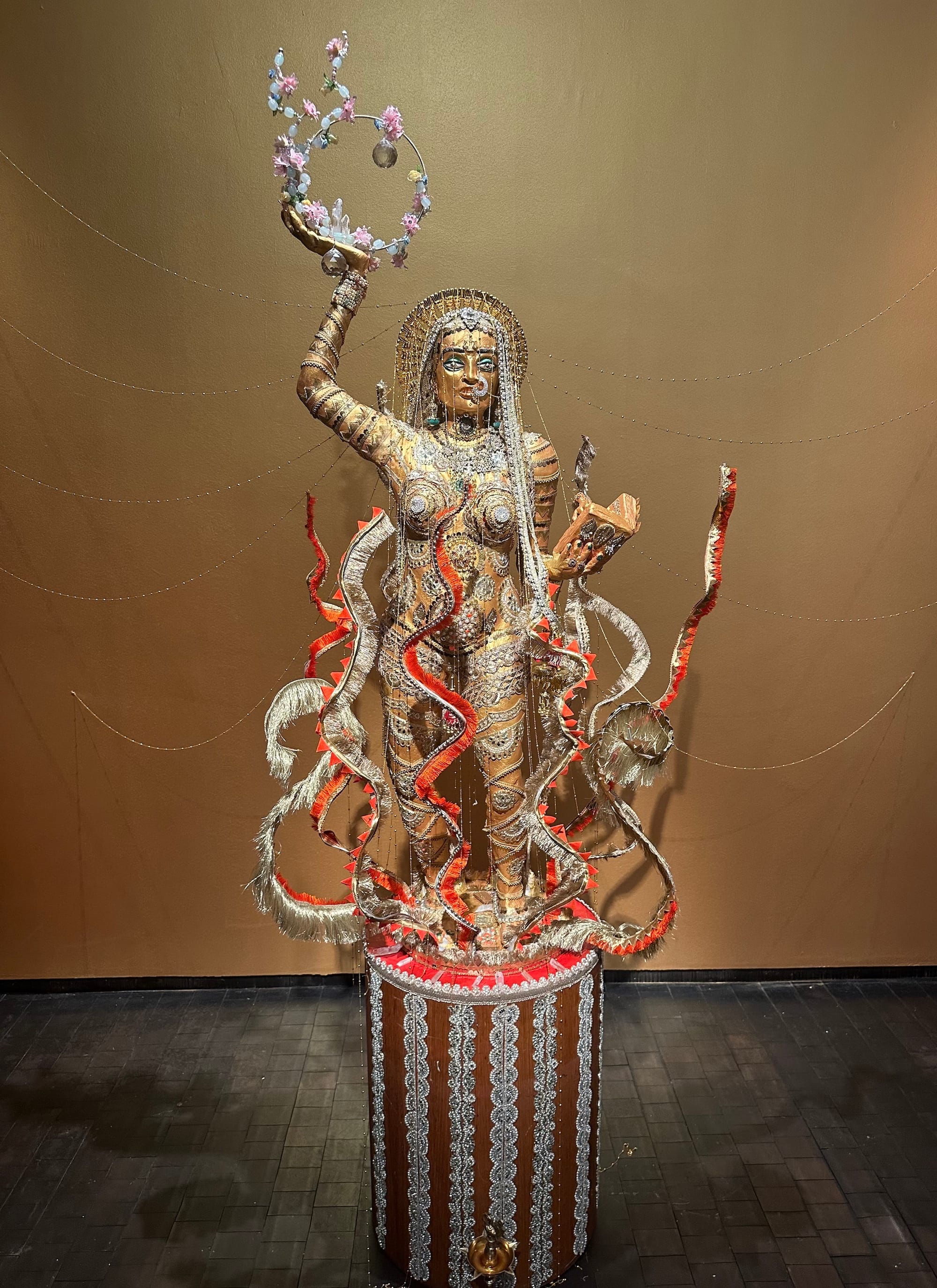 Pyaari Azaadi, "The Alchemist (For Anantha)" (2021) (photo Lakshmi Rivera Amin/Hyperallergic)