 Rare Cars/YouTube
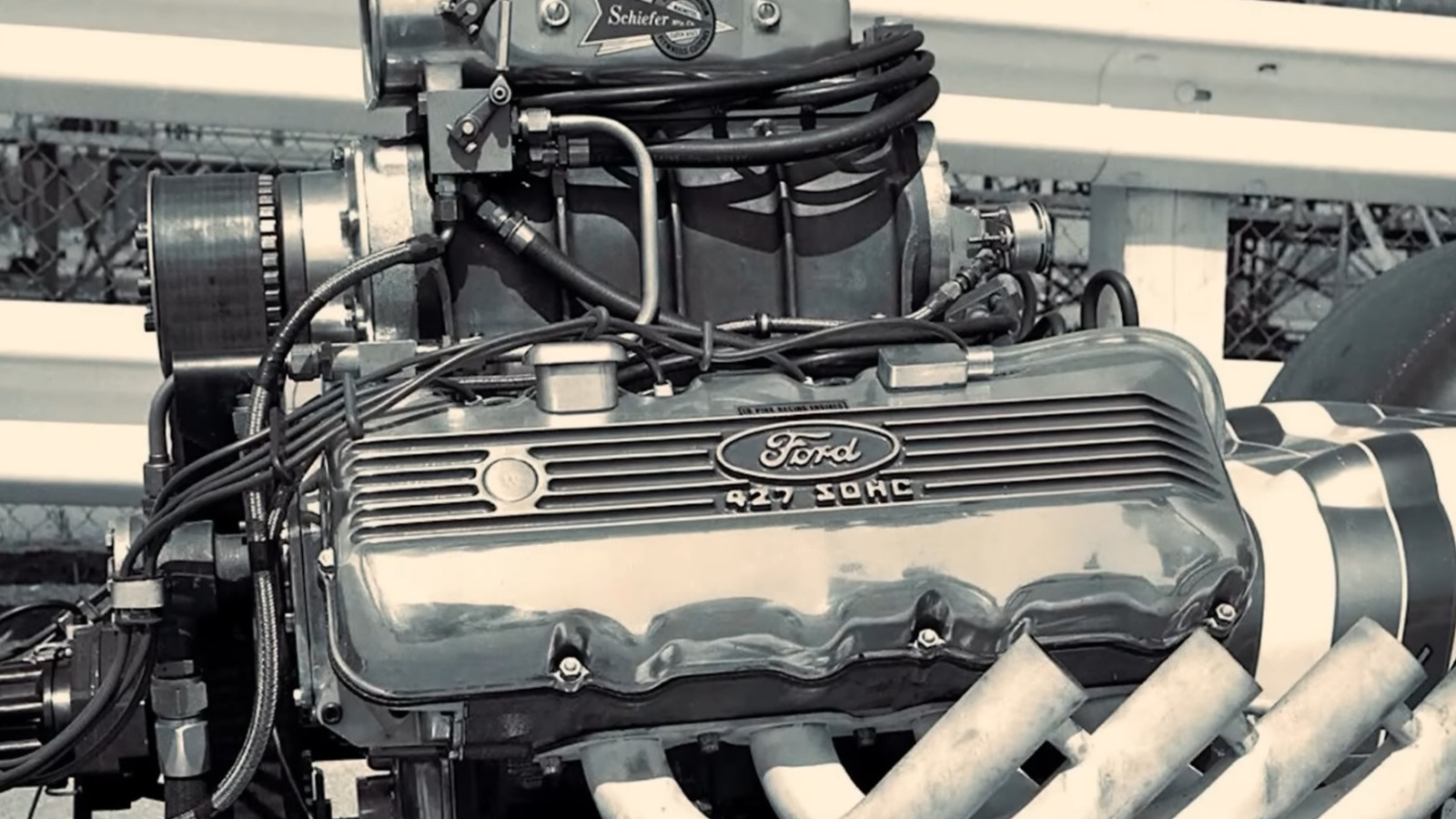
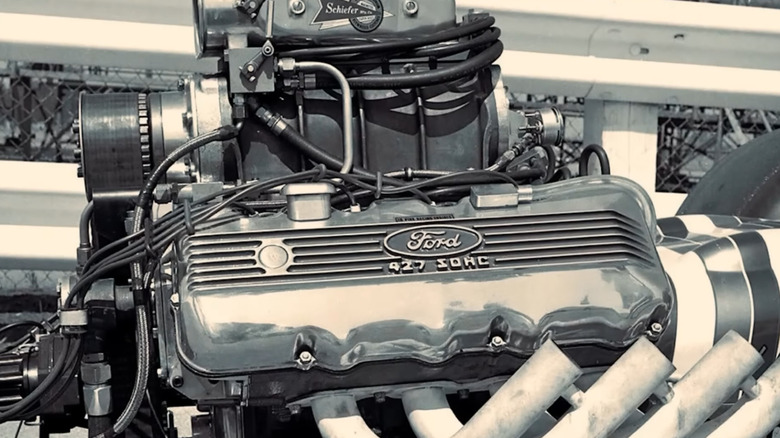
Yes, Ford once had a hemi engine of its own. So why have you never heard about it? Because the hemi-headed V8 known as the legendary 427 SOHC "Cammer" engine never actually made it under the hood of a vehicle in production. This is largely due to the fact that the engine it was originally built to beat was outlawed before Ford ever had a chance to use it.
Designed in less than three months in an attempt to counter Chrysler's 426 Hemi ahead of the 1964 NASCAR season, Ford's single-overhead-cam 427 really showed a lot of promise. Engineers had created a two-valve, SOHC conversion of the 427 FE side-oiler, complete with a 6-foot roller timing chain, cross-bolted mains, revised oiling, and hemispherical combustion chambers. In its factory trim, the Cammer produced roughly 616 horsepower at 7,000 RPM, which was far more than any showroom Ford could ever realistically contain at the time.
Meanwhile, NASCAR leadership took notice. To them, the escalating engine war was turning standard stock cars into something so powerful they needed to crack down on it. So, NASCAR banned "special racing engines" like the 426 Hemi, nicknamed, "The Elephant" and the 427 SOHC Cammer. However, this wasn't the official end of Ford's racetrack-ready hemi engine.
Where the Ford Cammer hemi went after NASCAR
 REVan Evan/YouTube
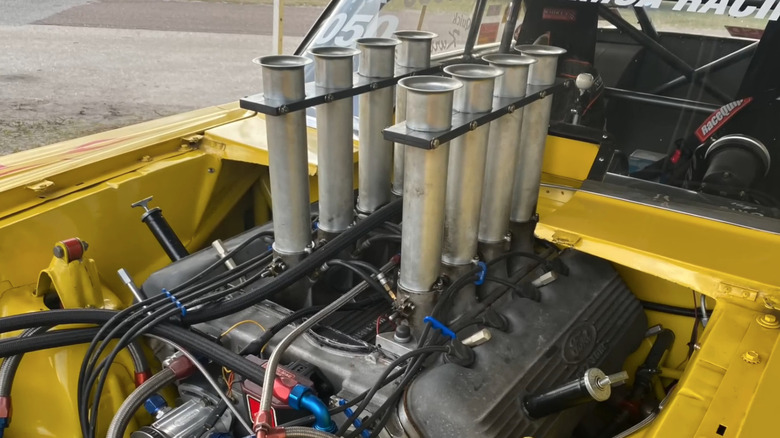
Even after the ban, Ford tried lobbying for approval. Unfortunately for them, it didn't work: NASCAR reinstated the ban in December 1965. The following year, NASCAR did permit the Cammer to race but with such severe restrictions that the project simply became unworkable for competition. With a single carburetor limit, Galaxie-only usage, and a 430-pound weight penalty, there was just no way Ford was going to make the Cammer a reality in a production car.
With its dreams of a NASCAR future now crushed, the Cammer immediately became an engine without a home. What's worse, Ford had already invested in a new hemispherical powerplant, which meant parts were stacked and ready. Rather than abandon the program entirely, the company redirected its V8 to take drag racing by storm instead.
Obviously, drag racing is an entirely different beast. As such, Ford had little engineering support to offer beyond parts distribution. This left racers to refine, modify, and, in many cases, rescue the engine in real time. Using Ford's hemi for drag racing also revealed some major weaknesses — especially in the block.
The final nail in the coffin for the Ford Cammer hemi
 Karolis Kavolelis/Shutterstock
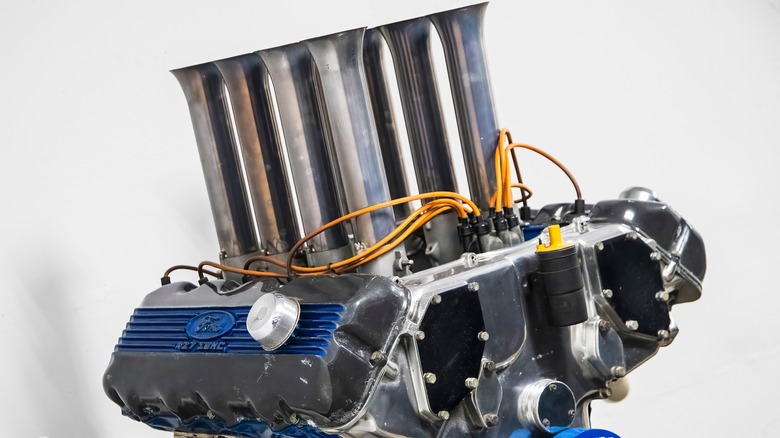
According to famed engine builder Ed Pink (via Hot Rod), the bottom end of Ford's hemi was only made to handle around 750 horsepower. However, when used for drag racing, nitro teams were extracting more than 2,500 horsepower, which meant they were blowing the engine blocks apart in just a handful of runs. Timing-chains and the oiling system repeatedly failed under quarter-mile loads as well.
It might have been just the thing to win at Daytona, but in the National Hot Rod Association (NHRA) pits, there was no denying the Cammer was way out of its element. That's not to say that it didn't bring home any wins for Ford, though. Drag racer Connie Kalitta was among the first to receive a Cammer, and he became the first driver to surpass 200 mph at an AHRA national event in 1965. Drivers including Bill Lawton, Gas Ronda, and Phil Bonner also scored significant wins.
While Kalitta and others continued to use the Ford engine, most teams would go on to transitioned to Chrysler power. By the early 1970s, the Cammer's competitive window had officially closed. From there, the 427 SOHC never entered mass production because it was never engineered for consumer use, nor was it ever intended for the emissions or durability standards that came with such use. As soon as Ford shifted its performance strategy away from the Cammer, its hemi was pretty much laid to rest.