 Photo by Stephane Cardinale - Corbis/Corbis via Getty ImagesDecember
3,
2025BeautyQ+AMeet the braider behind the Afro-textured hairstyles at PFW SS26
Photo by Stephane Cardinale - Corbis/Corbis via Getty ImagesDecember
3,
2025BeautyQ+AMeet the braider behind the Afro-textured hairstyles at PFW SS26From Chanel to Celine and Rabanne, this season’s Paris shows illustrated the versatility of Afro hair and signalled a shift in the representation of luxury fashion
ShareLink copied ✔️December 3, 2025BeautyQ+ATextSoraya OdubekoRead More Music‘We’re like brother and sister’: Yung Lean and Charli xcx in conversation
 FashionThe only looks that mattered from the 2025 Fashion Awards
 FashionIn pictures: 2hollis’s London show brought out the city’s best dressed
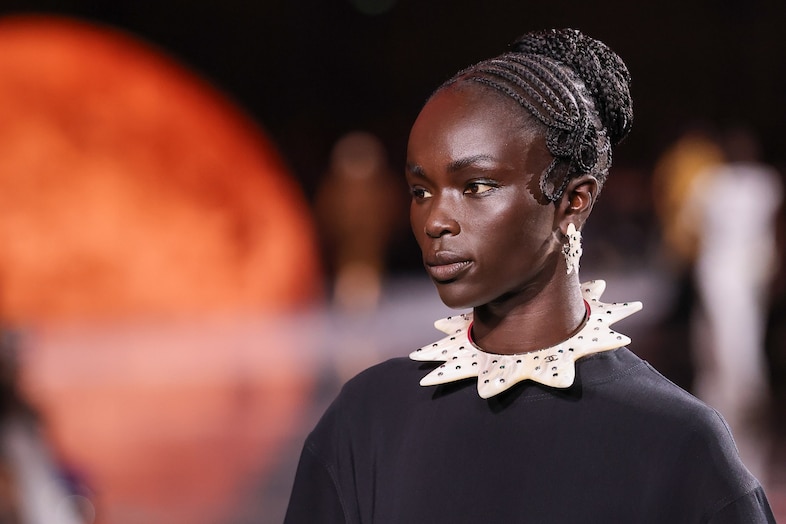
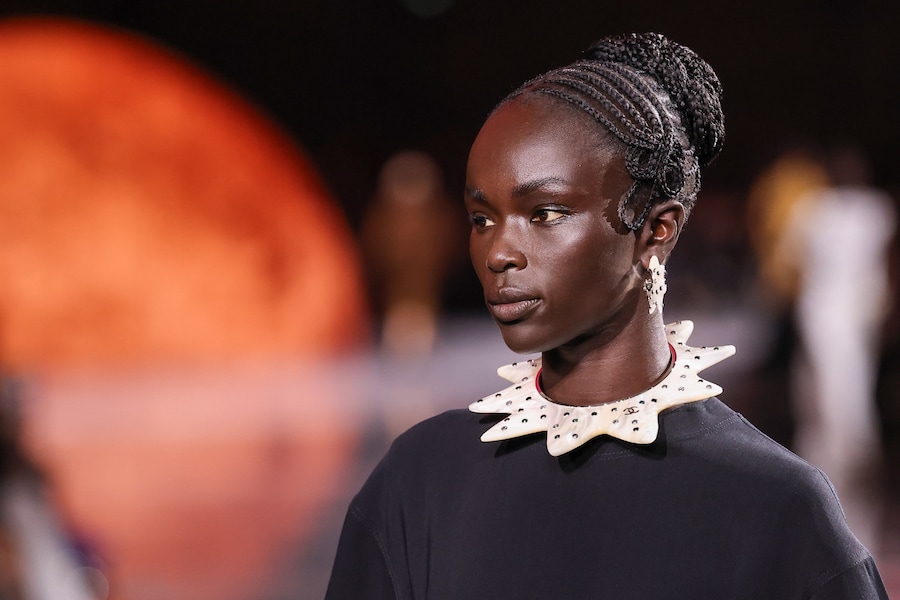
This season’s Paris shows illustrated the versatility of Afro hair, with models styled in the kinds of detailed, patterned braids that warrant hours in a salon chair. From Celine to Rabanne, SS26 marked a shift in the representation of textured hair on the runway. Like the garments themselves, the braiding came alive through shape and skilful construction, from swooping concentric cornrows framing either side of the face, to painstakingly tiny, pared-back cornrows gathering in a low, elegant knot. One model walked the Chanel show in long locs, a definitive embrace of natural hair in high fashion that complemented the clothing’s easy femininity.
For a long time, luxury fashion’s casting directors worked within narrow definitions of beauty. By default, models were slim and white, with palatable (read: untextured) hair types. Today runways are beginning to better reflect the industry’s (slowly) growing diversity, but age-old codes of beauty that cast textured hair as inconvenient, difficult or unpolished remain difficult to shake. Black models continue to share backstage experiences of being overlooked – or othered – during hair and make-up. When apathy and a lack of expertise converge backstage, models are left to act as their own hairstylists and make-up artists.
Stylists like Jawara Wauchope and Naeemah LaFond have been instructive in their considered treatment of textured hair, but the fashion industry all too often overlooks its cultural, spiritual and aesthetic value. It’s why the ornate, eye-catching braids that adorned models’ heads this season were so special. Led by veteran Duffy, a set of hairstylists that included Afro hair specialists brought intricate African braiding to shows like Celine, Rabanne and Matthieu Blazy’s Chanel debut. These looks signalled a shift in the representation of Afro hair in luxury fashion. Far from being treated as an inconvenience or an afterthought, textured hair was recognised as a versatile canvas for realising a cohesive creative vision.
Jelisa is a Paris-based hairstylist who has worked with Duffy’s team on some of fashion’s biggest stages. As a stylist and talented braider navigating the industry, she’s observed the uptick in elevated runway styles for textured hair. Following a busy Paris Fashion Week, she reflects on the changing treatment and representation of Afro-textured hair in fashion and the challenges the industry has yet to tackle.
Hi Jelisa, tell me a bit about how you started doing hair for fashion.
Jelisa: I started doing hair full-time in 2021. I was creating craft braids for my clients from my mum’s living room. Only a year after deciding to start doing this full-time, I was contacted to do braids for a Dior couture show. It was my very first step into fashion, and to be honest, I had no idea about the industry. I discovered a whole different world, different ways of working and different ways to approach our hair.
What does doing hair mean to you?
Jelisa: What I love the most about doing hair on my clients is that it allows me to combine creativity with connection. As a hair stylist, I’m both an artisan and a confidante to my clients. I also love being able to make them feel confident, seen, and celebrated. Hairstylists on the runway get the opportunity to build an identity and a narrative just through hair. It transforms a look into a story, and it brings a designer’s vision to life. One hairstyle can instantly communicate the mood of a collection and the cultural references behind it, and as an art-lover I love being a part of it.
What has been your favourite show that you’ve done this season?
Jelisa: The Chanel show was by far my favorite. Chanel is maybe the most prestigious couture house, and the most awaited show of this season because of Matthieu Blazy’s debut. It was such an accomplishment for me to be a part of the hair team for such a prestigious show! I was so grateful to the lead hairstylist, Duffy, for inviting me to join his hair team. He gave me and other braiders the opportunity to create some African tribal-inspired hairstyles on some models. We spent a lot of time doing it to make it look the best, and Matthieu Blazy loved it.
For so long models with coily and kinky textures have been overlooked by stylists, but the diversity of styles for textured hair has developed immensely over the past few years. We’re seeing more considered and intricate Afro hairstyles on the runways of major European houses. Where has this change come from?
Jelisa: I think there’s a growing awareness of the lack of representation in the fashion and beauty industries. More people have been demanding inclusivity, and brands are finally understanding the cultural place and artistic value of Afro-textured hair.
Has the diversity of expertise backstage changed while you’ve been working in fashion?
Jelisa: My first time working in the fashion industry was as a braider in Duffy’s team. His team is built with a lot of Afro-hair specialists, and I think his way of working with strong specialists to craft looks has inspired a lot in the fashion industry over the past few years. Very quickly after my first show I received a lot of demand for jobs, and since then I’ve met so many other Afro hair specialists in fashion. I think that there are enough hairstylists like myself, but it doesn’t always mean that black models’ hair is treated as it should be.
The future of representation of Afro hair on runways, and diversity of stylists, looks positive. What does the industry need to do to continue evolving?
Jelisa: As I mentioned previously, even though there are now more stylists who are trained to work with Afro hair, it doesn’t automatically mean that models’ hair is being treated with the care it needs. Afro hair is extremely delicate, and the industry still has work to do in creating styles that are adapted to its specific needs.
Another challenge is the lack of inclusion of Afro models in the overall artistic direction. I often notice that creative teams develop detailed, conceptual hairstyles for European or Asian hair types, but when it comes to Afro models walking the same show, they resort to very simple, minimal looks which have nothing to do with the show’s overall artistic direction. Like shaved hair, a slicked back bun or big straight-back braids. It gives the impression that these models are being overlooked as individuals, but also that there is still a reluctance to take the time to explore and celebrate a hair type that remains too often marginalised.
Why is it important that these braiding styles continue to appear on runways?
Jelisa: African braiding represents a rich cultural heritage. It deserves visibility and a deep respect. These styles are not just trends, they’re art forms with deep historical and cultural significance. Showing those on major fashion platforms helps to normalise and celebrate Afro-textured hair in all its forms. It promotes diversity in fashion, and hopefully it pushes our industry toward more inclusive representation.
ShareLink copied ✔️More on these topicsBeautyQ+ASS26Paris Fashion WeekafrohairExpand your creative community and connect with 15,000 creatives from around the world.
READ MORE
‘Accept your ugly’: I tried ‘beauty shadow work’ to help my self-esteem
Horoscopes December 2025: Expect fun, flirting and major plot twists
Trail shoe to fashion trailblazer: the rise of Salomon’s ACS PRO
This film is an intimate portrait of Black hair and identity
How tech-inspired SFX is revealing our anxieties about a cybernetic future
Bleach play: How halo rings and ghost roots are taking over hair trends
Echo Seireeni’s prosthetic creations are warping reality
My year of divesting from beauty culture
Can psychedelics enhance your workout?
So you want to smell like an ancient god?
Inside India’s blossoming drag scene