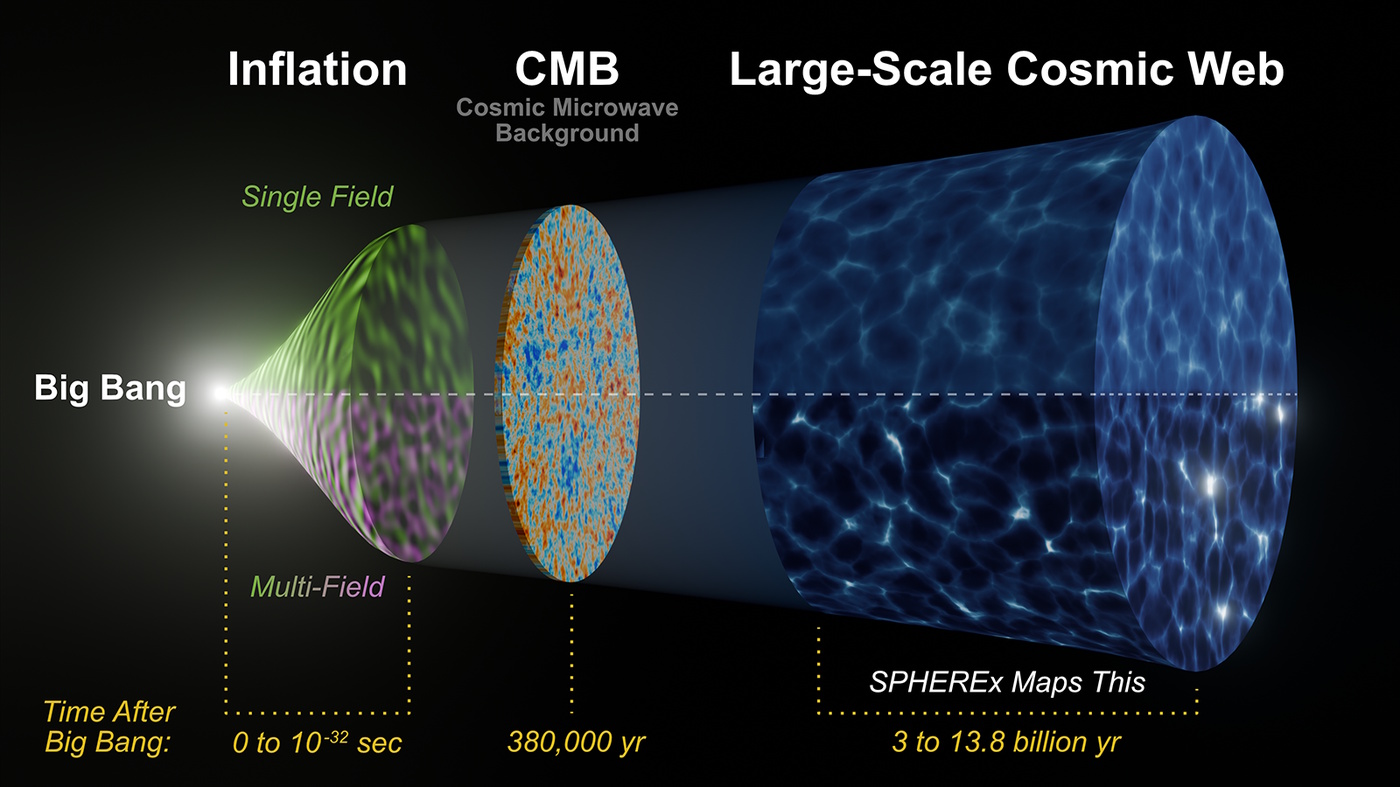
 In the aftermath of inflation, signatures are imprinted onto the Universe that are unmistakably inflationary in origin. While the CMB provides an early-time "snapshot" of these features, that's just one moment in history. By probing the large variety of times/distances accessible to us throughout cosmic time, such as with large-scale structure, we can obtain information that would otherwise be obscure from any single snapshot.
Credit: Caltech/Robert Hurt(IPAC)
Key Takeaways
In the aftermath of inflation, signatures are imprinted onto the Universe that are unmistakably inflationary in origin. While the CMB provides an early-time "snapshot" of these features, that's just one moment in history. By probing the large variety of times/distances accessible to us throughout cosmic time, such as with large-scale structure, we can obtain information that would otherwise be obscure from any single snapshot.
Credit: Caltech/Robert Hurt(IPAC)
Key Takeaways
- Although we exist here and now on Earth, we can look down, at our planet’s past, and up, at the Universe beyond our world, and piece together various aspects of the cosmic story uniting us all.
- We’ve learned an impressive amount about both our planetary and our cosmic histories, consistent with the known fundamental laws, forces, and constituents of our Universe.
- However, despite all we’ve learned and our ongoing best efforts, some significant gaps in our understanding persist. Here’s where the greatest unsolved problems facing us today can be found.
 Sign up for the Starts With a Bang newsletter
Travel the universe with Dr. Ethan Siegel as he answers the biggest questions of all.
Subscribe
Sign up for the Starts With a Bang newsletter
Travel the universe with Dr. Ethan Siegel as he answers the biggest questions of all.
Subscribe
The answer to nature’s greatest riddles are written upon the Universe itself.
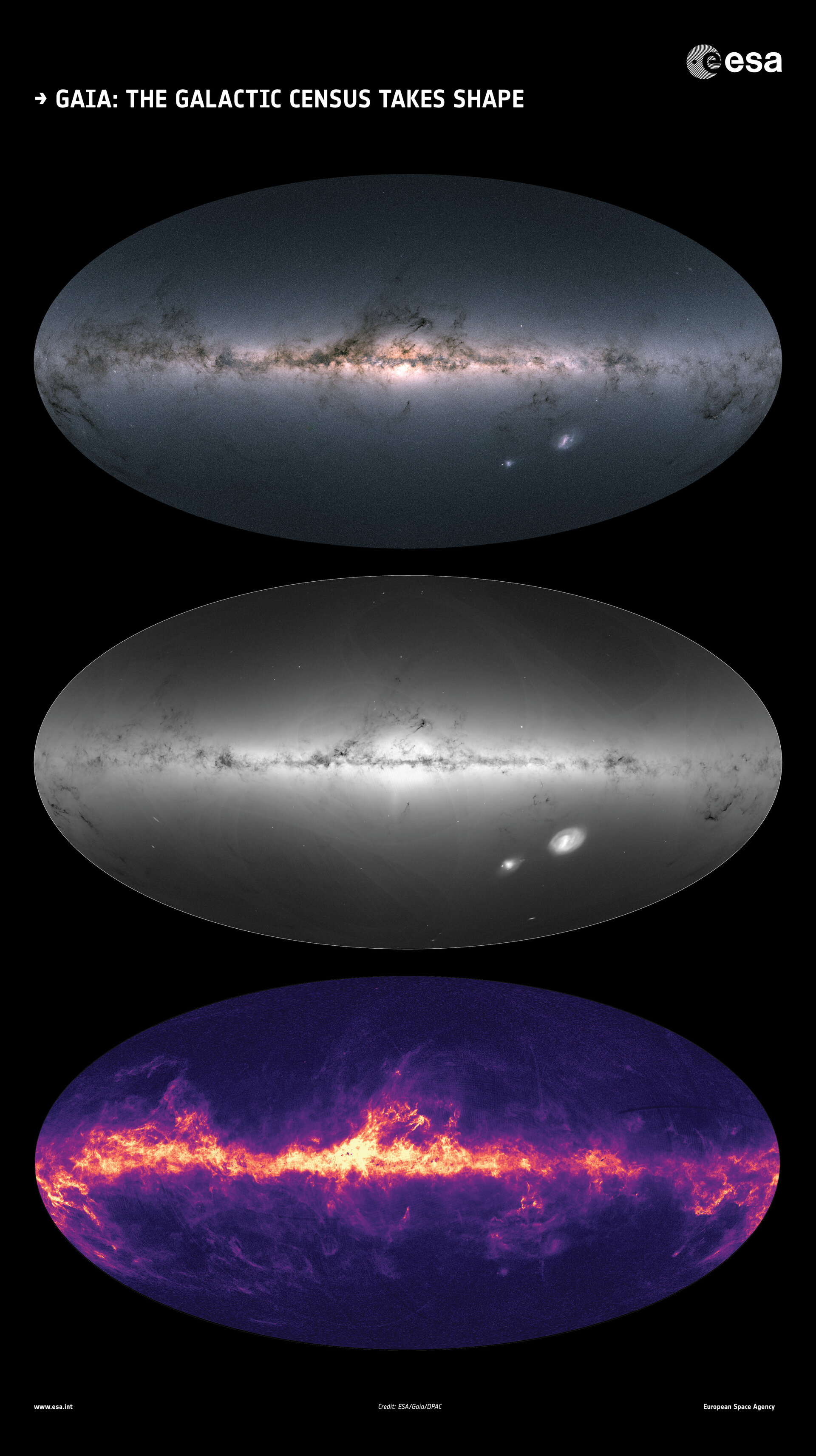 Gaia’s all-sky view of our Milky Way Galaxy and neighboring galaxies. The maps show the total brightness and color of stars (top), the total density of stars (middle), and the interstellar dust that fills the galaxy (bottom). Note how, on average, there are approximately ~10 million stars in each square degree, but that some regions, like the galactic plane or the galactic center, have stellar densities well above the overall average.
Credit: ESA/Gaia/DPAC
Gaia’s all-sky view of our Milky Way Galaxy and neighboring galaxies. The maps show the total brightness and color of stars (top), the total density of stars (middle), and the interstellar dust that fills the galaxy (bottom). Note how, on average, there are approximately ~10 million stars in each square degree, but that some regions, like the galactic plane or the galactic center, have stellar densities well above the overall average.
Credit: ESA/Gaia/DPAC
From the fundamental to the cosmic, science reveals our natural history.
 Our Universe, from the hot Big Bang until the present day, underwent a huge amount of growth and evolution, and continues to do so. Our entire observable Universe was approximately the size of a modest boulder some 13.8 billion years ago, but it has expanded to be ~46 billion light-years in radius today. The complex structure that has arisen must have grown from seed imperfections of at least ~0.003% of the average density early on, and has gone through phases where atomic nuclei, neutral atoms, and stars first formed, eventually giving rise to our Solar System, planet, life, and humans.
Credit: NASA/CXC/M. Weiss
Our Universe, from the hot Big Bang until the present day, underwent a huge amount of growth and evolution, and continues to do so. Our entire observable Universe was approximately the size of a modest boulder some 13.8 billion years ago, but it has expanded to be ~46 billion light-years in radius today. The complex structure that has arisen must have grown from seed imperfections of at least ~0.003% of the average density early on, and has gone through phases where atomic nuclei, neutral atoms, and stars first formed, eventually giving rise to our Solar System, planet, life, and humans.
Credit: NASA/CXC/M. Weiss
Despite all we’ve learned, these nine major puzzles remain unsolved.
 The quantum fluctuations inherent to space, stretched across the Universe during cosmic inflation, gave rise to the density fluctuations imprinted in the cosmic microwave background, which in turn gave rise to the stars, galaxies, and other large-scale structures in the Universe today. This is the best picture we have of how the entire Universe behaves, where inflation precedes and sets up the Big Bang. Unfortunately, we can only access the information contained inside our cosmic horizon, which is all part of the same fraction of one region where inflation ended some 13.8 billion years ago.
Credit: E. Siegel; ESA/Planck and the DOE/NASA/NSF Interagency Task Force on CMB research
The quantum fluctuations inherent to space, stretched across the Universe during cosmic inflation, gave rise to the density fluctuations imprinted in the cosmic microwave background, which in turn gave rise to the stars, galaxies, and other large-scale structures in the Universe today. This is the best picture we have of how the entire Universe behaves, where inflation precedes and sets up the Big Bang. Unfortunately, we can only access the information contained inside our cosmic horizon, which is all part of the same fraction of one region where inflation ended some 13.8 billion years ago.
Credit: E. Siegel; ESA/Planck and the DOE/NASA/NSF Interagency Task Force on CMB research
1.) What triggered or preceded cosmic inflation?
 From a region of space as small as can be imagined (all the way down to the Planck scale), cosmological inflation causes space to expand exponentially: relentlessly doubling and doubling again with each tiny fraction-of-a-second that elapses. Although this empties the Universe and stretches it flat, it also contains quantum fluctuations superimposed atop it: fluctuations that will later provide the seeds for cosmic structure within our own Universe. What happened before the final ~10^-32 seconds of inflation, including the question of whether inflation arose from a singular state before it, not only isn’t known, but may be fundamentally unknowable.
Credit: Big Think / Ben Gibson
From a region of space as small as can be imagined (all the way down to the Planck scale), cosmological inflation causes space to expand exponentially: relentlessly doubling and doubling again with each tiny fraction-of-a-second that elapses. Although this empties the Universe and stretches it flat, it also contains quantum fluctuations superimposed atop it: fluctuations that will later provide the seeds for cosmic structure within our own Universe. What happened before the final ~10^-32 seconds of inflation, including the question of whether inflation arose from a singular state before it, not only isn’t known, but may be fundamentally unknowable.
Credit: Big Think / Ben Gibson
Inflation wasn’t the beginning; we don’t know what was.
 Various models of inflation and what they predict for the scalar (x-axis) and tensor (y-axis) fluctuations from inflation. Note how just a small subset of viable inflationary models gives rise to a huge variety of possible predictions for these parameters, and how even with the joint constraints provided by various independent cosmological probes, that many models of inflation remain viable and consistent with the data.
Credit: Planck collaboration, Astronomy & Astrophysics, 2020
Various models of inflation and what they predict for the scalar (x-axis) and tensor (y-axis) fluctuations from inflation. Note how just a small subset of viable inflationary models gives rise to a huge variety of possible predictions for these parameters, and how even with the joint constraints provided by various independent cosmological probes, that many models of inflation remain viable and consistent with the data.
Credit: Planck collaboration, Astronomy & Astrophysics, 2020
2.) What “flavor” of inflation occurred?
 This map shows the CMB’s polarization signal, as measured by the Planck satellite in 2015. The top and bottom insets show the difference between filtering the data on particular angular scales of 5 degrees and 1/3 of a degree, respectively. While temperature data, alone, can demonstrate that the CMB is of cosmic nature, the polarization signal gives us key pieces of information relevant to the details of cosmic inflation, including which “flavors” of inflation are allowed and disallowed.
Credit: ESA and the Planck Collaboration, 2015
This map shows the CMB’s polarization signal, as measured by the Planck satellite in 2015. The top and bottom insets show the difference between filtering the data on particular angular scales of 5 degrees and 1/3 of a degree, respectively. While temperature data, alone, can demonstrate that the CMB is of cosmic nature, the polarization signal gives us key pieces of information relevant to the details of cosmic inflation, including which “flavors” of inflation are allowed and disallowed.
Credit: ESA and the Planck Collaboration, 2015
Primordial gravitational waves, cosmic flatness, and primordial non-Gaussianity observations will inform us.
 The contribution of gravitational waves left over from inflation to the B-mode polarization of the cosmic microwave background has a known shape, but its amplitude is dependent on the specific model of inflation and can only be constrained observationally. These B-modes from gravitational waves from inflation have not yet been observed, but detecting them would help us tremendously in pinning down precisely what type of inflation occurred. A false detection, from the BICEP2 team, famously occurred in the early 2010s, but was swiftly refuted. We now know that the r-ratio, represented on the y-axis, must be no greater than about ~0.01, with future experiments hoping to get down to the 0.001 or even the 0.0001 level.
Credit: Planck Science Team
The contribution of gravitational waves left over from inflation to the B-mode polarization of the cosmic microwave background has a known shape, but its amplitude is dependent on the specific model of inflation and can only be constrained observationally. These B-modes from gravitational waves from inflation have not yet been observed, but detecting them would help us tremendously in pinning down precisely what type of inflation occurred. A false detection, from the BICEP2 team, famously occurred in the early 2010s, but was swiftly refuted. We now know that the r-ratio, represented on the y-axis, must be no greater than about ~0.01, with future experiments hoping to get down to the 0.001 or even the 0.0001 level.
Credit: Planck Science Team
3.) How did baryogenesis occur?
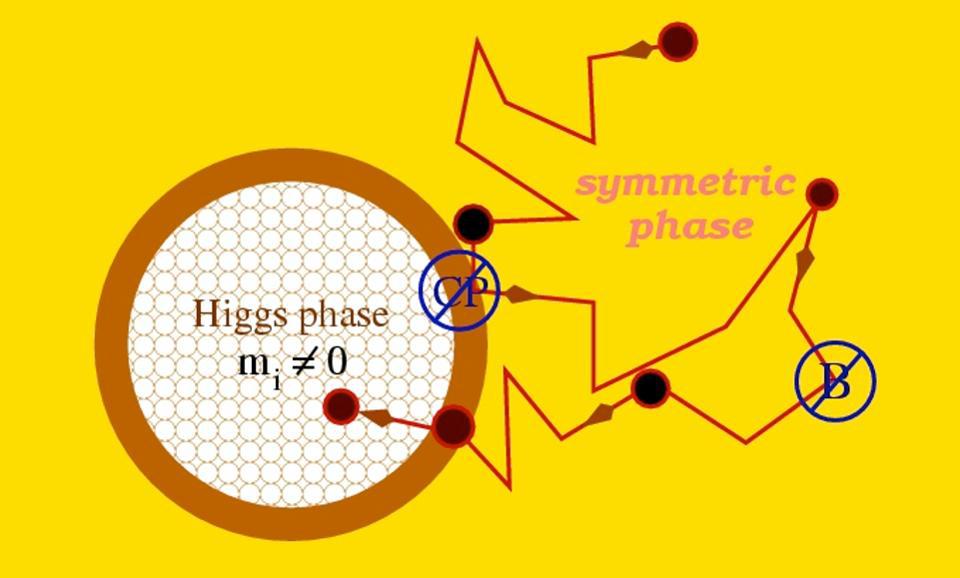 When the electroweak symmetry (the symmetry that corresponds to the Higgs field) breaks, the combination of CP-violation and baryon number violation can create a matter/antimatter asymmetry where there was none before, owing to the effect of sphaleron interactions working on, for example, a neutrino excess. This can only occur, however, if the electroweak phase transition is first-order, rather than the second-order transition predicted by the Standard Model alone.
Credit: University of Heidelberg
When the electroweak symmetry (the symmetry that corresponds to the Higgs field) breaks, the combination of CP-violation and baryon number violation can create a matter/antimatter asymmetry where there was none before, owing to the effect of sphaleron interactions working on, for example, a neutrino excess. This can only occur, however, if the electroweak phase transition is first-order, rather than the second-order transition predicted by the Standard Model alone.
Credit: University of Heidelberg
We don’t know how our Universe came to be matter dominated.
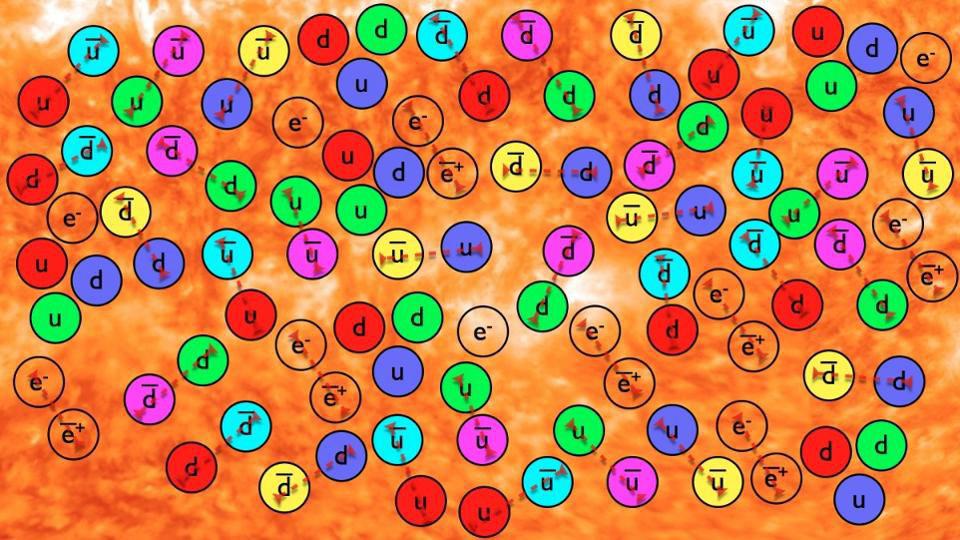 In the very early Universe, there were tremendous numbers of quarks, leptons, antiquarks, and antileptons of all species. After only a tiny fraction-of-a-second has elapsed since the hot Big Bang, most of these matter-antimatter pairs annihilate away, leaving a very tiny excess of matter over antimatter. How that excess came about is a puzzle known as baryogenesis, and it is one of the greatest unsolved problems in modern physics.
Credit: E. Siegel/Beyond the Galaxy
In the very early Universe, there were tremendous numbers of quarks, leptons, antiquarks, and antileptons of all species. After only a tiny fraction-of-a-second has elapsed since the hot Big Bang, most of these matter-antimatter pairs annihilate away, leaving a very tiny excess of matter over antimatter. How that excess came about is a puzzle known as baryogenesis, and it is one of the greatest unsolved problems in modern physics.
Credit: E. Siegel/Beyond the Galaxy
4.) What is the nature of dark matter?
 The X-ray (pink) and overall matter (blue) maps of various colliding galaxy clusters show a clear separation between normal matter and gravitational effects, some of the strongest evidence for dark matter. The X-rays come in two varieties, soft (lower-energy) and hard (higher-energy), where galaxy collisions can create temperatures ranging from several hundreds of thousands of degrees up to ~100 million K. Meanwhile, the fact that the gravitational effects (in blue) are displaced from the location of the mass from the normal matter (pink) shows that dark matter must be present. Without dark matter, these observations (along with many others) cannot be sufficiently explained.
Credit: NASA, ESA, D. Harvey (École Polytechnique Fédérale de Lausanne, Switzerland; University of Edinburgh, UK), R. Massey (Durham University, UK), T. Kitching (University College London, UK), and A. Taylor and E. Tittley (University of Edinburgh, UK)
The X-ray (pink) and overall matter (blue) maps of various colliding galaxy clusters show a clear separation between normal matter and gravitational effects, some of the strongest evidence for dark matter. The X-rays come in two varieties, soft (lower-energy) and hard (higher-energy), where galaxy collisions can create temperatures ranging from several hundreds of thousands of degrees up to ~100 million K. Meanwhile, the fact that the gravitational effects (in blue) are displaced from the location of the mass from the normal matter (pink) shows that dark matter must be present. Without dark matter, these observations (along with many others) cannot be sufficiently explained.
Credit: NASA, ESA, D. Harvey (École Polytechnique Fédérale de Lausanne, Switzerland; University of Edinburgh, UK), R. Massey (Durham University, UK), T. Kitching (University College London, UK), and A. Taylor and E. Tittley (University of Edinburgh, UK)
Despite overwhelming astrophysical evidence for its presence, its nature remains elusive.
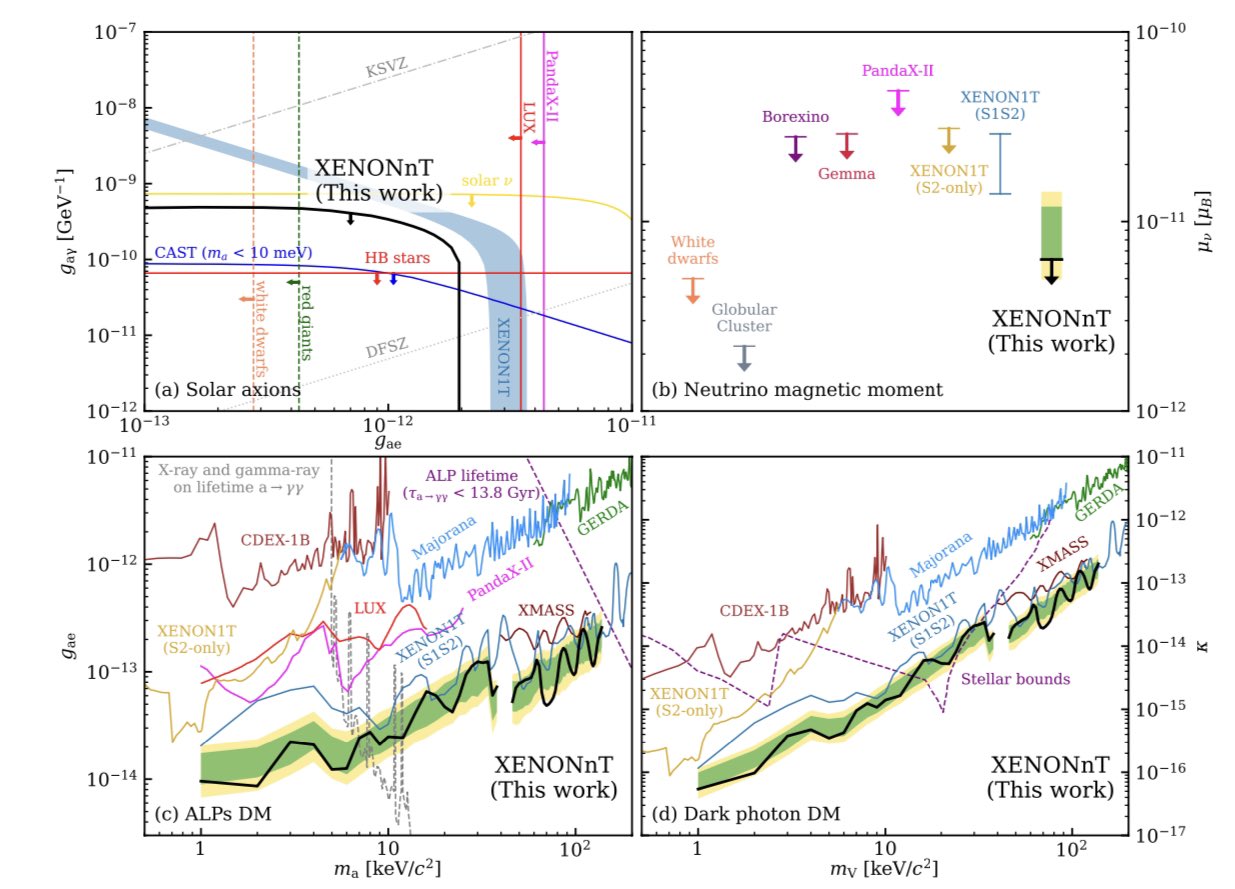 This 4-panel graph shows constraints on solar axions, on the neutrino magnetic moment, and on two different “flavors” of dark matter candidates, all constrained by the latest XENONnT results. These are the best such constraints in physics history, and remarkably demonstrate just how good the XENON collaboration has gotten at what they do. Axions, like other dark matter candidates, have not yielded a positive direct detection signature yet.
Credit: E. Aprile et al. for the XENON Collaboration, arXiv:2207.11330, 2022
This 4-panel graph shows constraints on solar axions, on the neutrino magnetic moment, and on two different “flavors” of dark matter candidates, all constrained by the latest XENONnT results. These are the best such constraints in physics history, and remarkably demonstrate just how good the XENON collaboration has gotten at what they do. Axions, like other dark matter candidates, have not yielded a positive direct detection signature yet.
Credit: E. Aprile et al. for the XENON Collaboration, arXiv:2207.11330, 2022
5.) How and when did the first stars appear?
 The dwarf galaxy UGCA 281, shown here as imaged by Hubble in the visible and ultraviolet, is rapidly forming new stars. An older, background population of redder stars coexists alongside the newer, bluer stars that are superimposed atop them. The newly-formed stars are largely heavily-enriched Population I stars, while the older stars are largely metal-poor Population II stars. No pristine, metal-free, Population III stars are yet known.
Credit: NASA, ESA, LEGUS Team
The dwarf galaxy UGCA 281, shown here as imaged by Hubble in the visible and ultraviolet, is rapidly forming new stars. An older, background population of redder stars coexists alongside the newer, bluer stars that are superimposed atop them. The newly-formed stars are largely heavily-enriched Population I stars, while the older stars are largely metal-poor Population II stars. No pristine, metal-free, Population III stars are yet known.
Credit: NASA, ESA, LEGUS Team
The first generation of stars, formed after the Big Bang, remains undiscovered.
 This graph shows the combination of the Hubble, JWST NIRCam, and JWST NIRSpec data for galaxy RXJ2129-z8HeII. There is an unusually strong, blue tilt to the stellar spectrum of this object, but the evidence for any pristine material amidst the highly enriched gas and stars that are present is too flimsy to make a compelling case for the presence of any pristine, Population III (a.k.a., the “first”) stars. No such population, as of 2025, has yet been found.
Credit: X. Wang et al., Astrophysical Journal Letters, 2024
This graph shows the combination of the Hubble, JWST NIRCam, and JWST NIRSpec data for galaxy RXJ2129-z8HeII. There is an unusually strong, blue tilt to the stellar spectrum of this object, but the evidence for any pristine material amidst the highly enriched gas and stars that are present is too flimsy to make a compelling case for the presence of any pristine, Population III (a.k.a., the “first”) stars. No such population, as of 2025, has yet been found.
Credit: X. Wang et al., Astrophysical Journal Letters, 2024
6.) How “alone” are we in the Universe?
 These two designs represent artist concepts for the potential look and architecture of the upcoming, planned NASA astrophysics flagship mission of HWO: the Habitable Worlds Observatory. It will represent a truly generational leap, the same way Hubble or JWST did for NASA science. As the #1 recommended mission by the National Academy of Sciences’ 2020 decadal survey, it will be the first mission to directly image Earth-sized worlds at Earth-like distances around Sun-like stars, but only if we design, advance, fund, and build it.
Credit: NASA’s Goddard Space Flight Center Conceptual Image Lab
These two designs represent artist concepts for the potential look and architecture of the upcoming, planned NASA astrophysics flagship mission of HWO: the Habitable Worlds Observatory. It will represent a truly generational leap, the same way Hubble or JWST did for NASA science. As the #1 recommended mission by the National Academy of Sciences’ 2020 decadal survey, it will be the first mission to directly image Earth-sized worlds at Earth-like distances around Sun-like stars, but only if we design, advance, fund, and build it.
Credit: NASA’s Goddard Space Flight Center Conceptual Image Lab
When and where did life arise, and how common is it? We still know almost nothing.
 The Confidence of Life Detection (CoLD) scale is a way for scientists to quantify how confident we are that a potential biosignature actually arose from the activity of life. Signatures like “methane on Mars” or the new features found inside Perseverance’s latest sedimentary rock (as well as ancient Mars Viking results) have only risen to Level 1 on this scale. Until we reach at least Level 4, ruling out abiotic pathways to creating the observed signatures, appropriate skepticism (including disbelief) of any claims of life’s involvement is warranted.
Credit: NASA
The Confidence of Life Detection (CoLD) scale is a way for scientists to quantify how confident we are that a potential biosignature actually arose from the activity of life. Signatures like “methane on Mars” or the new features found inside Perseverance’s latest sedimentary rock (as well as ancient Mars Viking results) have only risen to Level 1 on this scale. Until we reach at least Level 4, ruling out abiotic pathways to creating the observed signatures, appropriate skepticism (including disbelief) of any claims of life’s involvement is warranted.
Credit: NASA
7.) How did life on Earth begin?
 Deep under the sea, around hydrothermal vents, where no sunlight reaches, life still thrives on Earth. How to create life from non-life is one of the great open questions in science today, but hydrothermal vents are one of the leading locations where the first metabolic processes, the precursor to living organisms, may have first arisen. If life can exist down there on Earth, perhaps undersea on Europa or Enceladus, there’s life down there, too.
Credit: NOAA Office of Ocean Exploration and Research
Deep under the sea, around hydrothermal vents, where no sunlight reaches, life still thrives on Earth. How to create life from non-life is one of the great open questions in science today, but hydrothermal vents are one of the leading locations where the first metabolic processes, the precursor to living organisms, may have first arisen. If life can exist down there on Earth, perhaps undersea on Europa or Enceladus, there’s life down there, too.
Credit: NOAA Office of Ocean Exploration and Research
We know so much about biology, biochemistry, and evolution, but haven’t solved the abiogenesis puzzle.
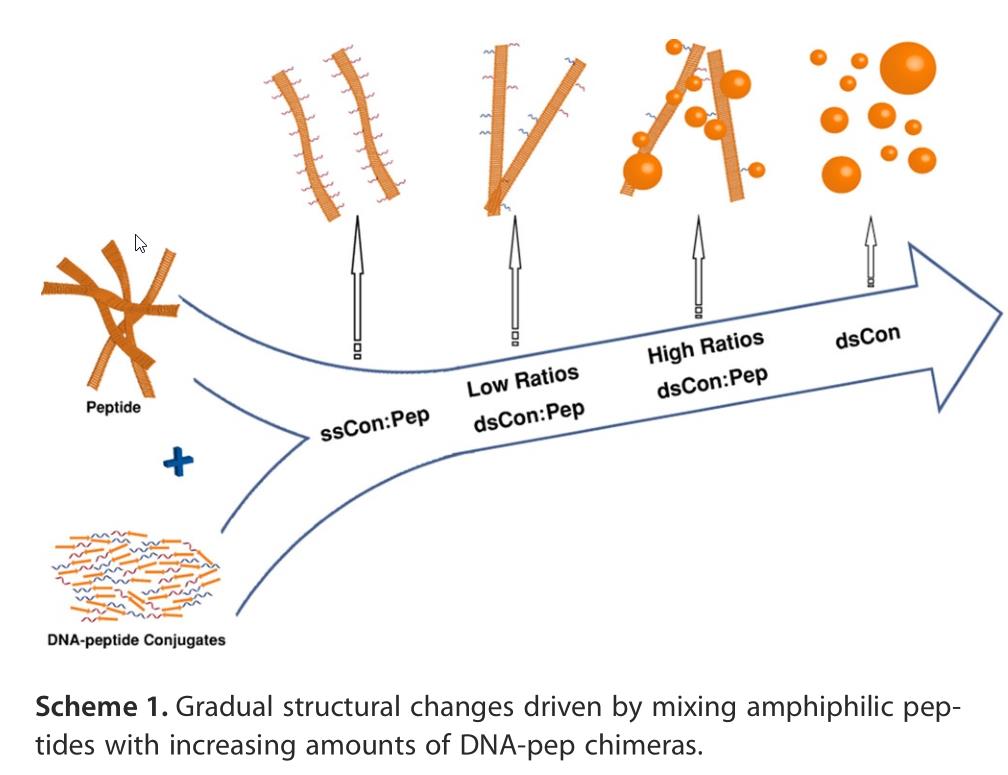 If life began with a random peptide that could metabolize nutrients/energy from its environment, replication could then ensue from peptide-nucleic acid coevolution. Here, DNA-peptide coevolution is illustrated, but it could work with RNA or even PNA as the nucleic acid instead. Asserting that a “divine spark” is needed for life to arise is a classic “God-of-the-gaps” argument, but asserting that we know exactly how life arose from non-life is also a fallacy. These conditions, including rocky planets with these molecules present on their surfaces, likely existed within the first 1-2 billion years of the Big Bang.
Credit: A. Chotera et al., Chemistry Europe, 2018
If life began with a random peptide that could metabolize nutrients/energy from its environment, replication could then ensue from peptide-nucleic acid coevolution. Here, DNA-peptide coevolution is illustrated, but it could work with RNA or even PNA as the nucleic acid instead. Asserting that a “divine spark” is needed for life to arise is a classic “God-of-the-gaps” argument, but asserting that we know exactly how life arose from non-life is also a fallacy. These conditions, including rocky planets with these molecules present on their surfaces, likely existed within the first 1-2 billion years of the Big Bang.
Credit: A. Chotera et al., Chemistry Europe, 2018
8.) What is dark energy’s nature?
 This fun graphic illustrates the tension on Λ, Einstein’s cosmological constant, exerted by combining supernova data (right), baryon acoustic oscillations (left), and the cosmic microwave background (top). When all three data sets are combined, the idea of a cosmological constant struggles to hold together; it’s possible that something, but perhaps not necessarily Λ, is going to give.
Credit: Claire Lamman
This fun graphic illustrates the tension on Λ, Einstein’s cosmological constant, exerted by combining supernova data (right), baryon acoustic oscillations (left), and the cosmic microwave background (top). When all three data sets are combined, the idea of a cosmological constant struggles to hold together; it’s possible that something, but perhaps not necessarily Λ, is going to give.
Credit: Claire Lamman
Is it a cosmological constant? And from where does it arise?
 These graphs show the fit for evolving dark energy, in terms of the parameters w_0 and w_a, where a constant cosmological constant for dark energy corresponds to w_a = 0 and w_0 = -1, exactly. Note that the DESI data on its own is consistent with constant dark energy, but that when you combine CMB and supernova (for example, DESY5, as shown in the middle panel) data with it, it favors evolving dark energy instead.
Credit: DESI Collaboration/M. Abdul-Karim et al., DESI DR2 Results, 2025
These graphs show the fit for evolving dark energy, in terms of the parameters w_0 and w_a, where a constant cosmological constant for dark energy corresponds to w_a = 0 and w_0 = -1, exactly. Note that the DESI data on its own is consistent with constant dark energy, but that when you combine CMB and supernova (for example, DESY5, as shown in the middle panel) data with it, it favors evolving dark energy instead.
Credit: DESI Collaboration/M. Abdul-Karim et al., DESI DR2 Results, 2025
9.) What’s our ultimate cosmic fate?
 The expected fates of the Universe (top three illustrations) all correspond to a Universe where the matter and energy combined fight against the initial expansion rate. In our observed Universe, a cosmic acceleration is caused by some type of dark energy, which is hitherto unexplained. All of these Universes are governed by the Friedmann equations, which relate the expansion of the Universe to the various types of matter and energy present within it.
Credit: E. Siegel/Beyond the Galaxy
The expected fates of the Universe (top three illustrations) all correspond to a Universe where the matter and energy combined fight against the initial expansion rate. In our observed Universe, a cosmic acceleration is caused by some type of dark energy, which is hitherto unexplained. All of these Universes are governed by the Friedmann equations, which relate the expansion of the Universe to the various types of matter and energy present within it.
Credit: E. Siegel/Beyond the Galaxy
Big crunch? Big rip? A heat death? Or a rejuvenated cycle? The quest to find out continues.
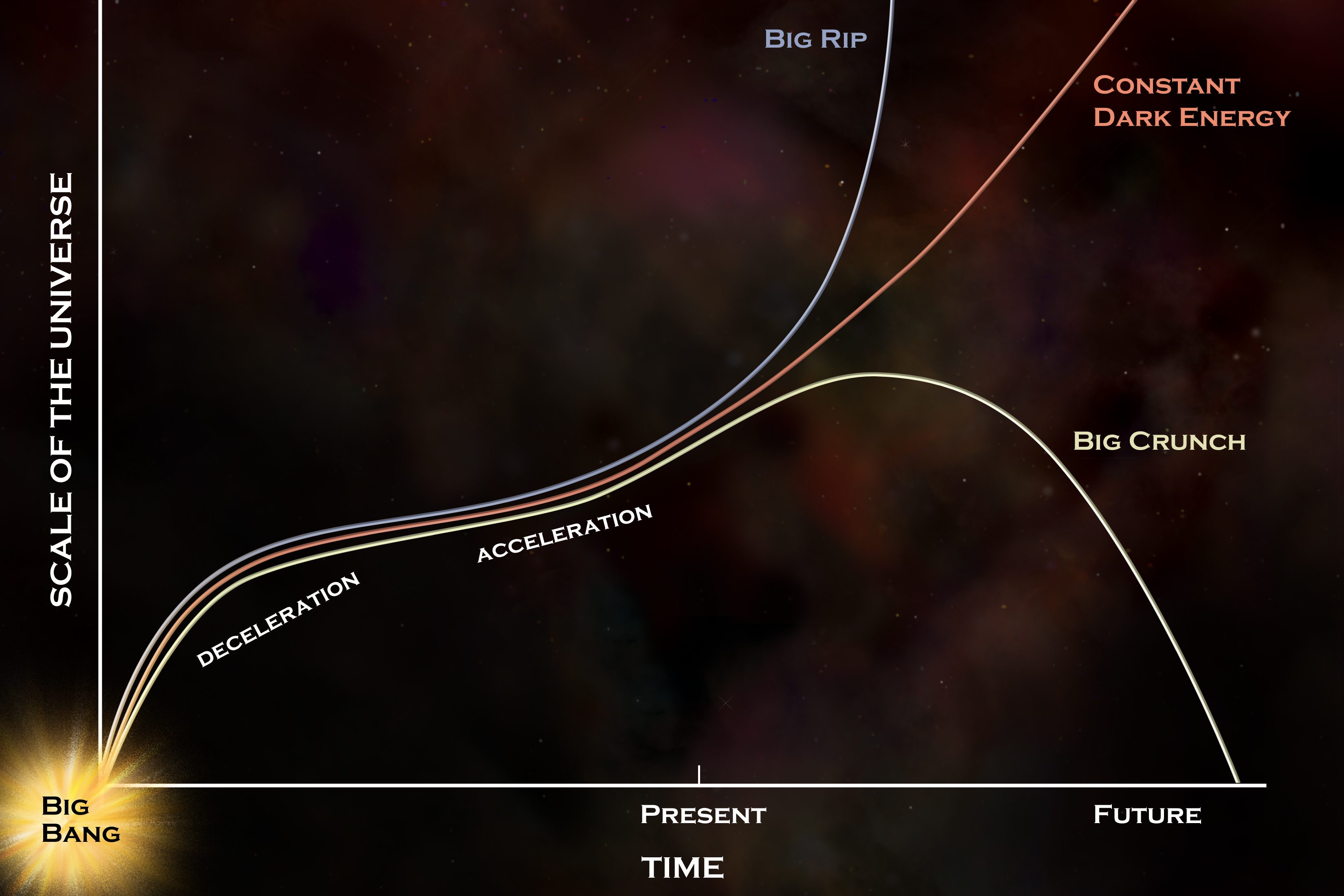 The far distant fates of the Universe offer a number of possibilities, but if dark energy is truly a constant, as the data best indicates, it will continue to follow the red curve, leading to the long-term scenario frequently described on Starts With A Bang: of the eventual heat death of the Universe. If dark energy can strengthen, weaken, or reverse sign over time, however, all bets are off, and alternative possibilities, like a Big Crunch or a Big Rip, suddenly abound.
Credit: NASA/CXC/M. Weiss
The far distant fates of the Universe offer a number of possibilities, but if dark energy is truly a constant, as the data best indicates, it will continue to follow the red curve, leading to the long-term scenario frequently described on Starts With A Bang: of the eventual heat death of the Universe. If dark energy can strengthen, weaken, or reverse sign over time, however, all bets are off, and alternative possibilities, like a Big Crunch or a Big Rip, suddenly abound.
Credit: NASA/CXC/M. Weiss
Mostly Mute Monday tells a scientific story in images, visuals, and no more than 200 words.
Tags Space & Astrophysics In this article Space & Astrophysics Sign up for the Starts With a Bang newsletter Travel the universe with Dr. Ethan Siegel as he answers the biggest questions of all. Subscribe