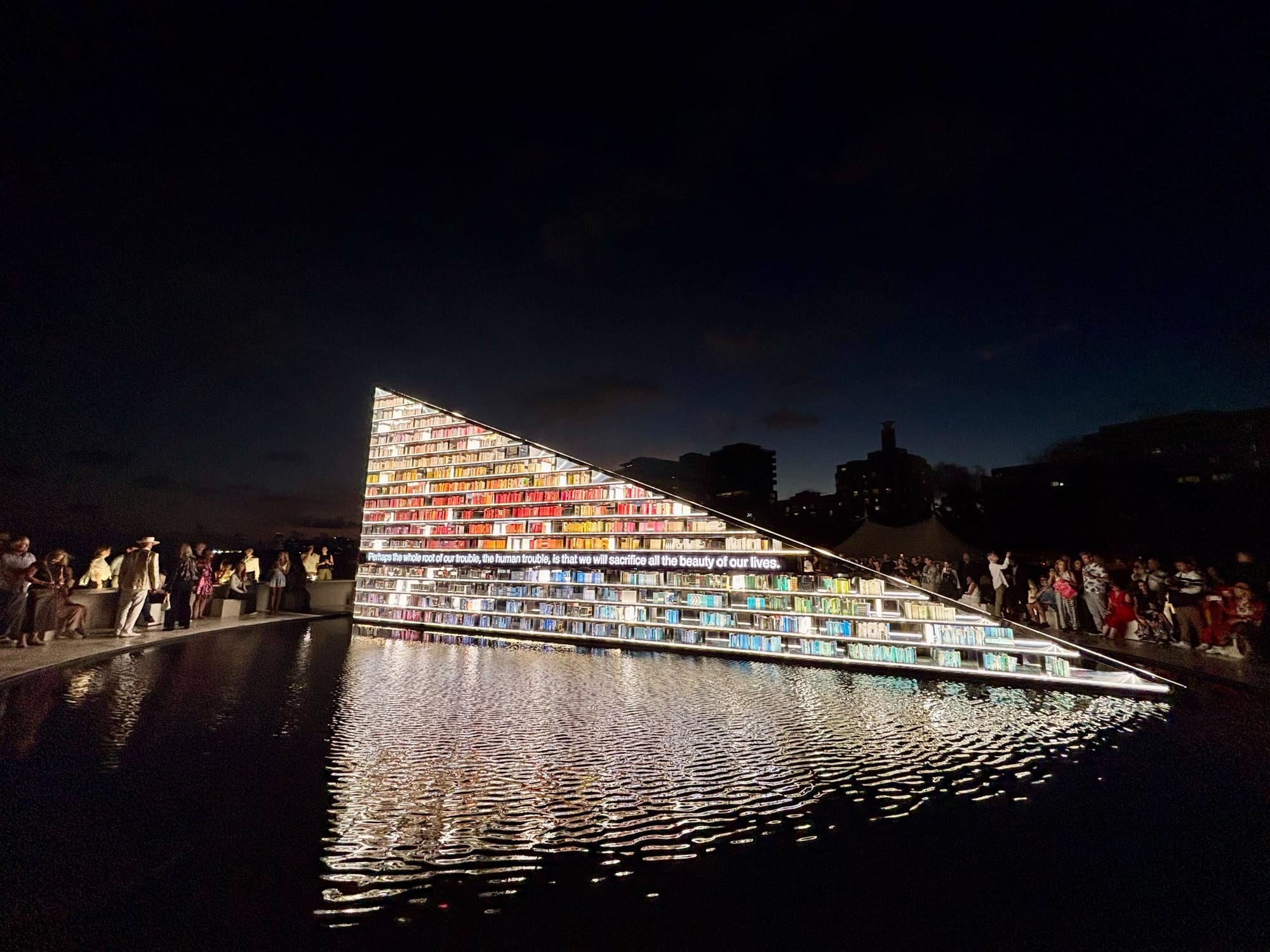
The mere spectacle of Ed Devlin’s revolving library on Miami Beach betrays its aim of engaging us in the act of reading.
 Valentina Di Liscia
December 2, 2025
— 3 min read
Valentina Di Liscia
December 2, 2025
— 3 min read
 Es Devlin’s “Library of Us” (2025) is a 50-foot revolving library on Miami Beach. (all photos Valentina Di Liscia/Hyperallergic)
MIAMI — When I first heard of Es Devlin’s latest project, a 50-foot revolving library plunked on the sands of Miami Beach at 32nd and Collins in partnership with Faena Art, my immediate thought was how much better this sounded than so many of the gratuitous beach artworks I’ve stared at miserably over the years. Who could forget the “Great Elephant Migration” of 2024, magnet for selfie seekers and hyperactive young climbers? Devlin’s piece, “Library of Us,” sounded different, thoughtful. After all, it would be filled with books, which the public is invited to read and which will be donated to various Miami organizations at the end of its run. (Never before has Naomi Klein been read on the sands of Faena Beach, of that I can almost assure you.)
“Let others pride themselves about how many pages they have written; I'd rather boast about the ones I've read.” That quote, which is by Jorge Luis Borges, is one of many that emanate from Devlin’s spinning installation, drawn from the books on display and spoken by the artist herself. But little reading was taking place at the opening event for the massive artwork on Monday night, December 1, which drew a few hundred people to Faena Beach’s private sands to witness a moving violin performance and an introductory speech by the artist. In her address, which struck me as very genuine, Edlin spoke of her longing for the days when she used to “live in a book.” As a child and teenager, she’d fall asleep reading, and then wake up and finish the chapter “while eating my Rice Krispies.” She mourns her attention span for books, whose loss she attributes to owning a smartphone, and says she wanted to invite people to engage again with the act of reading.
 Installation view of Es Devlin, “Library of Us” (2025)
Appropriately, “Library of Us,” whose central feature is an inaccessible triangular bookshelf set within a reflecting pool, is encircled by individual stations where visitors can sit and page through titles like Margaret Atwood’s Oryx and Crake (2003) or Pablo Neruda’s poems. The “reading table” will be set each day by the artist with different books, and the idea is that participants seated on the static and moving elements will encounter each other as well as new texts.
I watched this premise fall apart almost immediately after Edlin’s speech, as attendees invited to mount the slowly rotating installation did what anyone who finds themselves riding an enormous sparkly spinning thingy on a beach would do in 2025: They pulled out their phones to document every second. (That includes me.) “Perhaps the root of our trouble, the human trouble, is that we will sacrifice all the beauty of our lives,” bellowed Devlin’s disembodied voice, as the bodies around it stared transfixed through their little screens at the words scrolling gently on the bigger LED screen in front of them.
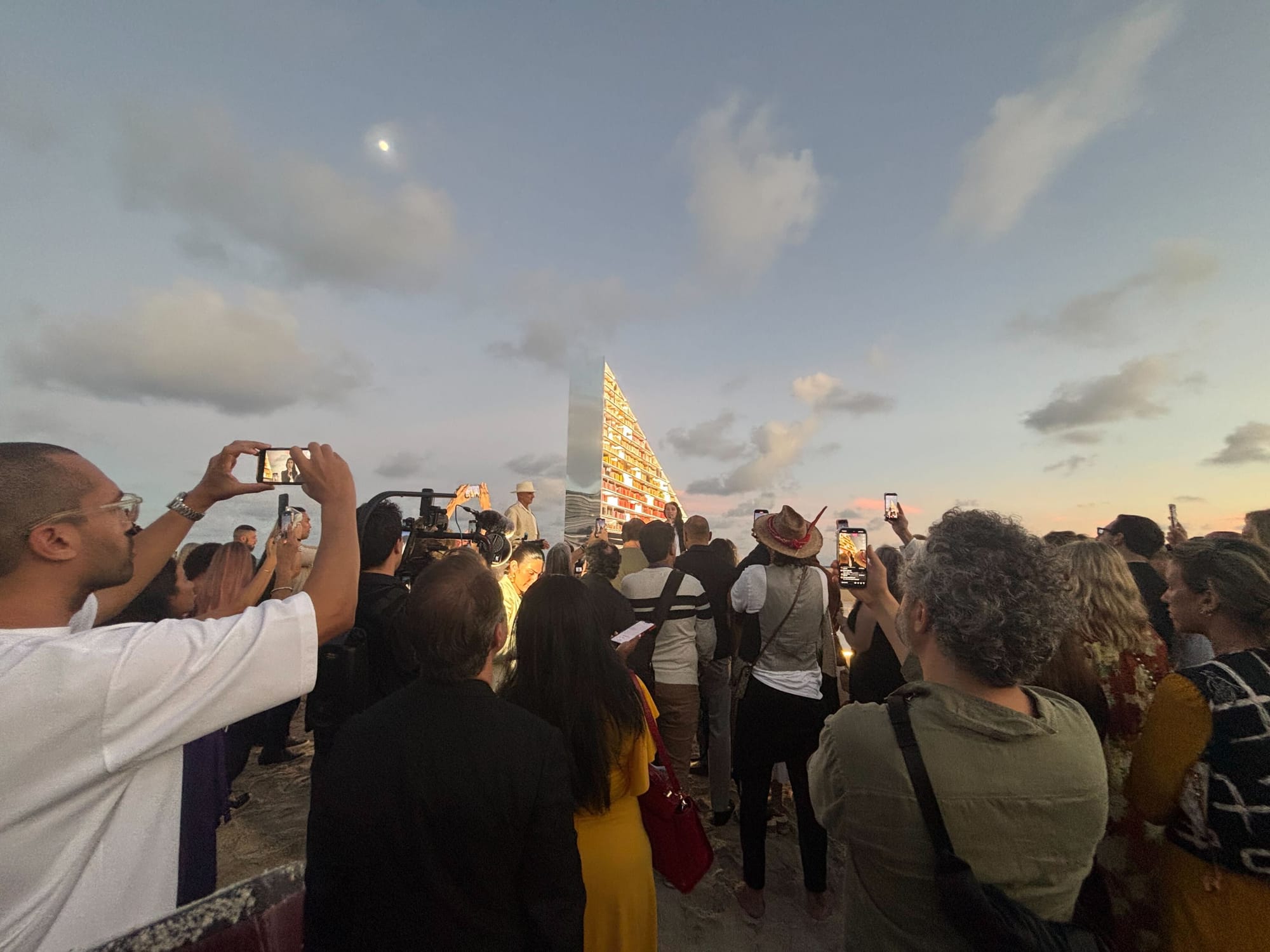 Instead of reading books, visitors pulled out their phones to capture the spectacle.
By now, we should all be inured to the experience of art mediated through a phone, and yet the sight is always a little deflating. It was made more so by the fact that the whole point of this installation, its raison d’être, was to engage people with the written word outside of their shiny pocket rectangles. Defeated, I had the additional, intrusive thought that the view right in front of us — the one Devlin’s piece partly blocks — was so much more likely to spark a literary renaissance, if we looked at it long enough. But art can’t compete with the ocean.
Perhaps it won’t always be like this for Edlin’s “Library of Us.” Maybe when the work is on view to the public, it will draw a more diverse crowd, not just the first-preview guests itching to post. But I think the mere spectacle of “Library of Us,” its carousel of light, sound, movement, and people, betrays its aim of engaging us in the act of constructing meaning from text. If anything, I’m grateful to Devlin for creating a work that so transparently articulates exactly why people are reading less. As an accidental (I think?) symbol of our collective distraction, it works well.
My real hot take, by the way, is this: Stop putting art on Miami’s beaches. Seriously. They don’t need it.