- Home
Edition
Africa Australia Brasil Canada Canada (français) España Europe France Global Indonesia New Zealand United Kingdom United States Edition:
Global
Edition:
Global
- Africa
- Australia
- Brasil
- Canada
- Canada (français)
- España
- Europe
- France
- Indonesia
- New Zealand
- United Kingdom
- United States
Academic rigour, journalistic flair
 Roman Samborskyi/Shutterstock
It’s not you – some typefaces feel different
Published: December 2, 2025 6.31pm GMT
Andrea Piovesan, Edge Hill University
Roman Samborskyi/Shutterstock
It’s not you – some typefaces feel different
Published: December 2, 2025 6.31pm GMT
Andrea Piovesan, Edge Hill University
Author
-
 Andrea Piovesan
Lecturer in Psychology, Edge Hill University
Disclosure statement
Andrea Piovesan does not work for, consult, own shares in or receive funding from any company or organisation that would benefit from this article, and has disclosed no relevant affiliations beyond their academic appointment.
Partners

Edge Hill University provides funding as a member of The Conversation UK.
View all partners
DOI
https://doi.org/10.64628/AB.46dm6rffe
https://theconversation.com/its-not-you-some-typefaces-feel-different-270192 https://theconversation.com/its-not-you-some-typefaces-feel-different-270192 Link copied Share articleShare article
Copy link Email Bluesky Facebook WhatsApp Messenger LinkedIn X (Twitter)Print article
Have you ever thought a font looked “friendly” or “elegant”? Or felt that Comic Sans was somehow unserious? You’re not imagining it.
Typefaces carry personalities, and we react to them more than we realise. My work explores how the shapes of letters can subtly influence our feelings.
When we read, we are not just processing the words. We are also taking in the typeface, which can shape how we interpret a message and even what we think of the person who wrote it.
Researchers demonstrated this in a 2018 study using simulated text conversations. They presented participants with an ambiguous message (for example, “That’s what I do”) and altered the typeface. A cheerful-looking font seemed to encourage readers to interpret the message positively, while a harsher one pushed them toward a more negative reading.
A similar pattern appears in email communication. In a 2014 study, the same email sent in Times New Roman made the sender seem formal and professional, whereas the more playful Kristen ITC made them appear more polite and even more attractive. Just as a voice sets the mood of a conversation, a typeface sets the mood of the page.
Research also shows that we process words more quickly when the typeface matches the meaning we expect. In one experiment, published in 1989, people recognised the word “slow” more quickly when it appeared in Cooper Black, a typeface associated with heaviness and slowness, but took longer when the same word was shown in Palatino Italic, which conveys lightness and speed.
A 2021 study found a similar priming effect in brand logos. After seeing a logo set in a particular typeface, participants were quicker to identify words that matched the qualities suggested by that design. When the style of the lettering aligns with the message, our brains seem to work more efficiently.
But how is that possible?
The answer is a mix of factors. Some qualities are built into the physical features of the typeface. Thick, straight lines signal sturdiness, while curves tend to feel softer or more approachable. Some associations may even have evolutionary roots.
Across a range of studies, people reliably link curved shapes with positivity and angular ones with threat or negativity. A 2016 review of this research traces the pattern back to survival mechanisms.
Sharp, angular forms in the environment can indicate danger, so our visual system has evolved to detect and prioritise them quickly. This bias appears to spill over into our perception of typefaces too, making angular fonts feel harsher or more alarming, while curved ones seem warmer and more pleasant.
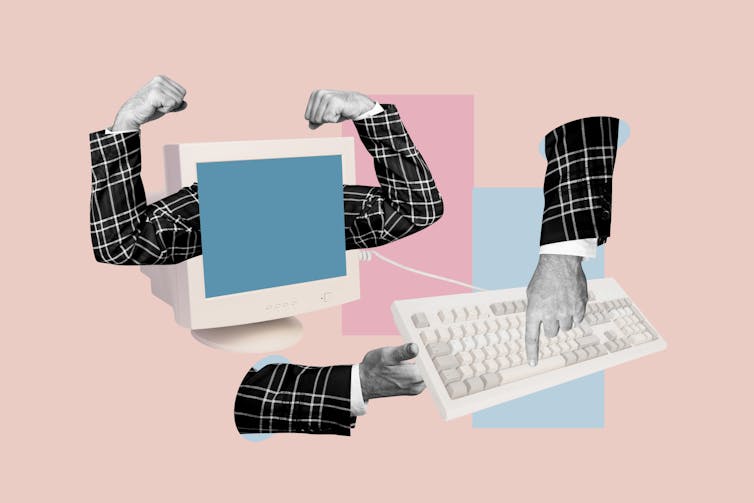 Some fonts just feel ‘strong’.
Roman Samborskyi/Shutterstock
Some fonts just feel ‘strong’.
Roman Samborskyi/Shutterstock
Other typeface personalities have been shaped by history and use. Take Times New Roman, originally designed in the 1930s for the British newspaper the Times. Over time, its connection with journalism has become ingrained, making Times New Roman synonymous with professionalism and formality today.
The influence of typefaces becomes even clearer when the wrong choice is made. An example comes from the European organisation for nuclear research, Cern, in 2012 when researchers used Comic Sans to announce the discovery of the Higgs boson (also called the “God particle”).
The decision sparked widespread criticism because Comic Sans is widely seen as playful and informal, hardly befitting one of the most important scientific discoveries of our time.
People who work in design, communication and marketing know this phenomenon well and use it deliberately. Think about the last time you bought a product you couldn’t see inside the box. What persuaded you if the product itself wasn’t visible? Most likely the packaging.
Designers choose typefaces as well as images that communicate the qualities they think you’re looking for.
If you’re searching for screws for a DIY project, you’re more likely to trust packaging set in bold, heavy lettering that signals strength and sturdiness. If you’re choosing a perfume as a gift, a delicate, flourished typeface might suggest elegance and femininity before you’ve even smelled it.
In one 2006 study, people were shown a range of fonts and asked where they would feel appropriate.
Serif typefaces such as Times New Roman and Cambria, which are recognisable by the small finishing strokes at the ends of their letters, were judged most suitable for business documents. Monospaced fonts like Courier New, in which every character takes up the same amount of space, were seen as better suited to technical materials and computer code.
This very article is set in Baskerville, and that’s no accident. Baskerville, like Goudy Old Style and other classic typefaces, tends to be seen as professional, trustworthy and high-quality. Those are the qualities The Conversation aims to convey to its readers. The same principle applies to any professionally designed website. Every typeface has been chosen to create the right impression.
Typefaces can also shape our experience of music. An album cover with rounded letters, for example, can make the music feel more pleasant. Designers also match typefaces to the genre: curvy, playful fonts appear on hippy music covers, conveying joy and peace, while sharp, angular lettering is common on punk albums, signalling anger and aggression.
Sometimes we don’t know exactly why a font feels a certain way. In a 2023 article, I reviewed studies from the past century that asked people to rate how they perceived different typefaces.
This large collection of data revealed some surprising patterns. For example, condensed typefaces, which have letters packed closely together, tend to convey a sense of sadness more than other fonts.
Thick lines reliably signalled strength, but the opposite was not true: thin lines were not consistently judged as weak. Instead, perceptions of weakness were more strongly associated with irregular strokes and high contrast, features common in typefaces that resemble handwriting. Why do they do that? I am afraid I don’t have an answer.
Next time you pick up a book, scroll through a website or glance at a label, take a moment to notice the font. Those subtle lines and curves are doing more than you might think, shaping your experience in subtle ways.
- Psychology
- Linguistics
- Fonts
- Typefaces
- Educate me
Events
Jobs
-
 Senior Lecturer, Clinical Psychology
-
University Lecturer in Early Childhood Education
-
Case Specialist, Student Information and Regulatory Reporting
-
Lecturer in Paramedicine
-
Associate Lecturer, Social Work
 Senior Lecturer, Clinical Psychology
 University Lecturer in Early Childhood Education
 Case Specialist, Student Information and Regulatory Reporting
 Lecturer in Paramedicine
 Associate Lecturer, Social Work
- Editorial Policies
- Community standards
- Republishing guidelines
- Analytics
- Our feeds
- Get newsletter
- Who we are
- Our charter
- Our team
- Partners and funders
- Resource for media
- Contact us
-
-
-
-
Copyright © 2010–2025, The Conversation