- Home
Edition
Africa Australia Brasil Canada Canada (français) España Europe France Global Indonesia New Zealand United Kingdom United States Edition:
Global
Edition:
Global
- Africa
- Australia
- Brasil
- Canada
- Canada (français)
- España
- Europe
- France
- Indonesia
- New Zealand
- United Kingdom
- United States
Academic rigour, journalistic flair
 Jota Buyinch Photo/Shutterstock
Why the £18 million for playgrounds in the budget is so important – and how it should be spent
Published: December 2, 2025 6.31pm GMT
Naomi Lott, University of Reading
Jota Buyinch Photo/Shutterstock
Why the £18 million for playgrounds in the budget is so important – and how it should be spent
Published: December 2, 2025 6.31pm GMT
Naomi Lott, University of Reading
Author
-
 Naomi Lott
Lecturer in Law, University of Reading
Disclosure statement
Naomi Lott is Lecturer in Law at the University of Reading. She has previously received funding from the Economic and Social Research Council, for her research on the right to play.
Partners

University of Reading provides funding as a member of The Conversation UK.
View all partners
DOI
https://doi.org/10.64628/AB.ujx97cchn
https://theconversation.com/why-the-18-million-for-playgrounds-in-the-budget-is-so-important-and-how-it-should-be-spent-271020 https://theconversation.com/why-the-18-million-for-playgrounds-in-the-budget-is-so-important-and-how-it-should-be-spent-271020 Link copied Share articleShare article
Copy link Email Bluesky Facebook WhatsApp Messenger LinkedIn X (Twitter)Print article
Chancellor Rachel Reeves’ recent budget included an investment of £18 million to be spent, over two years, on up to 200 playgrounds across England.
This new investment is the first significant policy step towards supporting children’s play since 2008, when the then Labour government introduced the first national play strategy. That strategy was scrapped just two years later as an austerity measure.
This is an apt example of how frequently play is overlooked and undervalued, despite the mountain of evidence that proves its importance and its protection as a right in the UN convention on the rights of the child.
In truth, decades of attempts to support children’s play have failed in part because play hasn’t been looked at as a right. It’s seen as instrumentally valuable, meaning that it helps towards other aims, such as child wellbeing and mental and physical health.
This is of course true. But we need to see play as intrinsically valuable. This means that it is fundamentally important in itself.
This history that has presented play as a luxury, rather than a right, must change in order to ensure that our children live lives reflective of their dignity as humans.
The recent independent review into England’s national curriculum, for instance, completely neglected play. This was despite it being raised as a top issue throughout the review’s call for evidence.
A poor understanding of children’s wellbeing and narrow framing of what education is – and what children need to succeed academically – has pushed play to the edges of children’s lives.
The decline in play
Children’s outdoor play has declined by 50% in a single generation. Only 27% of children play in the streets regularly, compared with 80% of adults when they were children in the 1970s.
Over 2 million children in England under the age of nine do not live within a ten-minute walk of a playground.
This lack of access to playgrounds is more significant for children from deprived areas. A recent study found substantial inequality: deprived areas of England have fewer, smaller playgrounds that were also further to travel to.
Read more: We mapped 18,000 children's playgrounds and revealed inequality across England
In 2023, the UN Committee on the Rights of the Child reviewed the extent to which the UK has upheld, promoted and fulfilled children’s rights. In their report they called for children’s “access to accessible and safe public outdoor play spaces” to be strengthened.
Playgrounds must meet the play needs of all children and should be designed in an inclusive manner, with opportunities for children of all ages, genders and abilities to play. In allocating and spending the money set aside for playgrounds, it is crucial that their primary beneficiaries and users – children – are involved in decisions about how the money is spent and how play spaces are designed.
As stated in the UN convention on the rights of the child, children have a right to be heard in all matters that affect them. The design of playgrounds directly affects children, and therefore any spending on playgrounds that is done without consultation with children would be in breach of their right to be heard. This means funding consultation with children on the design of local play spaces, their location and accessibility, and the activities that are provided for.
Play spaces need to be accessible to children. This means considering how far playgrounds are from children’s homes, and whether children are able to safely get to them by themselves. They must offer quality play experiences: they must support imaginative play, creativity, be stimulating and include elements of risk.
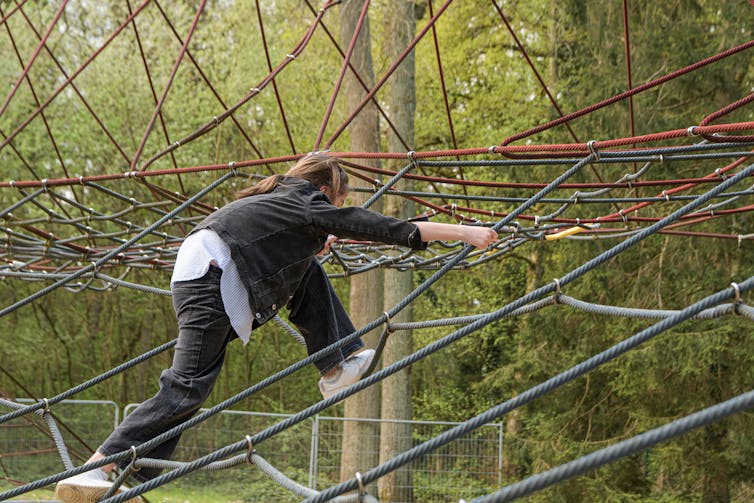 Teenagers need places to play too.
KiNOVO/Shutterstock
Teenagers need places to play too.
KiNOVO/Shutterstock
While the government’s promise to invest in playgrounds goes some way to meet the UN’s call for better play spaces and to remedy the need that has been documented across England, it is not sufficient as a measure on its own.
Meeting the right to play
Fulfilling children’s right to play – making quality play possible for all children – means more than just giving children physical spaces for play. Children also need psychological space to play. This means they need accessible play spaces that provide opportunities for quality play, and they need to be free from adult pressures and expectations.
Children need protected and unpressured time to be able to play freely, both within and outside of the school day. They need a society that acknowledges and champions their right to play, and supports and enables their play – playing children should be seen as something valuable, not as a nuisance or as frivolous.
Finally, children have a range of rights, and they all matter for play. Children need all their rights to be protected and promoted in law, policy and in their interactions with the adults around them. Without any one of these, children cannot fully enjoy their right to play.
The budget announcement of playground investment is welcome, and long overdue, but it is just the first step to ensuring that children have their right to play fulfilled.
Children’s right to play can only be realised through acknowledging that children’s rights are equal to those of adults. This means we need a cultural shift that acknowledges this equality and that play is critical for children of all ages. We need a culture that supports and promotes children’s play, especially their free play: play that is child-led. Playgrounds are only part of the answer.
- Children's rights
- Play
- Playgrounds
- Children's play
- UN Convention on the Rights of the Chlid
- Give me perspective
- Budget 2025
Events
Jobs
-
 Senior Lecturer, Clinical Psychology
-
University Lecturer in Early Childhood Education
-
Case Specialist, Student Information and Regulatory Reporting
-
Lecturer in Paramedicine
-
Associate Lecturer, Social Work
 Senior Lecturer, Clinical Psychology
 University Lecturer in Early Childhood Education
 Case Specialist, Student Information and Regulatory Reporting
 Lecturer in Paramedicine
 Associate Lecturer, Social Work
- Editorial Policies
- Community standards
- Republishing guidelines
- Analytics
- Our feeds
- Get newsletter
- Who we are
- Our charter
- Our team
- Partners and funders
- Resource for media
- Contact us
-
-
-
-
Copyright © 2010–2025, The Conversation