 Porsche
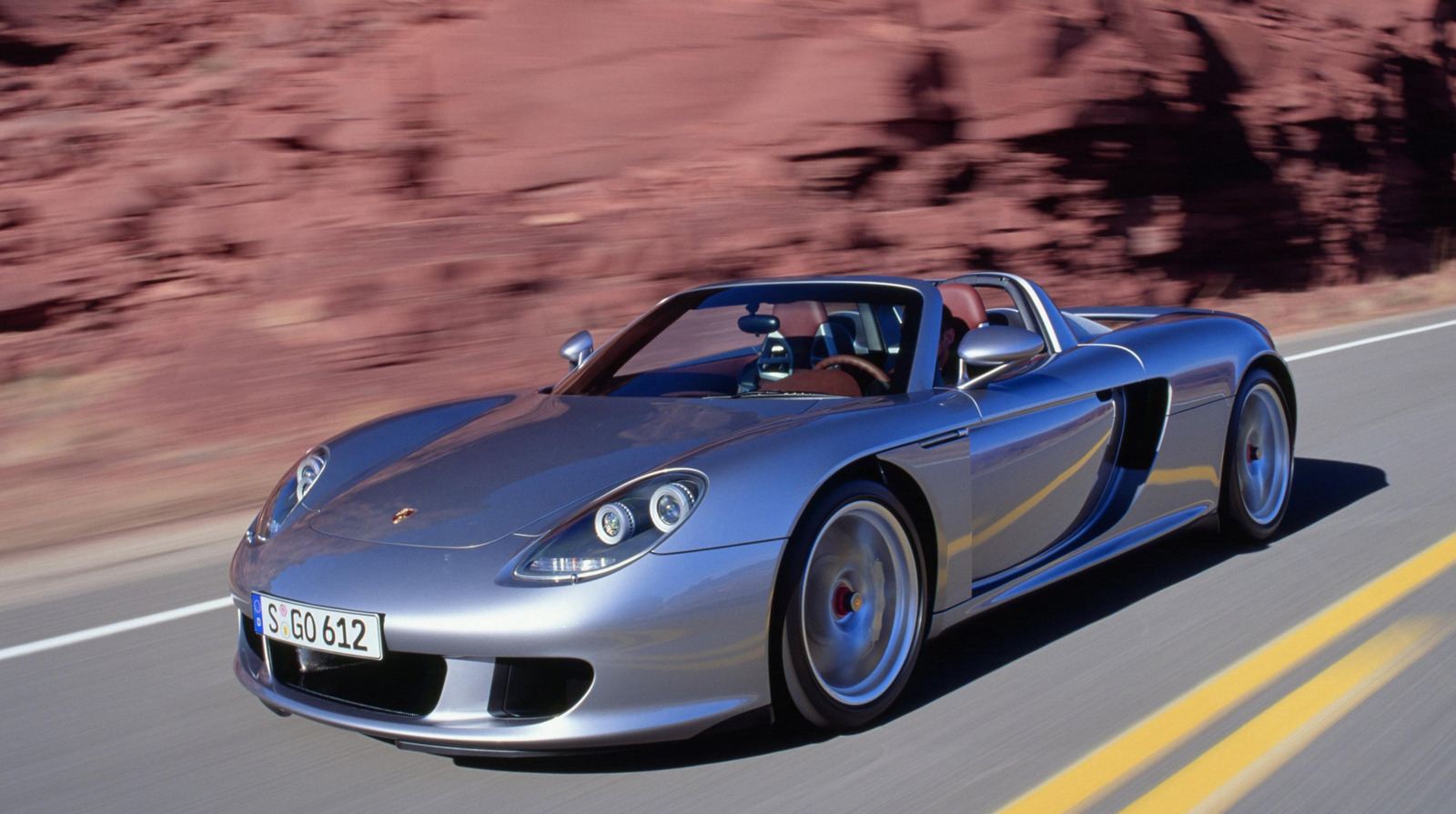
Most cars are fairly straightforward to drive with your foot down. Obviously it requires skill, but many are quite forgiving; these are your modern low-power, front-wheel drive pedestrian cars. Then there are certain cars that are known to be tricky to drive. Generally, classic cars dominate this list — anything with a lot of power and no assists to rein any of it in. Similarly, rear-wheel drive sports cars from the 1990s and 2000s. However, some cars exceed even these: cars that just straight-up want to kill you. Few vehicles personify this like the Porsche Carrera GT, a car considered so dangerous that Porsche faced a high-profile lawsuit over its safety after Paul Walker's fatal crash in 2013.
A reputation like that isn't earned easily. Cars like the Dodge Viper, Shelby Cobra, and Porsche's own 930 Turbo (AKA the "Widowmaker) share the spotlight here, all of which are known to feature extraordinarily high skill ceilings. But what is it about the Porsche Carrera GT that requires so much skill in the first place? Is it the power, the balance, the handling characteristics, or something else? Moreover, is the reputation it boasts something that's actually warranted, or is it blown out of proportion?
Firstly, there's nothing inherently "wrong" with the Carrera GT in the sense that it's fundamentally unsafe. The car has only had one recall, due to a suspension failure affecting one-third of approximately 1,300 vehicles produced. However, this fault wasn't responsible for prolific accidents, or the one that claimed Paul Walker's life. That was due to old tires that made the car incredibly unforgiving in ideal conditions. So what's the deal here? Let's explore exactly what makes cars like these inherently dangerous — when they're driven incorrectly.
What makes the Porsche Carrera GT dangerous
 Porsche
It's difficult for most people to visualize exactly how extreme vehicles like this can be. To put it into perspective, take a first-generation Dodge Viper, a car with a 400-horsepower V10 and a curb weight of 3,476 pounds. According to journalists and owners alike, the Viper is one of the most dangerous vehicles to drive fast, requiring tremendous respect to keep it in a straight line. The Viper features absolutely no assists, windows made of canvas, a key from a minivan, and air conditioning installed almost out of reluctance. It's as basic as one can reasonably get and still qualify as a "car."
Now let's look at the Porsche Carrera GT. Like the Viper, it has a V10 mated to a six-speed and boasts no advanced driving aids. Except the Porsche Carrera GT has over 600 horsepower and weighs about 3,042 pounds. Granted, yes, the chassis is a far more refined and stiffened design with the carbon fiber and Kevlar monocoque, plus the active aero. Even so, that's still a 50 percent power increase and less weight, meaning from a physics perspective, it's still just as savage, if not more so. Even veteran drivers like Ben Collins (as the Stig) and longtime owners like Jay Leno lose control. Sometimes — like in Paul Walker's case — with fatal consequences.
According to Ben Collins, for instance, the Carrera has a high skill cap, due to its hypersensitive throttle, requiring expert pedal control to balance the car through corners. In one sentence, then, the thing that makes this car dangerous — to the point of reaching lawsuits — is how utterly unforgiving it is.
Is it really the car's fault?
 Porsche
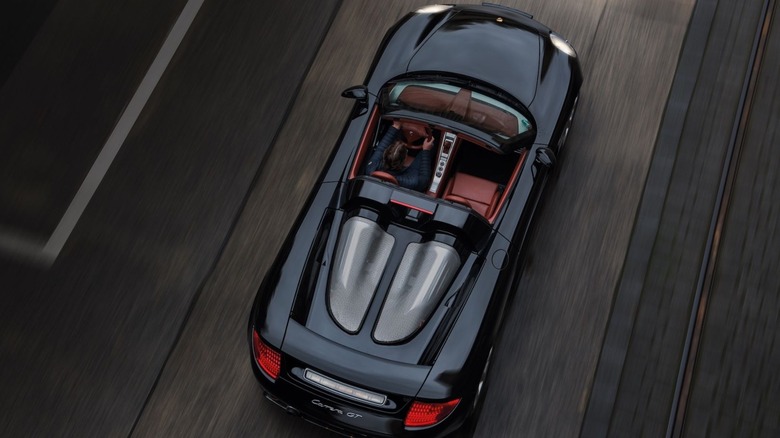
One of the main issues surrounding the Carrera GT is its utilization of analog technology in a modern, heavily motorsport-inspired package. From the pushrod suspension to the massive rear diffuser, these are serious components for serious racing, almost never featured on road cars outside of exotic hypercars. The Carrera GT, on the other hand, is sometimes described as the "last analog hypercar" owing to its combination of these features with manual everything else. This means that there are no computers to save you. Plus, according to drivers, you'll need sharp skills and dexterity to operate the weirdly counterintuitive transmission, but it gets easier the faster you drive.
Basically, this is what many hypercars would be like if they were analog. Therefore, it's nothing to do with Porsche's design; the Carrera GT was, first and foremost, created as a no-compromise vehicle. It reused no major components in its powertrain or running-gear, featured a bespoke frame, and used an engine taken out of a Le Mans prototype. If it had a paddle-shifter, traction aids, and stability control, it'd likely be as tame as any other hypercar, within reason.
The Porsche Carrera GT remains a true enigma in the automotive world because of these reasons. It's effectively the last of its breed, since no manufacturer in their right mind would design such a vehicle today. Does that make it inherently dangerous? No, it just makes it highly specialized for a specific type of driving, and not giving the car enough respect will inevitably result in an accident. The same applies with any car; the only real difference here is that the line is tightrope-thin. And that's arguably what makes this car so unique and special, at least until it was discontinued.
Our methodology
 Porsche
With so few of these cars floating around, and even fewer still having been driven hard, it comes down to several reliable sources to determine exactly why this car is (or isn't) dangerous. A Porsche Carrera GT is exclusive both in terms of expense and skill, requiring a driver with both to fully harness. Not many people qualify there, making it relatively straightforward to source articles and testimonials describing such incidents. We dug a little deeper, however, relying primarily on sources from long-term owners and hardcore drivers, as well as Porsche themselves. For example, Walter Röhrl, test driver for Porsche, broke down many talking points concerning why the car isn't inherently dangerous.
That said, we also took a look at the other end of the spectrum — ordinary owners, or those lucky enough to drive these cars, at least. These people often describe the general difficulty with such a unique car, such as the process of taking off from a stop in regular conditions (often leading to stalling out because of the tiny clutch and flywheel), for example. We've taken into consideration all these opinions as well, because these also affect the overall driving experience and make the car generally more unpleasant to control. Examples of sources we used are periodicals like Road & Track, Jay Leno's Garage, and The Drive. With other testimonials, we primarily used forums and reviews posted by accredited journalists for informed details and everyman opinions.