

Last October, Indian news outlets ran with what they promoted as a “landmine” story: a fugitive wanted for terrorism was on the payroll of the Canadian government.
Sandeep Singh Sidhu was not only a “dreaded terrorist,” an Indian television anchor told her millions of viewers, he was also a Canada Border Services Agency superintendent.
Under banners that read “Trudeau’s tax-funded terrorist” and “Kanada rewards assassin,” Indian news hosts called it a shocking revelation about “dirty Canadian secrets.”
But it wasn’t true, according to the Canadian government and Sidhu’s lawyers, who allege the veteran law enforcement officer was the victim of an Indian government disinformation campaign.
And now Sidhu, a lifelong British Columbia resident who has spent the past two decades safeguarding Canada’s frontiers, is pushing back against those he says threw his life into turmoil.
In a lawsuit against India’s government to be filed in the Ontario court, Sidhu accused the South Asian nation of recklessly making him the face of a ploy aimed at embarrassing Canada.
He is also suing the Canadian government, which he says failed to defend him from the state-sponsored scheme that forced him into hiding amid calls for his arrest and killing.
The case is a rare attempt to seek accountability for the falsehoods that India’s government and its loyal news outlets and social media users have been widely accused of peddling.
And it comes as Prime Minister Mark Carney is deepening ties with Indian Prime Minister Narendra Modi’s government despite mounting evidence of its attacks on Canadians.
The lawsuit, which seeks $9 million in personal injury damages, alleges that New Delhi spread fabrications about Sidhu to hit back at Ottawa for accusing India of committing violence in Canada.
Sidhu, who goes by “Sunny,” was singled out by India because he had a common Sikh name and a visible, uniformed position within the Canadian national security apparatus, they said in a statement of claim.
AdvertisementFor those reasons, India made him the “patsy” of an effort to punish Canada for blaming it for an assassination in Surrey, B.C., and a list of other crimes, the lawsuit alleges.
“Sunny became merely an instrument of India’s propaganda machine to falsely accuse Canada of employing and supporting a Khalistani extremist,” the statement of claim reads.
As a result of the “coordinated foreign interference” offensive, Sidhu was subjected to a “tidal wave of aggressive misinformation” and calls for his extradition and murder, the suit alleges.
But the CBSA would not provide him with any protection and threatened him with suspension or termination unless he cooperated with intrusive background checks that ultimately cleared him, it said.
“The CBSA did nothing to help him and instead mocked the death threats against him and advised him that this was not a work-related matter,” according to the claim filed by Sidhu’s Toronto lawyer, Jeffrey Kroeker.
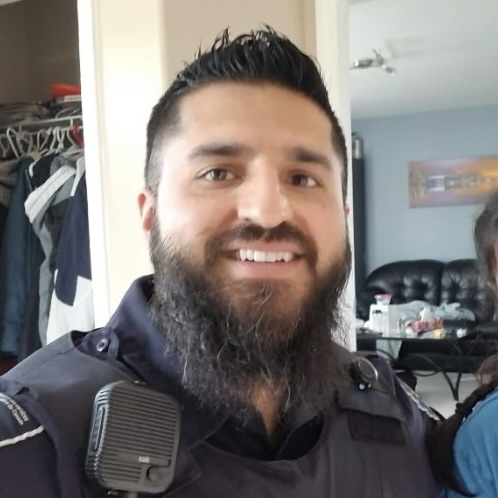 CBSA office Sunny Sidhu is suing those who threw his life into turmoil by claiming he was a wanted terrorist.
Handout
CBSA office Sunny Sidhu is suing those who threw his life into turmoil by claiming he was a wanted terrorist.
Handout
Sidhu was born in B.C. and is not involved in Indian politics, nor is he a practising Sikh. Until recently, his public exposure was limited to cameos in the reality television series Border Security.
Being the target of a foreign state, one that federal authorities have accused of assassinating another Canadian India had labelled a terrorist, was life-altering, the suit claims.
Amid the relentless threats and harassment, he turned to alcohol and admitted himself to a rehab program at St. Paul’s Hospital in Vancouver.
Smeared by India, he was then abandoned by Canada, according to the suit, as officials who had a duty to help him “instead took every opportunity to turn their back on him and wash their hands of responsibility.”
The High Commission of India in Ottawa did not respond to requests for comment. India has denied charges that it is behind disinformation, transnational repression, assassination plots and election meddling in Canada.
Although the RCMP has said its investigations support the allegations, Carney has restored diplomatic ties with India and is pursuing a trade deal with Modi as he tries to lessen Canada’s dependence on the U.S. market.
The two leaders met at the G20 summit in South Africa last month and “launched negotiations for a trade deal that could more than double our trade to $70 billion,” Carney wrote on X.
“India is the world’s fifth largest economy, and that means big new opportunities for Canadian workers and businesses,” he wrote.
But what it means for Canada’s South Asian community, which the RCMP says is the main target of the Modi government’s activities in Canada, is another matter.
1. India's 'propaganda machine'
 View image in full screen
Prime Minister Mark Carney shakes the hand of Indian Foreign Minister Subrahmanyam Jaishankar, right, as Indian Prime Minister Narendra Modi greets Canada’s Foreign Affairs Minister Anita Anand at G20 Summit, Johannesburg, South Africa, Nov. 23, 2025. THE CANADIAN PRESS/Sean Kilpatrick.
View image in full screen
Prime Minister Mark Carney shakes the hand of Indian Foreign Minister Subrahmanyam Jaishankar, right, as Indian Prime Minister Narendra Modi greets Canada’s Foreign Affairs Minister Anita Anand at G20 Summit, Johannesburg, South Africa, Nov. 23, 2025. THE CANADIAN PRESS/Sean Kilpatrick.
Since Modi became India’s prime minister in 2015, his government and supporters have characterized Canada as awash with anti-India “terrorists.”
While Canada does have an active Khalistan movement that advocates for independence for India’s Sikh-majority Punjab state, CSIS reports that only a “small group” are extremists.
But as India has tried to rebrand itself as a global power, it has escalated its efforts against what it deems anti-India influence, and pro-Khalistan activists have become primary targets.
AdvertisementThe situation escalated significantly in 2022, when Indian intelligence agents allegedly began plotting to assassinate Sikhs in Canada, the U.S. and elsewhere.
On June 18, 2023, gunmen shot Hardeep Singh Nijjar outside a Sikh temple in Surrey, B.C. Like Sidhu, Nijjar had been labelled a terrorist by India based on what the RCMP deemed flimsy evidence.
When the RCMP investigation linked Indian agents to the killing, then-prime minister Justin Trudeau notified Parliament, setting off a flood of disinformation.
Modi-aligned media outlets spread memes portraying Trudeau, Canadian security agencies and Sikhs as ‘enablers of terrorism’ and threats to India, according to a government report.
2. The pro-Modi influencer
A month later, a pro-Modi online influencer and former army officer with 750,000 followers posted a video on YouTube accusing Sidhu of being a terrorist known as “Toronto Sunny,” according to the lawsuit.
“This false allegation was circulated within Indian social media channels by other prominent pro-Modi influencers, along with calls for the Canadian government to arrest Sunny and extradite him,” the lawsuit alleges.
“The instruction to make this allegation came from the Indian government.”
Shocked, Sidhu reported the matter to his superiors. He expected support, but instead the CBSA responded that it had no responsibility to protect him, the statement of claim alleges.
To put the matter to rest, Sidhu cooperated with the Canadian Security Intelligence Service, which looked into his past, canvassed friends and family, and conducted polygraph tests, he said.
“CSIS found nothing,” said the suit.
Satisfied the Indian media reports were fake, the CBSA cleared him. But the story returned with a vengeance last year, as tensions between Canada and India reached new heights.
3. The Indian press
On Oct. 14, 2024, the commissioner of the RCMP announced that Indian agents were implicated not only in Nijjar’s killing but also in other shootings, arsons and extortions across Canada.
In response, Canada expelled six Indian diplomats the RCMP had identified as persons of interest in its investigations into the attacks.
Less than a week later, Sidhu found himself on Indian news outlets depicted as a wanted terrorist in the employ of a hypocritical Canadian government.
 View image in full screen
Indian news agency falsely reporting CBSA officer Sandeep Sidhu is a wanted terrorist.
YouTube
View image in full screen
Indian news agency falsely reporting CBSA officer Sandeep Sidhu is a wanted terrorist.
YouTube
Indian commentators called “terrorist Sidhu” proof of Ottawa’s nerve for pointing the finger at New Delhi for killing Nijjar, when its own government had terrorists on its payroll.
“Trudeau has egg on his face,” the Times Now headline read. “Hypocrisy exposed,” said the banner on the India Today broadcast.
The India Today host said the story “completely undermines, if not exposes, Canada’s criticism of India for allegedly targeting individuals on foreign soil.”
Calling Canada “a threat to India’s national security,” he said the country was not only a “safe haven” for anti-India terrorists, but put them into key government positions.
“The only possible explanation is that Sandeep Singh Sidhu has been deliberately hand-picked, deliberately chosen by the Canadian government to fill a sensitive post specifically so that his criminal skills can be harnessed and deployed for other reasons, perhaps to facilitate the passage of criminals and separatists from Punjab to Canada,” the host claimed.
AdvertisementThe video was posted on India Today’s YouTube channel, which has 10.9 million subscribers. The same host was cited in a 2024 Canadian government report on Indian disinformation.
Neither India Today nor Times Now responded to requests for comment.
4. The social media onslought
Sidhu’s name, photo and home address were soon splashed across Indian news channels that were now calling him a terrorist mastermind who had paid assassins to gun down an activist opposed to the Khalistan separatist movement.
They called him a member of the International Sikh Youth Federation, which is on Canada’s list of terrorist groups, and accused him of working with Pakistan’s ISI intelligence service.
The information was attributed to a “dossier” of India’s counter-terrorism branch, the National Investigation Agency. Tellingly perhaps, the photo of Sidhu featured on news broadcasts was one he had provided the Indian government when he applied for a travel visa in 2018.
Although the CBSA told Indian reporters there was no evidence supporting their claims, the stories remain online. Times Now characterized the CBSA’s denial as “defiance” against India following a “so-called investigation.”
As the story made its way through the echo chamber of India’s news outlets and social media users, the threats piled up. On X, a user posted an aerial image of Sidhu’s home taken from Google Earth and wrote, “His address. Go and kill him.”
 View image in full screen
Sandeep Sidhu is a CBSA officer in BC. India wrongly called him a wanted terrorist mastermind.
Handout
View image in full screen
Sandeep Sidhu is a CBSA officer in BC. India wrongly called him a wanted terrorist mastermind.
Handout
He reported the incidents to police in Abbotsford. B.C., where he lived. They told him India had “previously circulated false terrorism allegations against nine other people, and that one of those people had been murdered under suspicious circumstances,” the suit alleges.
“Given this history, the police warned Sunny to be extremely cautious, and to take safety measures such as changing his appearance, switching his vehicle, checking his vehicle for GPS or other tracking devices, taking different routes to and from work, and vacating his family home.”
But the CBSA ignored his request to be transferred to the port of Vancouver, where security was tighter, his lawyers argued. To make matters worse, they said, the agency sent one of the Indian news reports to every employee in an email blast.
Meanwhile, colleagues allegedly joked about Sidhu making bombs out of fertilizer at his family farm in B.C.’s Fraser Valley, and asked how his “friends in Hamas” were doing.
5. Smeared by India, abandoned by Canada
It isn’t easy being the chosen weapon of a disinformation campaign by a country of almost 1.5-billion people. The threats wore Sidhu down. He worried about his family, his safety and the impact on his otherwise unblemished career.
Sidhu was diagnosed with clinical depression, anxiety and post-traumatic stress disorder. He began seeing a counsellor, paying out of pocket.
On March 3, 2025, the CBSA concluded that Sidhu faced no threats to his safety, according to the lawsuit. No further action was warranted, according to the agency, which closed its workplace assessment into his security concerns without even interviewing him, the lawyers alleged.
 View image in full screen
Border officer Sandeep Sidhu was the victim of an Indian government disinformation campaign, his lawyers allege.
Handout
View image in full screen
Border officer Sandeep Sidhu was the victim of an Indian government disinformation campaign, his lawyers allege.
Handout
“This conclusion was incomprehensible, ludicrous and tone deaf especially given the multiple explicit threats to Sunny’s safety, the concerted doxxing attempts and the countless warnings from law enforcement agencies with knowledge of the risks to his safety,” they wrote.
AdvertisementSidhu was only treated that way because of CBSA management’s perception that, being of Sikh heritage, he was more likely to sympathize with Khalistan extremists, according to the allegations.
The suit alleges the CBSA was “negligent, reckless, careless, and failed to meet the standards of the duty of care of a competent employer.”
For its part, India also owes him redress for its “prolonged disinformation and smear campaign,” which consisted of “widespread proliferation of blatantly false and defamatory allegations.”


